How to Self-Transfer at Incheon: Is 3 Hours Enough?
Rules and times checked on 12 Nov 2026 against Incheon Airport's English and Korean pages, Asiana and Jeju Air airport pages, the Ministry of Justice and the K-ETA and e-Arrival Card portals.
Three hours is usually enough for a self-transfer at Incheon when both flights use the same terminal, because you clear immigration, collect bags and re-check before counters close 50–60 minutes before departure. Book 4 hours or more if you change terminals, travel on holiday peak dates or your first flight is often late (checked 12 Nov 2026).
Best forFirst-timersBudgetWith luggageSolo
Your situation → do this
| If you… | Do this |
|---|---|
| Both flights in the same terminal, checked bags, normal travel day | 3 hours is workable; under 2½ hours, don't book it |
| Your flights use different terminals (T1 and T2) | Allow 4 hours; take the free shuttle bus or AREX (6 min, ₩1,050) landside |
| US, UK, Canadian, Australian or Singapore passport, landing by 31 Dec 2026 | No K-ETA needed; file the free e-Arrival Card before you land |
| Indian or Philippine passport without a US, Canada, Australia, NZ or EU-32 visa | You can't collect bags landside; rebook on one ticket or go carry-on with an online boarding pass |
| Gap of 8 hours or more, or overnight | Store bags or book a capsule; counters open only 2–3 hours before departure |
Key takeaways
- No official minimum exists for separate tickets; Asiana's 70–90 minutes covers through tickets only.
- Asiana closes Incheon check-in 50 minutes before departure; Jeju Air wants you through security 1 hour before.
- Press reports show arrival immigration queues of 30 minutes to 2 hours at peaks in 2025–26.
- The free T2→T1 shuttle bus runs every 7–20 minutes; AREX links the terminals in 6 minutes for ₩1,050.
- From 1 Jan 2027, US, UK, Canadian, Australian and Singapore passports need a K-ETA unless the exemption is extended.
| Airline minimum connection (through tickets only) | 70 min within T1 or T2, 90 min between terminalsSource: Asiana Airlines airport guide |
|---|---|
| Check-in closes | Asiana: 50 min before departure (60 min on some routes); Jeju Air: security by 1 h before, gate closes 15 min beforeSource: Asiana, Jeju Air |
| Check-in opens | Foreign airlines 2–3 h before departure; Jeju Air 3 h beforeSource: Incheon Airport, Jeju Air |
| Terminal 2 airlines (2026) | Korean Air, Asiana (since 14 Jan 2026), Jin Air, Air Busan, Air Seoul, Delta, Air France, KLM and a few others; the rest use T1Source: Newsis; Asiana airport guide |
| T1 ↔ T2 landside | Free shuttle bus every 7–20 min (04:30–23:35 from T2); AREX 6 min, ₩1,050Source: Incheon Airport |
| Automated entry gates | Visa-free visitors aged 17+ from 42 countries incl. UK, Canada, Australia, NZ, Singapore; not the USSource: Ministry of Justice, 1 Oct 2026 |
- Time
- 3 h minimum in one terminal · 4 h+ between terminals
- Cost
- ₩0 shuttle bus · ₩1,050 AREX between terminals
- What you need
- Passport and e-Arrival Card or K-ETA · Both e-tickets or booking references · Onward airline's bag allowance · Mobile data for online check-in
A self-transfer means two separate bookings, so at Incheon you enter Korea, collect your bags and start again as a departing passenger. This page times each step for separate-ticket connections. For one-ticket layovers and leaving the airport, see our transit visa guide; more airport and transport guides are in Getting Around.
How long do you really need?
Neither Incheon Airport nor the airlines publish a minimum time for separate tickets. The only official figures are airline minimum connecting times for through tickets: Asiana lists 70 minutes within Terminal 1 or Terminal 2 and 90 minutes between them. Those assume your bags are checked through and you never see immigration. A self-transfer adds four queues on top.
So the honest way to size a connection is to work backwards from the counter cut-off. Asiana closes Incheon check-in 50 minutes before departure (60 minutes on some routes). Jeju Air asks you to be through security an hour before departure and closes the gate 15 minutes before. Counting back from departure, a 3-hour connection leaves roughly two hours to get off the plane, clear immigration, wait at the baggage belt and walk to the counter. On a quiet day that is plenty. On a bad day it isn’t: Kyunghyang reported arrival immigration queues of one to two hours in March 2026, and Korea Daily reported an hour at Terminal 2 on 30 January 2026.
Self-transfer at Incheon by connection length, our estimate from published cut-offs and press-reported queues (checked 12 Nov 2026)
| Connection | Same terminal, checked bags | Different terminals | Carry-on only, boarding pass on phone |
|---|---|---|---|
| Under 2 h | Don’t book | Don’t book | Risky; possible on a quiet day |
| 2–2½ h | Don’t book | Don’t book | Workable |
| 3 h | Workable on a normal day | Tight | Comfortable |
| 4 h | Comfortable | Workable | Comfortable |
| 5 h+ | Safe, even with a late arrival | Comfortable | Plenty of time |
The table is our estimate, not an airport rule: it adds the 50–60 minute counter cut-off to press-reported immigration queues, so treat 3 hours in one terminal as the floor, not the target.
When this advice is wrong: if your first flight lands in a quiet early-morning slot and you hold a passport that can use the automated gates, 2½ hours with carry-on can work. If your first flight is on a route that often runs late, add the typical delay on top.
Can your passport go through Korean immigration?
Check this before you think about minutes. Collecting a bag means entering Korea, so the normal entry rules apply even if you only stay two hours.
Entry paperwork for a self-transfer at Incheon, by passport (checked 12 Nov 2026)
| Your passport | What you need to pass immigration | Automated gates? |
|---|---|---|
| US | e-Arrival Card until 31 Dec 2026, then K-ETA unless extended | No, staffed desks |
| UK, Canada, Australia, Singapore | e-Arrival Card until 31 Dec 2026, then K-ETA unless extended | Yes, aged 17+ |
| Malaysia | Approved K-ETA before you board | Not on the 42-country list |
| India, Philippines | A Korean visa, or the 30-day transit waiver with a US, Canada, Australia, NZ or EU-32 visa on a qualifying route | No |
The table shows the main split: most Western and Singapore passports can enter with a free form until the end of 2026, while Indian and Philippine passports need a visa route.
- K-ETA exemption. Korea’s embassies say the temporary exemption for the currently exempt countries runs from 1 January to 31 December 2026 (KST). No extension had been announced by 12 November. If your self-transfer is on or after 1 January 2027, apply for a K-ETA in advance; our K-ETA guide covers the fee and timing.
- e-Arrival Card. If you are K-ETA-exempt, you must file it; you can do so from three days before landing, and it is free. K-ETA holders skip it. Our e-Arrival Card guide walks through the form.
- Automated gates. From 1 October 2026 the Ministry of Justice lets visa-free visitors aged 17 or over from 42 countries use the Smart Entry gates, including the UK, Canada, Australia, New Zealand and Singapore. The US is not on that list. The ministry says foreign use of the gates reached 62.3% over Chuseok 2026, so on a good day the gates can save a long queue.
- No way in? If your passport cannot enter, a self-transfer with checked bags doesn’t work. Rebook both flights on one ticket, or travel carry-on only and check in online for the second flight, then ask that airline whether you can follow the Transfer signs without entering Korea. Our transit visa guide has the transit waiver conditions in full.
How do I self-transfer at Incheon, step by step?
- Check in online for flight 2 as soon as it opens, if the airline allows it. A boarding pass on your phone removes one queue if you have no bag to drop.
- File the e-Arrival Card (or carry your K-ETA approval) before you board flight 1.
- Follow the Arrivals signs, not Transfer, after landing. Transfer leads to airside security for through-ticket passengers.
- Clear immigration. Use the automated gates if your passport qualifies; otherwise join the foreigner queue.
- Collect your bags at the belt shown for your flight, then walk through customs into the arrivals hall on 1F.
- Go up to 3F departures. Move to the other terminal first if flight 2 leaves from there (see below).
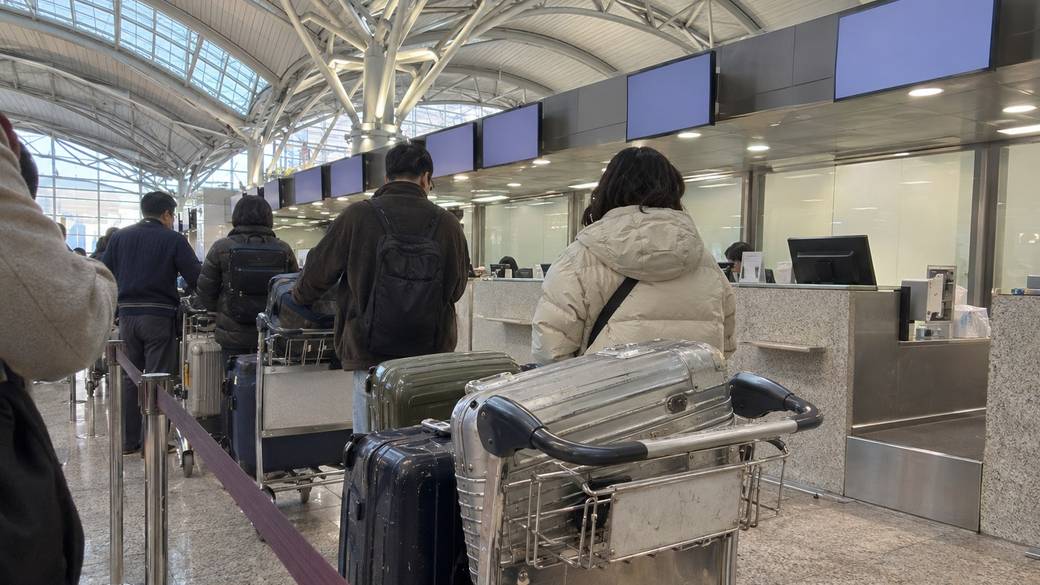
- Find your counter on the departure screens and check in. If the counter isn’t open yet, wait nearby; foreign airlines open 2–3 hours before departure.
- Clear security and departure immigration. Short-term visitors can use the automated departure gates without registering first, per Incheon Airport.
- Walk to your gate and be there before boarding closes; Jeju Air shuts its gates 15 minutes before departure.
What if your flights use different terminals?
Look at the terminal on both e-tickets before you book. In 2026, Terminal 2 hosts Korean Air, Asiana (since 14 January 2026, per Newsis), Jin Air, Air Busan, Air Seoul, Delta, Air France, KLM, Aeromexico, China Airlines, Garuda Indonesia, Xiamen Airlines and SAS, according to Asiana’s airport guide. Everything else, including Jeju Air, T’way, Air Premia and most foreign airlines, uses Terminal 1. Korean Air and Asiana merge into one airline on 17 December 2026; both are already in Terminal 2.
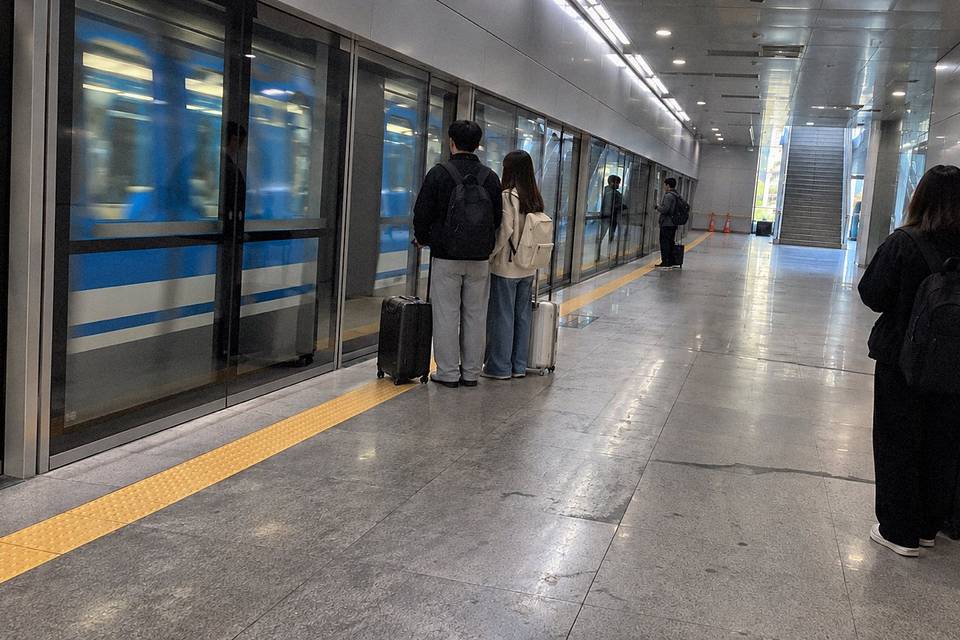
Once you are landside, the airside shuttle train is no longer an option: it is for passengers who have not entered Korea. You have two landside choices.
Moving between Incheon T1 and T2 after immigration (Incheon Airport, checked 12 Nov 2026)
| Option | Where to board | How often | Ride | Cost |
|---|---|---|---|---|
| AREX train | Airport Railroad station in each Transportation Center | Regular trains | 6 min | ₩1,050 |
| Shuttle bus 03 (T2 → T1) | T2 3F, near Gate 7 | Every 7–20 min, 04:30–23:35 | Not published by the airport | Free |
| Shuttle bus 04 (T1 → T2) | T1 3F, near Gate 8 | Every 10–20 min, 04:30–23:20 | Not published by the airport | Free |
The train is the predictable option; the bus is free but you may wait up to 20 minutes for it, and the airport does not publish the ride time.
Add up to an hour to the same-terminal advice for a terminal change (the bus wait, the ride and finding a new counter), which is why the quick-answer table says 4 hours. Pay for the AREX with a transit card or a single-journey ticket from the machines; if you are arriving for longer than the connection, our Incheon Airport to Seoul guide explains both.
When is Incheon at its busiest?
Your second half (check-in, security, departure immigration) depends on how many people are leaving at the same hour. Incheon publishes an hourly departure congestion forecast for the next two days, updated daily at 17:00 (link in the at-a-glance box). Check it the evening before.
- Holidays. Over Chuseok 2026 the airport handled 1.14 million passengers, with a peak of 247,018 on 27 September (Segye Ilbo). Seollal 2027 (6–9 February) is the next national holiday on that scale; our cheap flights guide lists the peak dates to avoid.
- The airport’s own advice. During Chuseok an airport official told Segye that arriving three hours before departure is enough, and that coming much earlier only adds to the crowds. On a self-transfer you are effectively arriving at the counter the moment you exit customs, so this is a useful check: if your exit time is less than about 2 hours before departure, you are already behind the airport’s own advice.
- Arrival waves. Immigration queues build when several long-haul flights land together. The airport does not publish average immigration times, which is why we size connections on the reported worst cases.
What if your gap is long or overnight?
You cannot drop bags until the counter opens, 2–3 hours before departure for foreign airlines and 3 hours for Jeju Air. With 8 hours or more you have three options.
- Store the bags. Hanjin’s T-Luggage counters are on 3F in both terminals (T1 opposite counter B, T2 opposite counter H); the airport page does not list prices.
- Sleep landside. Darakhyu capsules in both terminals’ Transportation Centers cost ₩69,000 for 12 hours overnight or ₩32,000 for 3 hours by day (≈ US$52 / US$24 at the ECB rate of 11 Nov 2026), as listed in our Incheon airport sleeping guide, which also covers hotels with free shuttles.
- Go into Seoul. With 8 hours or more and a passport that can enter, a half-day in the city is possible: the AREX Express reaches Seoul Station in 43 minutes from T1. Be back at the airport 3 hours before flight 2.
What can go wrong?
Common mistakes
Before you book the second flight
- Both terminals checked on the e-tickets, with an hour added if they differ
- At least 3 hours in one terminal, 4 hours between terminals
- Onward airline’s counter cut-off read on its own site
- e-Arrival Card or K-ETA sorted for your exact travel date
- Bag allowances matched: a low-cost second flight may charge for the bag the first one included
- A fallback plan if you miss flight 2: the next departure and its fare
None of this applies if both flights are on one ticket: you stay airside, follow the Transfer signs and need no K-ETA. If you are still choosing flights, a single booking through Incheon is usually worth paying a little more for when your connection would be under 3 hours.
Questions people ask
- Is 2 hours enough for a self-transfer at Incheon?
- Only with carry-on bags and an onward boarding pass already on your phone. With checked bags you need immigration, the baggage belt and a check-in counter that closes 50–60 minutes before departure, which leaves about an hour for queues that press reports put at 30 minutes to 2 hours at peaks.
- Do I need a K-ETA for a self-transfer in Korea?
- Yes, if your passport needs one, because collecting bags means entering Korea. US, UK, Canadian, Australian and Singapore passports are exempt until 31 Dec 2026 and file the free e-Arrival Card instead. Staying airside on one through ticket needs no K-ETA.
- Can the airline check my bags through on separate tickets?
- Sometimes, but only if the two airlines have a baggage agreement. Jeju Air, for example, connects bags only with its partner airlines. Ask the first airline at check-in and get it in writing on the bag tag; if the tag shows only Incheon, you collect the bag.
- How do I get from Terminal 1 to Terminal 2 after immigration?
- Take the free shuttle bus (T1 3F near Gate 8, every 10–20 minutes) or the AREX train, which takes 6 minutes and costs ₩1,050. The airside shuttle train is only for passengers who have not entered Korea.
- What happens if I miss my second flight on a separate ticket?
- The second airline treats you as a no-show, and the first airline has no duty to rebook it. Jeju Air's own guidance tells passengers who miss its flight because of another airline to contact that airline. Check the fare rules and your travel insurance before booking.
Next in your trip
- File the e-Arrival Card — K-ETA-exempt passports need it to clear immigration on a self-transfer
- Check if you need a K-ETA — the exemption for US, UK, Canada, Australia and Singapore ends 31 Dec 2026
- Sleep at Incheon Airport — capsules and transit hotels if your connection is overnight
Sources
- 인천국제공항 – 터미널 간 이동 (공항철도 6분, 1,050원) (Korean)
- 인천국제공항 – 무료 셔틀버스 03번 (T2→T1, 7–20분 간격) (Korean)
- 인천국제공항 – 항공사 체크인 카운터 운영시간 (Korean)
- 법무부 – 자동출입국심사 이용 확대 (1 Oct 2026) (Korean)
- 뉴시스 – 아시아나항공, 내년 1월 14일 인천공항 T2로 이전 (16 Dec 2025) (Korean)
- 제주항공 – 연결 탑승 수속 안내 (Korean)
- 세계일보 – 추석 인천공항 이용객 114만 명, '출발 3시간 전 도착' 당부 (22 Sep 2026) (Korean)
- 경향신문 – 인천공항 입국심사 1~2시간 대기 (19 Mar 2026) (Korean)
- 코리아데일리 – 인천공항 T2 입국 대기줄만 1시간 (16 Feb 2026) (Korean)
- e-Arrival Card – 신고 대상 안내 (Korean)
- Asiana Airlines – Airport guide (Incheon minimum connecting times)
- Incheon Airport – Shuttle bus between terminals (route 03)
- Incheon Airport – Departure congestion forecast
- Embassy of the Republic of Korea in the USA – K-ETA temporary exemption extended to 31 Dec 2026 (29 Dec 2025)
Updates
- Published with check-in cut-offs, terminal allocations, T1–T2 shuttle times, automated-gate eligibility and K-ETA status checked that day.
About Korea Field Notes
An English guide to the practical side of visiting South Korea. Guides are researched from Korean-language official sources (Korail, T-money, Seoul Metro, the Korea Tourism Organization) and re-checked when rules or prices change. Each guide shows when its facts were last checked and lists its sources. About the site · How we research and update guides · Found something out of date? Tell us.