How to Get Around Jeju Without a Car (2026)
Bus fares, routes and the taxi tariff checked against Jeju bus information (bus.jeju.go.kr); Udo fees against Jeju Province; taxi apps against Kakao Mobility and Uber Korea; tour prices against listings, all on 17 Oct 2026.
This guide contains affiliate links. If you book through them we may earn a commission at no extra cost to you. How this works.
Jeju works without a car if you ride the buses with a T-money card and fill the gaps with taxis or one day tour. Regular buses cost ₩1,150, express buses ₩2,000–3,000 and taxis start at ₩4,300, while east-coast tours begin around ₩39,800 (all checked 17 Oct 2026).
Best forFirst-timersBudgetSoloFamilies
Your situation → do this
| If you… | Do this |
|---|---|
| Want the cheapest way to see the island | T-money card + express buses (max ₩3,000 a ride), based in Jeju City and Seogwipo |
| Want Seongsan, Udo and the east coast in one day | Book a shared east-coast day tour with airport or Jeju City pick-up |
| Are 3–4 people who want your own pace | Hire a taxi by the hour (Uber Hourly ₩27,000/h) for the far coasts |
| Have no Korean phone number or card | Use k.ride or Uber for taxis; pay buses with T-money or a contactless Visa card |
| Are going to Udo | Express 111 or 101 to Seongsan port, walk on the ferry, ride Udo's ₩950 bus |
Key takeaways
- Regular buses cost ₩1,150 by card; express buses ₩2,000 on boarding, up to ₩3,000. No cash on board.
- Tap off every time: transfers are free or discounted within 40 minutes of tapping off, up to 2.
- Jeju buses have been cash-free since 1 Oct 2024: tap T-money, or any Visa contactless card on the second reader.
- k.ride (Kakao Mobility) takes overseas cards, GrabPay and Alipay; Uber Taxi and Uber Hourly work on Jeju too.
- Seongsan port is 86–95 minutes from the airport by express bus; rental cars are banned from Udo until 31 Jul 2029.
| Regular bus, adult | ₩1,150 by card (youth ₩850, child ₩350); no cash on board since 1 Oct 2024Source: Jeju bus information (bus.jeju.go.kr) |
|---|---|
| Express bus (급행), adult | ₩2,000 for the first 20 km, distance fare added at tap-off, max ₩3,000Source: Jeju bus information |
| Transfers | Within 40 min of tapping off, up to 2; express ↔ express saves only ₩1,150Source: Jeju bus information |
| Airport limousine | 600 (via Jungmun to Seogwipo) ₩1,300–5,500 · 800 (to Seogwipo terminal) ₩1,300–5,000Source: Jeju bus information |
| Taxi, mid-size | ₩4,300 for 2 km · +20% 23:00–04:00 · ₩1,000 app/call fee (tariff since 1 Jul 2024)Source: Jeju bus information, taxi page |
| Uber Hourly on Jeju | ₩27,000 per hour, base distance 15 km, then ₩800/km and ₩500/min over (launched 10 Nov 2025)Source: Uber Korea newsroom |
| Udo | Park fee ₩1,000 (ferry and terminal fee extra) · Udo village bus ₩950 by cardSource: Jeju Province; Jeju bus information |
- Time
- Express bus 37–100 min from the airport to most bases
- Cost
- ₩1,150 regular bus · ₩2,000–3,000 express bus · taxi from ₩4,300
- What you need
- T-money or other Korean transit card · Cash to top up T-money at a convenience store · Naver Map or Kakao Map · Mobile data
- Where
- bus.jeju.go.kr
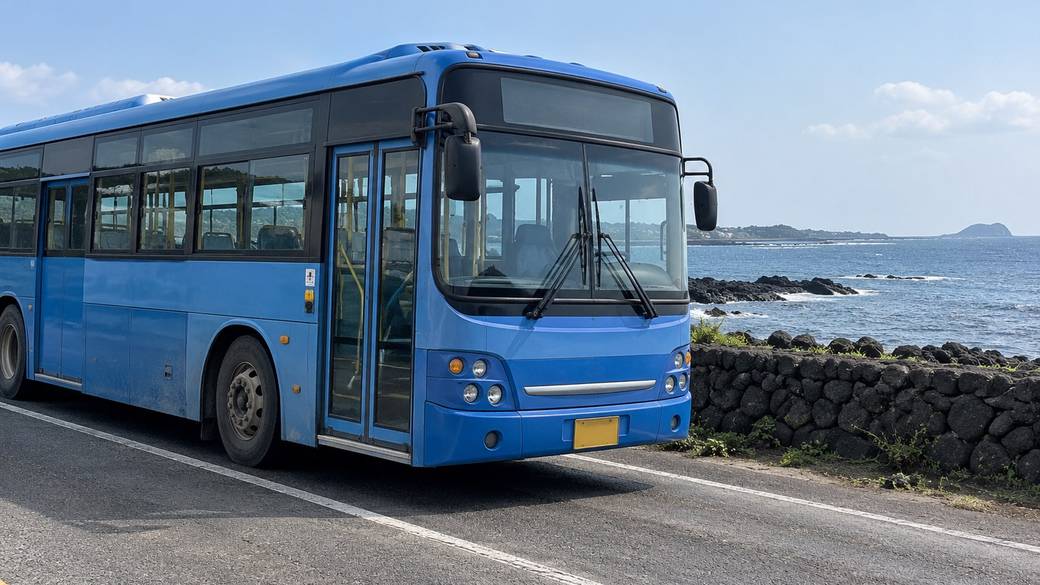
How Jeju’s buses, taxis and tours fit together for visitors who won’t drive, with fares checked on 17 October 2026. For day-by-day plans see our 3-day Jeju itinerary; everything else is in the Jeju section.
This page is for a first-timer from Singapore, Malaysia, the Philippines, Australia, the UK, North America or India who has already booked Jeju, won’t rent a car, and is planning on a phone: which bus, which app and when to pay for a tour. If you’re still deciding whether Jeju is worth the flight at all, read our honest take on Jeju first.
Can you really do Jeju without a car?
Yes, with one condition: sleep where the buses start. Jeju City (next to the airport) and Seogwipo (on the south coast) are the two hubs of the express-bus network, and from either one most coastal sights are one bus away. Our where to stay in Jeju guide compares the bases.
What works well by bus:
- Jeju City, Seogwipo and Jungmun, and the trips between them (₩3,000 or less on an express bus).
- The coast roads: express 101 runs along the east coast, 102 along the west coast, with regular buses 201 and 202 stopping more often.
- Seongsan Ilchulbong and the Udo ferry, on express 111 or 101.
What is slow or awkward by bus:
- Inland sights such as forests, oreum (volcanic cones) and theme parks, which sit off the main roads.
- Combining east and west in one day. The island is about 70 km across, and buses away from the hubs are less frequent.
- Late evenings outside Jeju City. Plan the last bus back before you go.
The usual answer is buses for most days, plus one day tour or hourly taxi for the parts the buses don’t reach well.
Which bus goes where?
Jeju numbers its buses by type: 1xx are express (급행), 2xx are intercity trunk routes, 3xx–4xx run in Jeju City, 5xx–6xx in Seogwipo, 7xx are village routes, and 810/820 are tourist circular buses. Airport limousines are 600 and 800 (Jeju bus information).
Jeju buses from the airport by destination (fares checked 17 Oct 2026; times from route timetables)
| Where you’re going | Bus from the airport | Scheduled time | Adult card fare |
|---|---|---|---|
| Jungmun resorts | Limousine 600, or express 182 | ~55 min (600) | ₩4,500 / ₩2,800 |
| Seogwipo | Limousine 600 via Jungmun; 800 or express 182 direct | ~100 min (600) · ~70–80 min (800/182) | ₩5,500 / ₩3,000 |
| Hamdeok Beach | Express 101 (east coast) | ~46 min | ₩2,000 |
| Aewol / Hallim (west) | Express 102 from Jeju bus terminal via the airport | ~37 / ~53 min | ₩2,000 / ₩2,400 |
| Seongsan port (Udo ferry) | Express 111 (via Songdang) or 101 | ~86 / ~95 min | ₩3,000 |
| Hallasan Seongpanak trail | Express 181 (5·16 road) | Depends on direction | ₩2,000–3,000 |
| Pyoseon (Jeju Folk Village) | Express 121 / 122 | — | ₩3,000 max |
Times are scheduled midday journeys read off each route’s timetable on bus.jeju.go.kr; traffic in Jeju City can add 10–20 minutes, and nothing on the express network costs more than ₩3,000.
A few routes visitors miss:
- 240 runs over the 1100 road past the Eorimok entrance of Hallasan to Jungmun.
- 281 links Jeju bus terminal and Seogwipo over the 5·16 road (the regular-fare twin of express 181).
- 810-1/810-2 loop from Daecheon transfer stop to Bijarim forest and Geosunsaemi Oreum; 820-1/820-2 loop from Donggwang transfer stop past the car museum and Jeju Shinhwa World. Both charge the regular ₩1,150.
- 3001 is a late-night loop between the airport, Nohyeong and central Jeju City.
How do you pay and ride a Jeju bus?
Jeju’s route buses have taken no cash since 1 October 2024: the cash boxes were removed (Jeju Sori, 24 Sep 2024). Each bus has two readers. One takes national prepaid transit cards (T-money, Cashbee and others, sold and topped up at convenience stores) and Korean transit credit cards. The second, ON나라페이, has taken any Visa contactless card since August 2025, whatever the issuing country (Financial News, 14 Aug 2025). We couldn’t confirm Mastercard, so carry a T-money card as the back-up. Our transit card comparison explains which one to get, and our Jeju Airport arrival guide shows which gate each bus leaves from.
- Get a T-money card at a convenience store (the one from Seoul works) and top it up with cash at the till, or plan to tap a Visa contactless card. There is no cash option on board.
- Find the route in Naver Map or Kakao Map. Check the number and the direction shown on the bus’s LED sign: 111 to Seongsan and 112 to Jeju City are different routes.
- Board at the front and tap on. Regular buses charge ₩1,150. Express buses charge ₩2,000 for the first 20 km.
- Tap off when you get off, every time. Express buses add the distance fare at tap-off (up to ₩3,000), and transfers only count from the tap-off.
- Change buses within 40 minutes. A transfer to a regular bus is free; up to 2 transfers count, but not onto the same route number in either direction.
- Check the last bus back in the map app before leaving a coastal stop in the late afternoon.
Jeju bus fares by card, adult/youth/child (checked 17 Oct 2026)
| Bus type | Adult (19+) | Youth (13–18) | Child (6–12) |
|---|---|---|---|
| Regular, city and circular buses | ₩1,150 | ₩850 | ₩350 |
| Express, first 20 km | ₩2,000 | ₩1,600 | ₩1,000 |
| Express, maximum (over 40 km) | ₩3,000 | ₩2,400 | ₩1,500 |
| Village bus (incl. Udo) | ₩950 | ₩550 | ₩350 |
| Airport limousine 600 / 800 | ₩1,300–5,500 / ₩1,300–5,000 | — | — |
The longest express ride on the island is ₩3,000 (about US$2.25 at the ECB rate of 16 Oct 2026, US$1 = ₩1,332), so buses are almost always the cheapest option by a wide margin.
Two transfer rules surprise people. Transfers between two express buses (or an express and a limousine) save only ₩1,150, not the whole fare. And a group travelling on one card can tap on together, but only one person gets the transfer discount: give each traveller their own card.
How do taxis and taxi apps work on Jeju?
Jeju taxis run on the island-wide tariff in force since 1 July 2024: a mid-size taxi costs ₩4,300 for the first 2 km, then ₩100 every 126 m, about ₩790 a km. Beyond 20 km, the rate rises to ₩120 per 126 m (about ₩950 a km), there’s a 20% night surcharge from 23:00 to 04:00, and app or phone bookings add ₩1,000. By our calculation from that tariff, a 40 km ride in free-flowing traffic comes to roughly ₩38,000 before waiting time.
Ways to get a taxi on Jeju as a visitor (checked 17 Oct 2026)
| Option | Foreign card? | What it’s good for | Watch out for |
|---|---|---|---|
| k.ride (Kakao Mobility) | Yes: overseas cards, Alipay, GrabPay | Hailing or pre-booking a taxi in English, fare estimate first | Payment method must be registered before you can call |
| Uber Taxi | Yes, your home Uber account | Visitors who already use Uber; built-in chat translation | Licensed taxis only, no UberX |
| Uber Hourly | Yes | A taxi for several hours: ₩27,000/h, base distance 15 km | ₩800/km and ₩500/min beyond the base |
| Taxi rank / street hail | Pay the driver | Airport, bus terminals, big hotels | Have the destination in Korean on your phone |
For Singapore, Malaysia and the Philippines, k.ride’s GrabPay and Alipay support is the easiest no-card option; visitors from the US, UK, Australia, Canada and India can simply open the Uber app they already have.
k.ride is Kakao Mobility’s app for foreign visitors: sign-up with Google, Apple or e-mail, an English, Japanese or Chinese interface, destination search and driver chat translated from over 100 languages, and payment with cards issued abroad. Its terms say you cannot call a car until an automatic payment method is registered, so set it up on hotel Wi-Fi before you need it.
Uber Taxi dispatches licensed Korean taxis through the normal Uber app. Uber launched Uber Hourly on Jeju and in Gyeongju on 10 November 2025: choose “Hourly” in the app, set the hours, pick-up and stops, and a mid-size taxi stays with you. Uber’s announced rate is ₩27,000 an hour with a base distance of 15 km. Check the price the app quotes before you confirm, as the rate was set at launch.
When is a day tour or hourly taxi better?
Book one when your day needs two or more far-apart sights, mainly the east (Seongsan, Udo, Manjanggul) or the west (Hyeopjae, Hallim Park, O’Sulloc). By bus, Seongsan alone is a 90-minute ride from the airport each way.
Bus vs tour vs hourly taxi for one east-coast day, per group (checked 17 Oct 2026)
| Option | 1 person | 3 people | Hours | Best for |
|---|---|---|---|---|
| Express buses (airport ↔ Seongsan + one hop) | ≈ ₩6,000–8,000 | ≈ ₩18,000–24,000 | Your own, but slow | Budget, solo, one main sight |
| Shared east-coast tour | From ₩39,800 | From ₩119,400 | ~9 h, fixed stops | First-timers, solo |
| Uber Hourly, 8 hours | ₩216,000+ | ₩216,000+ (₩72,000+ each) | You choose | Families, 3–4 friends |
| Private taxi tour (8 h) | Quote | Quote | 8 h + ₩30,000/extra hour | Groups wanting an English-speaking driver |
For one or two people a shared tour is usually cheaper than a taxi day; at three or four people an hourly taxi gets close to tour prices and lets you choose the stops.
What the tour price includes matters more than the headline. The East Jeju limousine-bus tour listed on Seoul Travel Pass from ₩39,800 picks up at Jeju Airport and Dongmun Market and includes Hueree and Herb Dongsan entry. Lunch is extra, and Seongsan Ilchulbong entry (₩5,000) is not listed as included. Trazy’s private taxi tour is 8 hours for up to 4 passengers with 2 cabin-size bags. It covers either the east or the west, not both, and charges ₩30,000 per extra hour.
The Jeju City Tour Bus, a hop-on hop-off double-decker, is another option. Trazy’s listing shows it running 09:00–19:30 except Mondays, with 21 stops around Jeju City, the airport and the coast near Iho and Yongduam. It stays inside the city, though, so it won’t replace a coast day.
How do you reach Udo and Hallasan without a car?
Udo. Most rental cars are banned from Udo from 1 August 2026 to 31 July 2029 (Visit Jeju), so arriving on foot is now normal:
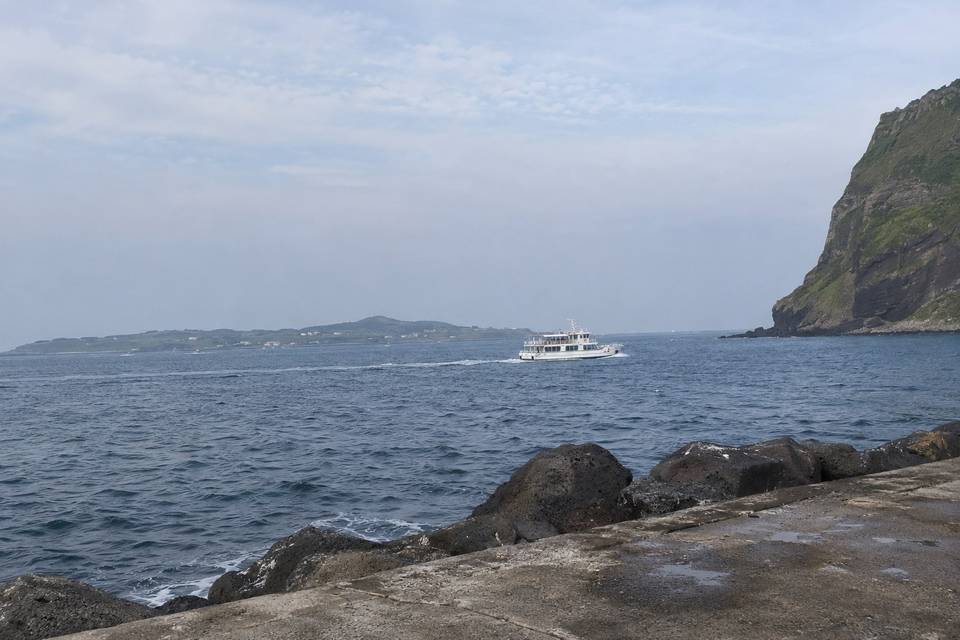
- Take express 111 (via Songdang) or 101 (east coast) to Seongsan port, about 86–95 minutes from the airport.
- Buy a ferry ticket at the Seongsan terminal; bring your passport, because ferry tickets in Korea are sold against ID. Jeju Province’s timetable shows boats every 30 minutes from 08:00. The last boat depends on the month, so check udoship.com or ask at the counter.
- Pay the ₩1,000 park fee, which is separate from the ferry fare and terminal fee.
- On Udo, use the village bus (₩950 by card), a rental bike or your feet.
Hallasan. Express 181 runs over the 5·16 road via the Seongpanak trailhead, and regular bus 240 runs over the 1100 road past the Eorimok entrance. For Yeongsil (the shortest climb) and Gwaneumsa, a taxi is the practical answer. Seongpanak and Gwaneumsa need a summit slot booked on visithalla.jeju.go.kr. From 1 October to 31 March, Seongpanak and Gwaneumsa close to new hikers at 11:30 and Yeongsil and Eorimok at 12:00. Plan the first bus up, not the last one down; the 3-day itinerary has the trail details.
What goes wrong without a car?
Common mistakes
Before your first car-free day on Jeju
- Base yourself in Jeju City and Seogwipo, not a village on the far coast.
- Carry a topped-up T-money card per person, not one shared card.
- Register a card or wallet in k.ride or Uber on Wi-Fi before you need a taxi.
- Put the east coast (Seongsan, Udo) on one day and the west coast on another.
- Book one day tour or an hourly taxi for the sights buses reach poorly.
- Check the last bus and the last Udo ferry the same morning.
Still choosing a base? Where to stay in Jeju compares every area by airport bus and car need, and the Jeju section has the rest.
Questions people ask
- Is it easy to get around Jeju without a car?
- Yes for Jeju City, Seogwipo, Jungmun and the coast roads, which express buses link for ₩3,000 or less. It is slow for the far east and west and for inland sights, so most car-free visitors add one day tour or a few taxi rides.
- Can I use a foreign credit card on Jeju buses?
- Yes, if it is a Visa contactless card. Since August 2025 Jeju city buses take any Visa card tapped on the second reader (ON나라페이), whatever the issuing country. We couldn't confirm Mastercard. A T-money card is the safe back-up, and since October 2024 the buses take no cash at all.
- Does Uber work in Jeju?
- Yes. Uber Taxi calls licensed Jeju taxis through the same Uber app you use at home, and Uber Hourly, launched on Jeju in November 2025, hires a mid-size taxi for ₩27,000 an hour.
- How do I get from Jeju Airport to Seogwipo without a car?
- Take airport limousine 600 via the Jungmun resort hotels (₩5,500, about 100 minutes end to end), or the 800 limousine or express 182 straight over the island to Seogwipo's bus terminal area (about 70–80 minutes, ₩3,000 on the 182).
- Can I get to Udo without a car?
- Yes, and it is the normal way now: most rental cars are banned from Udo until 31 July 2029. Take express 111 or 101 to Seongsan port, buy a ferry ticket with your passport, and use Udo's village bus (₩950 by card), a bike or your feet on the island.
Next in your trip
- Get a transit card — Jeju buses take T-money and no cash; a card also unlocks transfers
- Where to stay in Jeju — pick a base on the express-bus network
- 3-day Jeju itinerary — a day-by-day bus plan from Seogwipo
Sources
- 제주버스정보 – 제주버스 노선·요금체계·교통카드·환승 안내 (routes, fares, cards, transfers) (Korean)
- 제주버스정보 – 공항리무진 600·800 노선 안내 (airport limousines) (Korean)
- 제주버스정보 – 택시 운임 및 요율 (taxi tariff, from 1 Jul 2024) (Korean)
- 제주특별자치도 – 우도해양도립공원 입장료·도항선 안내 (Udo park fees, ferry terminals, timetable) (Korean)
- Uber 뉴스룸 – 우버 택시, 시간 단위 택시 대절 서비스 'Uber 대절' 경주·제주 론칭 (10 Nov 2025) (Korean)
- 카카오모빌리티 – k.ride, 외국인을 위한 글로벌 모빌리티 플랫폼 (sign-up, payment, languages) (Korean)
- 비짓제주 – 우도: 도항선, 차량 운행 제한 2026–2029 (Udo vehicle ban) (Korean)
- Visit Jeju – Useful Jeju travel information (map apps, Kakao T)
- Seoul Travel Pass – East Jeju Premium Limousine Bus Tour (price and inclusions)
- Trazy – Jeju private taxi tour (8 hours, up to 4 passengers, overtime rate)
- 제주 버스 10월부터 현금 없는 버스 전면 시행 (24 Sep 2024) – 제주의소리 (Korean)
- 제주 시내버스, 국적 상관없이 비자카드로 탑승 (14 Aug 2025) – 파이낸셜뉴스 (Korean)
- Frankfurter (ECB reference rates) – USD/KRW, 16 Oct 2026
Updates
- Corrected payment: Jeju route buses have taken no cash since 1 Oct 2024 and accept overseas Visa contactless cards since Aug 2025; removed the cash fare column and cash tips, linked the new Jeju Airport arrival guide.
- Published with 2026 bus fares and transfer rules, express routes from the airport, the taxi tariff, k.ride and Uber Hourly, Udo access and day-tour options.
About Korea Field Notes
An English guide to the practical side of visiting South Korea. Guides are researched from Korean-language official sources (Korail, T-money, Seoul Metro, the Korea Tourism Organization) and re-checked when rules or prices change. Each guide shows when its facts were last checked and lists its sources. About the site · How we research and update guides · Found something out of date? Tell us.