Best Waterfalls in Korea: Which Are Worth the Trip
Fees and hours checked against the Seogwipo e-ticket pages, Visit Jeju, Korea Tourism Organization, the national park service, the Seoul Metropolitan Government media hub and Korean press on 20 Nov 2026.
Pick Jeju's Jeongbang and Cheonjiyeon falls (₩2,000 each, open every day) between November and May, and Seoraksan's free 2.4 km Biryong Falls walk from June to October. Mainland falls are fullest in the July–August monsoon and thin or frozen by January (fees and hours checked 20 Nov 2026).
Best forFirst-timersFamiliesPhotographersSeniors
Your situation → do this
| If you… | Do this |
|---|---|
| You are on Jeju and want one waterfall | Jeongbang in Seogwipo: 23 m, falls straight onto the shore, ₩2,000, last entry 17:30 |
| You can only go in the evening, or need a flat path | Cheonjiyeon: open to 22:00 (last entry 21:20), level path from the car park, ₩2,000 |
| You are going to Sokcho or Seoraksan | Biryong Falls: 2.4 km and about 1 hour from Sogongwon, no admission fee |
| You are in Seoul with half a day | Hongje Falls by Line 3 and a short bus ride; free, with a café facing the fall |
| You are travelling in January or February | Go to Jeju, or see a frozen ice wall at Gugok Falls near Chuncheon |
Key takeaways
- Jeongbang, Cheonjiyeon and Cheonjeyeon on Jeju cost ₩2,000–2,500 and are open every day of the year.
- Cheonjiyeon's night opening reopened on 1 October 2026 after a fatal fall in September; it runs to 22:00.
- Biryong Falls in Seoraksan is 2.4 km, about an hour, from the Sogongwon entrance, with no admission fee.
- Seoul averages 414.4 mm of rain in July against 16.8 mm in January, so mainland falls swing from roaring to a trickle.
- Eongtto Falls on Jeju runs only after heavy rain, roughly 70 mm or more in the mountains.
| Jeongbang Falls | 23 m onto the shore; ₩2,000 adult, ₩1,000 youth/child; 09:00–17:50, last entry 17:30Source: Seogwipo e-ticket; Visit Jeju |
|---|---|
| Cheonjiyeon Falls | 22 m; ₩2,000 adult; 09:00–22:00, last entry 21:20; night opening resumed 1 Oct 2026Source: Seogwipo e-ticket; News Jeju |
| Cheonjeyeon Falls | Three tiers, first fall 22 m; ₩2,500 adult, ₩1,350 youth/child; last entry 17:10Source: Seogwipo e-ticket |
| Biryong Falls, Seoraksan | 2.4 km, about 1 h from Sogongwon; free entry; trail closed sunset to 2 h before sunriseSource: Korea Tourism Organization; Korea National Park Service |
| Free entry ages (Jeju falls) | Age 6 and under and 65 and over enter Jeongbang, Cheonjiyeon and Cheonjeyeon freeSource: Seogwipo e-ticket |
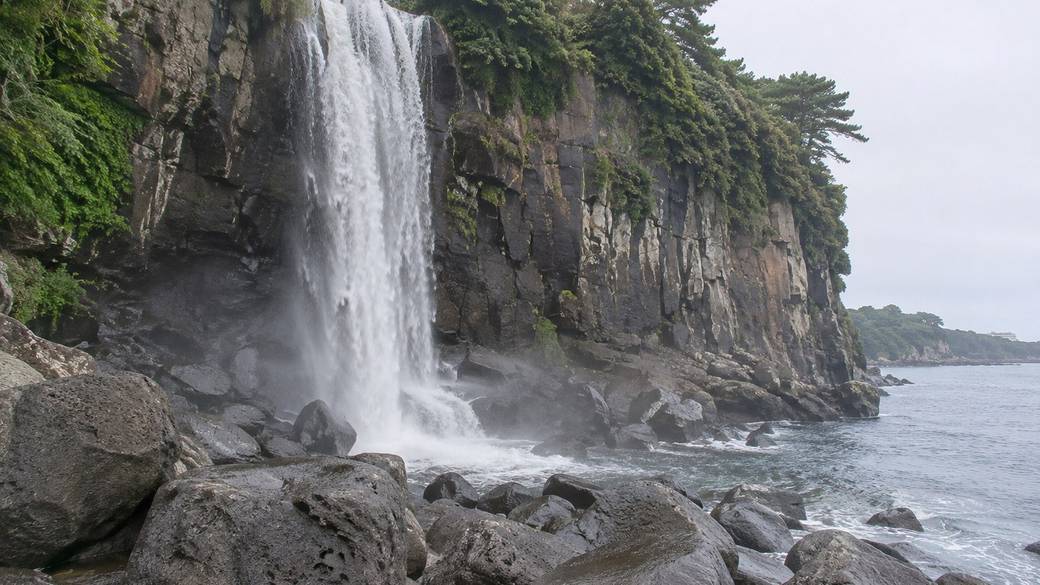
Nine waterfalls that fit a first trip to Korea, ranked by how easily they slot into a Seoul, Jeju or east-coast route and by whether they will actually be flowing in your month. More quiet nature picks are in Off the Beaten Path.
Which waterfall should you pick?
Pick by where you are already going, then check the month. Jeju has the most reliable falls for a short visit, Seoraksan has the best hike, and the falls near Seoul are easy half-days that depend heavily on recent rain or frost.
Must
- What it is
- A 23 m fall that drops straight onto the seashore in Seogwipo
- Why go
- The one Korean waterfall most visitors remember; 5 minutes of stairs from the ticket booth
- Time needed
- 40 minutes
- What it is
- A 22 m fall at the end of a wooded gorge in Seogwipo town
- Why go
- Open until 22:00 and reached by a level path, so it suits evenings, prams and older travellers
- Time needed
- 30–60 minutes
- What it is
- A mountain fall 2.4 km up a valley from the Sogongwon entrance
- Why go
- The best easy hike to a waterfall in Korea, with a steep extra climb to the Towangseong viewpoint
- Time needed
- 2–4 hours
Worth it
- What it is
- Three tiers of falls in a gorge next to the Jungmun resort area
- Why go
- Worth it if you stay in Jungmun; the first fall is 22 m
- Time needed
- 1 hour
- What it is
- A 50 m fall in a forested valley near Gangchon Station
- Why go
- The best winter pick near Seoul: it freezes into an ice wall used for ice climbing
- Time needed
- Half a day from Seoul
- What it is
- A fall dropping into a basalt gorge in the Hantan River geopark
- Why go
- A dramatic canyon with a suspension bridge and skywalk, north of Seoul
- Time needed
- A full day from Seoul
If time
- What it is
- A 25 m artificial fall on a rock face above the Hongjecheon stream
- Why go
- Free and inside the city, with a café facing the water
- Time needed
- 1 hour
- What it is
- A chain of falls up a valley behind Bogyeongsa temple
- Why go
- Only if you are already in Pohang or Gyeongju; free since 2023
- Time needed
- 2 hours to half a day
- What it is
- A 50 m fall near Seogwipo that is a dry cliff most days
- Why go
- Spectacular after heavy rain, nothing to see otherwise
- Time needed
- 30 minutes
How do the waterfalls compare?
Korean waterfalls by fee, hours, walk and best months (checked 20 Nov 2026)
| Waterfall | Region | Adult fee | Hours | Walk from entrance | Best months |
|---|---|---|---|---|---|
| Jeongbang | Jeju, Seogwipo | ₩2,000 | 09:00–17:50 (last 17:30) | 5 min of stairs | All year |
| Cheonjiyeon | Jeju, Seogwipo | ₩2,000 | 09:00–22:00 (last 21:20) | Level path | All year; evenings |
| Cheonjeyeon | Jeju, Jungmun | ₩2,500 | 09:00–17:50 (last 17:10) | Gorge paths | All year |
| Eongtto | Jeju, Gangjeong | Free | Not confirmed | About 500 m | Only after heavy rain |
| Biryong | Seoraksan, Sokcho | Free | Sunrise rule, see below | 2.4 km, about 1 h | Jul–Oct |
| Gugok | Chuncheon | ₩2,000 | 09:00–17:00 | About 1 km | Jul–Aug; late Dec–early Feb for ice |
| Jaein | Yeoncheon | ₩5,000 (₩3,000 back as a voucher) | Entry to 17:00 | About 20 min | Jul–Oct |
| Hongje | Seoul, Seodaemun | Free | 08:00–21:00 (2024 rule) | 4 min from the bus | Mar–Nov |
| Naeyeonsan | Pohang | Free | 06:00–18:00 | 1.5 km to the first falls | Jul–Nov |
The Jeju falls are the only ones on this list that are cheap, staffed and worth visiting in any month, which is why they top the list for a short first trip.
Prices for Gugok come from the Korea Tourism Organization’s data listing and for Jaein from a 2026 report citing Yeoncheon County, not from an operator page, so check them on the day. Children and seniors pay less or nothing at most sites: on Jeju, age 6 and under and 65 and over enter free.
When do Korean waterfalls look best?
Rain decides almost everything. Korea gets most of its rain in summer: Seoul averages 414.4 mm in July against 16.8 mm in January, according to the Korea Meteorological Administration’s 1991–2020 normals. Mountain falls that roar in the July–August monsoon can shrink to a thin thread by late autumn and freeze in the coldest weeks. For the rainy-season dates, see Korea’s rainy season.
- July to September: the fullest flow everywhere. Expect heat, humidity and wet rocks, and avoid mountain trails on days with heavy-rain warnings, when the national parks close them.
- October to mid-November: autumn colour around Biryong and Naeyeonsan, but less water. Good for photos of the valleys rather than the falls themselves.
- Mid-November to mid-December: autumn fire season. From 15 November to 15 December 2026 the national parks close high-risk trail sections. In Seoraksan these are high routes such as Osaek–Daecheongbong, while the low trails from the Sogongwon entrance stay open.
- Late December to early February: many mainland falls freeze. Gugok Falls near Chuncheon becomes an ice wall used for ice climbing (climbers must apply in advance at the site office), and Seoul’s Hongje Falls froze into an ice wall in February 2026, according to the Seoul city media hub.
- March to May: the falls start running again as snow melts, but Jeju’s are the dependable ones in spring.
This matters if your school holidays fall in December or January, as they do for most visitors from Australia and Singapore: pick Jeju for falling water, or treat the mainland falls as frozen scenery. UK and Canadian summer holidays in July and August coincide with the fullest flow, and with the monsoon.
Which Jeju waterfalls are worth it?
Jeju’s three paid falls are all on the south coast, run by Seogwipo City, and open every day of the year (they can close for bad weather). Jeongbang and Cheonjiyeon are both in Seogwipo town and Cheonjeyeon is in Jungmun to the west, so a driver can see all three in a morning. Without a car, base yourself in Seogwipo and use our guide to Jeju without a car.
Jeongbang Falls (정방폭포) is the one to choose if you only have time for one. The water drops 23 m off a basalt cliff straight onto the rocky shore. A staircase from the ticket booth takes about five minutes; Visit Jeju rates access as very difficult for wheelchair users. Tickets are ₩2,000 for adults and ₩1,000 for ages 7–24, with last entry at 17:30. Stay back from the water’s edge when the sea is rough.
Cheonjiyeon Falls (천지연폭포) sits at the end of a short gorge in Seogwipo town, 22 m high over a pool about 20 m deep. Its advantage is the hours: 09:00–22:00, with last entry at 21:20, and lighting that was replaced in spring 2026. The path from the car park is flat and suitable for wheelchairs and prams. Night viewing paused after a man fell into the pool while taking photos on 26 September 2026 and reopened on 1 October with staff posted around the falls, according to News Jeju. City buses 611, 612, 641, 642 and the yellow loop bus 880 end at the Cheonjiyeon stop.
Cheonjeyeon Falls (천제연폭포) is three falls stepped down a gorge beside the Jungmun resort area; the first is 22 m. It costs ₩2,500 (₩1,350 for ages 7–24), with last entry at 17:10. The nearest stop is a five-minute walk and is served by buses including 202, 510 and 520. Choose it if you are staying in Jungmun or visiting the Jusangjeolli cliffs nearby.
Eongtto Falls (엉또폭포) in Gangjeong, west of Seogwipo, is a 50 m cliff that only becomes a waterfall after heavy rain, roughly 70 mm or more in the mountains according to a June 2026 Wikitree report. On a dry day there is nothing to see. If you are on Jeju in a downpour, it is one of the few sights that improves; the Jeju rainy-day guide has the indoor options for the rest of the day.
Is Seoraksan’s Biryong Falls worth it?
Yes, if you are going to Sokcho or the east coast between June and October. It is the easiest real hike to a waterfall in Korea. From the Sogongwon ticket booth it is 2.4 km and about an hour to Biryong Falls along a valley, passing Yukdam Falls about 500 m before the end; the Korea Tourism Organization rates it ordinary in difficulty. The national park service says the first 1.2 km is flat enough for prams and wheelchairs. Entry to the park is free: the Sinheungsa temple fee that visitors used to pay at the gate was abolished in May 2023.
Fit walkers can continue up a steep stair climb, roughly 400 m of decking, to the Towangseong Falls viewpoint, which looks across to a tall fall on the opposite cliff that the public cannot reach. Allow about three hours for the full return walk. Our hiking guide compares it with Ulsanbawi from the same entrance.
City buses 7 and 7-1 run from Sokcho town to the Seoraksan car park terminus. For bus terminals and where to sleep, see where to stay near Seoraksan.
Can you see a waterfall from Seoul?
Yes, but plan around the season. Three options, from easiest to most rewarding:
- Hongje Falls (홍제폭포), Seodaemun. A 25 m artificial fall pumped down a rock face above the Hongjecheon stream. It is free and has a riverside café, Cafe Pokpo, facing the water. Take Line 3 to Hongje Station, Exit 4, then bus 7713 or 7738 to Baengnyeongyo; the falls are four minutes’ walk. In 2024 Seodaemun-gu said it would run the fall year-round, 08:00–21:00; we could not find a 2026 timetable, and in hard frost it turns into an ice wall instead.
- Gugok Falls (구곡폭포), Chuncheon. A natural 50 m fall about 1 km up a valley from the ticket office, on the ITX-Cheongchun and Gyeongchun Line via Gangchon Station. The Korea Tourism Organization’s listing gives ₩2,000 and 09:00–17:00, open all year. It is best in summer for water and from late December to early February as an ice wall. Combine it with a Chuncheon day trip.
- Jaein Falls (재인폭포), Yeoncheon. A fall dropping into a basalt gorge in the Hantan River geopark, a national scenic site since 2023, with an 80 m suspension bridge and a 27 m skywalk tower. Since 26 September 2025 it charges ₩5,000, with ₩3,000 returned as a local gift voucher, and entry closes at 17:00, according to a 2026 report citing the county. Line 1 has reached Yeoncheon Station since December 2023, but the falls are a taxi or bus ride beyond it, so it is a full day.
For more ideas in the same radius, see the best day trips from Seoul.
Which mainland falls are worth a detour?
Naeyeonsan’s 12 falls (내연산 12폭포), Pohang. A string of waterfalls up a valley behind Bogyeongsa temple. The temple’s admission fee was abolished in May 2023, and a 1 November 2026 travel report gives free entry from 06:00 to 18:00. The first falls are about 1.5 km from the temple; a short return walk to Gwaneum and Yeonsan Falls takes 1.5–2 hours, and the full loop about 7.5 km and 4–5 hours. Bus 5000 runs from Pohang Station or the Pohang intercity terminal to the temple car park in about an hour. Worth it only if Pohang or Gyeongju is already on your route.
We left out falls we could not verify for 2026, including Jikso Falls in Byeonsanbando National Park and Guryong Falls in Odaesan, where public transport and trail details were not confirmed.
What can go wrong?
- Arriving after last entry. Jeju’s daytime falls stop selling tickets at 17:10–17:30. In winter, do Jeongbang and Cheonjeyeon first and leave Cheonjiyeon for the evening.
- Going after a dry spell. Biryong, Jaein and Naeyeonsan can be disappointing in late autumn. If the last two weeks were dry, look at the valleys rather than expecting a torrent.
- Weather closures. National park trails shut during heavy-rain, heavy-snow and fire-season orders, and Jeju’s falls can close when weather is bad. Check the park or Seogwipo page on the morning you go.
- Expecting to swim. None of these falls are swimming spots; Jeju’s are protected scenic sites viewed from the bank.
Common mistakes
Before you go
- Picking a mainland fall for a December or January trip and expecting running water
- Driving to Eongtto on a dry day
- Starting the Towangseong viewpoint climb in the late afternoon
- Expecting Hongje Falls to be running in a hard frost, when it turns to ice
- Not checking the weather warning list before a mountain walk
If you are building a Jeju route around the falls, the Jeju 2-day itinerary already fits Jeongbang and an evening at Cheonjiyeon into a Seogwipo day.
Questions people ask
- What is the most famous waterfall in Korea?
- Jeongbang Falls on Jeju is the best known to visitors, because it drops 23 m straight onto the seashore. On the mainland, Seoraksan's Biryong Falls and the Towangseong viewpoint above it are the classic hike.
- Are Korean waterfalls frozen in winter?
- Many mainland ones are, usually from late December to early February. Gugok Falls near Chuncheon becomes an ice wall used for ice climbing, and Seoul's Hongje Falls froze into an ice wall in February 2026. Jeju's coastal falls stay open and are the safer winter pick.
- Can I see Cheonjiyeon Falls at night?
- Yes. The Seogwipo ticket page lists 09:00–22:00 with last entry at 21:20. Night viewing paused after a visitor fell on 26 September 2026 and reopened on 1 October with staff on site. Stay on the marked path; the rocks near the pool are slippery after dark.
- Do you need hiking gear for Biryong Falls?
- Not for the falls. The first 1.2 km from Sogongwon is flat enough for prams, and the rest is a valley path. Wear proper shoes if you continue up the steep stair climb to the Towangseong viewpoint, and carry a layer from November.
- Can you swim at waterfalls in Korea?
- Not at the ones in this guide. Jeju's falls are protected scenic sites viewed from decks and rocks, and swimming in their pools is not part of a visit. Mountain pools in national parks are for looking at; keep to the trail.
Next in your trip
- Jeju without a car — the buses that reach Seogwipo and Jungmun from the airport
- Where to stay near Seoraksan — Sokcho town vs Seorak-dong for an early Biryong start
- Korea weather by month — rain by month, which decides how full the falls are
Sources
- 서귀포시 E-Ticket – 정방폭포 관람시간·요금 (Korean)
- 서귀포시 E-Ticket – 천지연폭포 관람시간·요금 (Korean)
- 서귀포시 E-Ticket – 천제연폭포 관람시간·요금·교통 (Korean)
- 비짓제주 – 정방폭포 (Korean)
- 비짓제주 – 천지연폭포 야간관람 재개 (8 May 2026) (Korean)
- 뉴스제주 – 천지연폭포 야간관람 1일부터 재개장 (Oct 2026) (Korean)
- 파이낸셜뉴스 – 천지연폭포 추락 사고, 야간 개장 잠정 중단 (28 Sep 2026) (Korean)
- 위키트리 – 엉또폭포, 많은 비가 내려야 볼 수 있는 폭포 (22 Jun 2026) (Korean)
- Korea Tourism Organization – Seoraksan National Park (Biryong Falls course)
- 국립공원공단 – 입산시간 지정제 (설악산 소공원 구간) (Korean)
- 대한민국 정책브리핑 – 국립공원 가을철 산불조심기간 탐방로 통제 (15 Nov 2026) (Korean)
- 내 손안에 서울 – 홍제폭포 연중 가동 (7 Mar 2024) (Korean)
- 내 손안에 서울 – 홍제천 은빛 빙벽 (13 Feb 2026) (Korean)
- 내 손안에 서울 – 겨울내 얼어있던 홍제폭포, 봄을 깨우다 (26 Mar 2026) (Korean)
- 한국관광 데이터 (ktriptips) – 구곡폭포 이용 안내 (updated 11 Nov 2026) (Korean)
- 트래블맵저니 – 연천 재인폭포 관람료 (8 Aug 2026) (Korean)
- 뉴스와 – 포항 내연산 12폭포 (1 Nov 2026) (Korean)
- 기상자료개방포털 – 우리나라 기후평년값 (1991~2020) (Korean)
Updates
- Published with nine waterfalls, their 2026 fees and hours, Cheonjiyeon's 1 October night reopening and the autumn fire-season closure in Seoraksan.
About Korea Field Notes
An English guide to the practical side of visiting South Korea. Guides are researched from Korean-language official sources (Korail, T-money, Seoul Metro, the Korea Tourism Organization) and re-checked when rules or prices change. Each guide shows when its facts were last checked and lists its sources. About the site · How we research and update guides · Found something out of date? Tell us.