Korea Rainy Season (Jangma): What to Expect
KMA climate data portal (rainy-season and monthly normals), KMA heavy-rain criteria and typhoon statistics, KMA press release of 3 July 2026, KNPS and Seoul closure notices, and 2027 term dates from MOE Singapore, NSW and Victoria, checked 2 Nov 2026
Korea's rainy season normally runs 25 June to 26 July around Seoul, a week earlier on Jeju, with about 17–18 rain days in that month. City trips still work if each day has an indoor anchor; hikes, river parks and island ferries need a spare day.
Best forFirst-timersFamiliesRainy day
Your situation → do this
| If you… | Do this |
|---|---|
| Your only free dates are late June to late July | Keep them; build every day around one indoor anchor and do outdoor sights in the drier hours |
| You planned a mountain hike or an island ferry | Give it two possible days and check the park or ferry status that morning; closures follow heavy-rain advisories |
| You can move your dates by two to three weeks | Go in early June: Seoul's June averages 129.5 mm against 414.4 mm in July; August is hotter and still wet |
| You are going to Jeju | Expect the rain a week earlier (19 June–20 July on average) and keep the last day before your flight free |
Key takeaways
- Seoul's normal jangma is 25 June–26 July, about 32 days with 17–18 of them rainy.
- Seoul's July averages 414.4 mm of rain, more than three times June's 129.5 mm.
- Closures start with a heavy-rain advisory: 60 mm in 3 hours or 110 mm in 12.
- KMA gives no advance dates; the 2026 season ran 1–26 July in the central region.
- Typhoons peak later: 1.2 affect Korea in an average August, 0.8 in September.
| Normal rainy season (1991–2020) | Central 25 Jun–26 Jul; south 23 Jun–24 Jul; Jeju 19 Jun–20 JulSource: Korea Meteorological Administration climate data portal |
|---|---|
| Rain days in the season | 17.7 central, 17.0 south, 17.5 Jeju (about 31–32 days long)Source: Korea Meteorological Administration climate data portal |
| Heavy-rain advisory / warning | 60 mm in 3 h or 110 mm in 12 h / 90 mm in 3 h or 180 mm in 12 hSource: Korea Meteorological Administration |
| 2026 season (central region) | 1–26 July, 325.0 mm (about 86% of normal)Source: KMA press release, 3 Jul 2026; Segye Ilbo, 27 Jul 2026 |
| Typhoons affecting Korea | 3.4 a year on average; 1.0 in July, 1.2 in August, 0.8 in SeptemberSource: KMA typhoon statistics, 1991–2020 |
This page is for travellers whose dates fall in Korea’s summer rainy season and who want to know what actually happens and how to plan around it; for every other month, see Korea weather by month and our planning guides.
Should you still go to Korea in the rainy season?
Yes, for most trips. Jangma (장마) is a front of humid air that drifts north and south over the peninsula for about a month. It brings the year’s heaviest rain, but in bursts: a wet morning, a dry afternoon, two grey days, then sun. Around Seoul the normal season lasts 32 days, and KMA counts about 17–18 rain days in that window, so roughly half the days stay dry or close to it.
What it costs you is flexibility, not the trip:
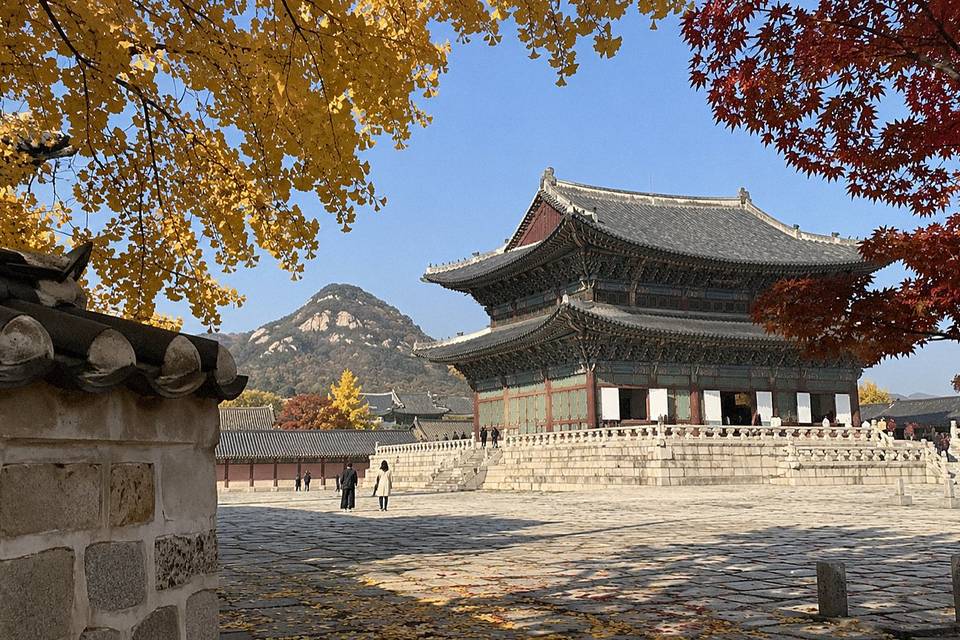
- City sightseeing works. Seoul’s subway, museums, malls, markets with roofs, jjimjilbang and noraebang carry a wet day. Palaces and Bukchon are fine in light rain with an umbrella.
- Outdoor plans need a second day. Mountain trails, island ferries, the Han River parks and riverside walks close when heavy-rain advisories go out.
- Heat and humidity are the bigger discomfort. Seoul’s July averages a 29.0°C high, a 22.3°C low and 76% humidity, so you sweat under a raincoat.
Skip or move the trip only if the whole point is hiking, Jeju’s coast or long beach days, or if you cannot shift a single plan by a day.
When does jangma start and end?
On average the rainy season reaches Jeju around 19 June, the south around 23 June and the Seoul region around 25 June, and it ends about a month later in each. Those are 30-year normals; any single year can be a fortnight off in either direction.
Normal rainy season by region, KMA 1991–2020 normals (checked 2 Nov 2026)
| Region | Starts | Ends | Length | Rain days | Rainfall |
|---|---|---|---|---|---|
| Central (Seoul, Gyeonggi, Gangwon, Chungcheong) | 25 Jun | 26 Jul | 31.5 days | 17.7 | 378.3 mm |
| South (Busan, Gyeongsang, Jeolla) | 23 Jun | 24 Jul | 31.4 days | 17.0 | 341.1 mm |
| Jeju | 19 Jun | 20 Jul | 32.4 days | 17.5 | 348.7 mm |
Read the table as a planning window, not a timetable: the start and end dates move, but the length and the number of rain days are fairly steady. Recent seasons show how wide the swing is.
Recent rainy seasons in the central region (Seoul), KMA records and Korean press, checked 2 Nov 2026
| Year | Central region dates | What stood out |
|---|---|---|
| 2018 | 26 Jun – 11 Jul | Shortest on record for the region: 16 days |
| 2020 | 24 Jun – 16 Aug | Longest: 54 days, 696 mm nationally |
| 2023 | 26 Jun – 26 Jul | 663.3 mm in the centre; deadly Osong underpass flood on 15 Jul |
| 2024 | 29 Jun – 27 Jul | 472 mm in the centre |
| 2025 | 19 Jun – 20 Jul | Early start; the south’s season lasted only 13 days |
| 2026 | 1 Jul – 26 Jul | Started late; 218.6 mm nationally, about 63% of normal |
2026 was a dry year overall, but not in the capital: the central region still got 325.0 mm, about 86% of normal, while the south got about 42% and Jeju about 33%. A light season in one place can be a heavy one 300 km away.
What does a rainy-season day look like?
Most days follow the front’s position. When it sits over your region you get long spells of steady rain and short, very heavy downpours; when it moves away you get hot, sticky, partly sunny weather. Because the exact hours of rain are hard to pin down days ahead, plan each day in blocks rather than by the clock.
| Month | High / low °C | High / low °F | Rain | Verdict | Note |
|---|---|---|---|---|---|
| Jun | 27.6 / 18.7 | 82 / 66 | 130 mm | Good | Rain from late June |
| Jul | 29 / 22.3 | 84 / 72 | 414 mm | Fine with caveats | Wettest month; jangma |
| Aug | 30 / 22.9 | 86 / 73 | 348 mm | Fine with caveats | Hottest; showers, typhoons |
July is Seoul’s wettest month by far, but August is close behind with 348.2 mm even though the jangma front has usually gone by then: late-summer rain comes from short, intense showers and typhoons.
A workable daily pattern:
- Morning: the outdoor sight, early, before the heat (palaces open at 09:00).
- Midday to mid-afternoon: the indoor anchor (a museum, a mall, a covered market) when downpours and heat peak.
- Evening: a neighbourhood walk, food street or night view if the radar is clear.
How do you get rain alerts in English?
KMA issues two levels of heavy-rain alert. An advisory (호우주의보) goes out when 60 mm is expected in 3 hours or 110 mm in 12 hours; a warning (호우경보) at 90 mm in 3 hours or 180 mm in 12 hours. An advisory is the usual trigger for trail and riverside closures; a warning means stay off riverbanks, underpasses and mountain paths altogether.
For the most intense bursts, Korea now sends a heavy-rain emergency text (호우 긴급재난문자) straight to phones in the area when 50 mm falls in an hour and 90 mm in three hours, or 72 mm in one hour. These texts are written in Korean, but since 28 February 2024 the most urgent alerts also show the type of disaster in English. Whether a roaming foreign phone receives them is not something we could confirm, so do not rely on it.
What does work for visitors:
- Emergency Ready App (the foreigners’ version of Korea’s 안전디딤돌 safety app): pushes disaster alerts in English, Chinese, Vietnamese, Thai and Japanese, and lists shelters near you. Install it before you fly.
- KMA’s English site (kma.go.kr/neng): current warnings and forecasts in English.
- 1330 Korea Travel Hotline: English-speaking help on closures and transport, by phone or chat; see our Korea travel apps guide.
All of this needs mobile data all day, which is the strongest argument for a local eSIM or SIM in summer; our eSIM vs SIM vs pocket Wi-Fi guide compares them.
What closes when it pours?
Nothing closes for ordinary rain. Closures follow official heavy-rain advisories (호우주의보) and warnings (호우경보), river levels and wind, and they are announced on the day.
What changes for visitors in heavy rain (official notices and reports, checked 2 Nov 2026)
| Place | What happens | Where to check |
|---|---|---|
| National park trails | Each park decides; Jirisan shut every trail in its Jeonnam district within hours of an advisory on 9 April 2026 | KNPS 탐방통제정보 (knps.or.kr), per park |
| Han River parks | Riverside parks and paths close as Paldang Dam releases raise the river; Seoul says releases decide the closures | Seoul Mediahub, Han River park notices |
| Cheonggyecheon and city streams | The stream path is cleared and gated on control-room orders when rain is heavy; other city streams close the same way | Seoul Facilities Corporation |
| Jamsugyo bridge | Closed to cars since 26 Oct 2026; pedestrians and cyclists are also barred for paving from May to August 2027 | Seoul Mediahub, 13 Oct 2026 |
| Jeju flights and island ferries | Strong wind and rain cancel flights; on 9 April 2026, 196 Jeju flights were cancelled by 14:00 and the Udo, Gapado and Marado ferries stopped from 09:00 | Your airline; the ferry operator |
| Subway | Runs as normal in almost all rain; in the 8 August 2022 floods, Line 7 trains skipped Isu after its ceiling gave way, and Line 9 closed Dongjak and stopped running between Nodeul and Sapyeong | Seoul Metro app, station announcements |
The table’s pattern is that closures hit nature and waterside sights, not the city: if a hike, a river picnic or an island day trip is on your list, give it two possible days.
The Jamsugyo row matters for summer 2027 in particular: the low bridge is Seoul’s best-known spot to walk across the river at water level, and it will be closed to walkers for exactly the rainy-season months.
What should you pack for jangma?
Pack for heat first, rain second. A heavy waterproof is too hot; what works is light, quick-drying and easy to carry.
Rainy-season packing list
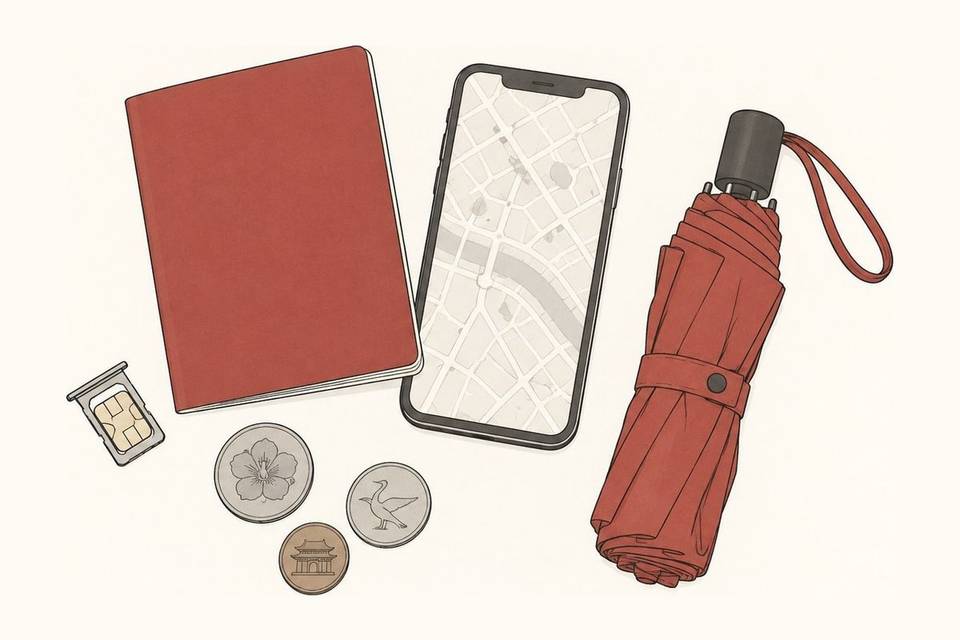
- A compact umbrella that fits a day bag
- A thin rain jacket or poncho for hikes and windy days
- Quick-dry shoes or sandals with grip, plus spare socks; leather and canvas stay wet for days
- Breathable clothes that dry overnight in a hotel room
- A dry bag or zip bags for your phone and passport
- A small power bank: you will use the map, radar and alerts all day
Our Korea packing list covers the rest by season, including what you can skip and buy on arrival.
What can you do on a wet day?
Pick one of these as each day’s anchor, near your outdoor plan. All are on the subway.
Rain-proof anchors in Seoul (official pages, checked 2 Nov 2026)
| Place | Cost | Hours | Good to know |
|---|---|---|---|
| National Museum of Korea (Ichon) | Free permanent halls | 09:30–17:30; Wed and Sat to 21:00 | Galleries close the first Monday of March, June, September and December |
| War Memorial of Korea (Samgakji) | Free | Daytime; last entry 17:00 | Closed Mondays |
| Starfield Library, COEX (Samseong) | Free | 10:30–22:00 daily | Inside the COEX mall, so the whole afternoon stays dry |
| Jjimjilbang (bathhouse) | Varies by venue | Many open late or overnight | Hot baths and saunas; see our jjimjilbang guide |
| Noraebang (karaoke rooms) | From coins per song | Late into the night | See how to do noraebang |
These cover a full wet day each, and the museum’s late Wednesday and Saturday hours make it the best evening backup. Underground shopping arcades, department stores and the big station complexes connect to the subway, so in heavy rain you can move between them with little time outside; our Seoul subway guide explains the transfers.
How do Seoul, Busan and Jeju differ?
Jeju gets the season first and Seoul last, about a week apart, and the south is not simply wetter.
Rainy season by region, KMA 1991–2020 normals (checked 2 Nov 2026)
| Seoul (central region) | Busan (south) | Jeju | |
|---|---|---|---|
| Normal jangma | 25 Jun – 26 Jul | 23 Jun – 24 Jul | 19 Jun – 20 Jul |
| June rain | 129.5 mm | 188.4 mm | 171.2 mm (Jeju City) |
| July rain | 414.4 mm | 326.8 mm | 210.2 mm (Jeju City) |
| August rain | 348.2 mm | 266.5 mm | 272.3 mm (Jeju City) |
| Biggest visitor risk | River parks and streams closing | Coastal wind, beach days lost | Flights, ferries and Hallasan trails |
Seoul gets the most July rain of the three, while Jeju City’s wettest month is August, when typhoons pass. Jeju is also where weather costs you the most: the island is a flight away and much of what you go for (Hallasan, Udo, the coast roads) is outdoors. On a Jeju trip in the rainy season, keep the last day before your flight back free, and read our Jeju without a car guide if you were planning to drive coastal roads in the rain.
Which school holidays land in the rainy season?
Most of our readers travel in school holidays, and several of 2027’s fall right in the rain. The Korean dates below are KMA normals; the holiday dates are from each education department.
2027 school holidays vs Korea's normal rainy season (education departments; KMA 1991–2020 normals; checked 2 Nov 2026)
| Market | 2027 holiday | Overlap with jangma | What to do |
|---|---|---|---|
| Singapore | 29 May – 27 Jun | Only the last week or so | Go in the first three weeks of June for drier weather |
| Australia, Victoria | 26 Jun – 11 Jul | Entirely inside it | Indoor anchor every day; hikes early |
| Australia, NSW | 3 – 19 Jul | Entirely inside it, the wettest weeks | Same; leave Jeju’s coast for a spare day |
| UK (England) | From about 21–27 Jul (set by each school) | The tail end, then hot August | Expect heat more than rain; typhoons possible |
| Philippines | School year ends 8 Apr 2027 | None: the break is April–May | Your break falls before the rain |
Families from Victoria and New South Wales land in the middle of the season, while Singapore’s June holidays mostly miss it. Most US and Canadian summer breaks span July and August, so the same advice applies: rain in July, heat and typhoon risk in August. Korea’s own holiday rush adds to this: the government’s 2026 summer travel period ran from 25 July to 10 August, with about 6.14 million trips a day, so book trains and Jeju flights for late July and early August early.
Entry for a summer 2027 trip: visitors from the US, UK, Canada, Australia and Singapore are exempt from K-ETA only until 31 December 2026 unless Korea extends it. Check the current rule in our K-ETA guide before you book.
Is typhoon season the same as the rainy season?
No. Typhoons are a separate risk that peaks after jangma. KMA’s 1991–2020 averages show 3.4 typhoons a year affecting Korea, with 1.0 in July, 1.2 in August and 0.8 in September. A typhoon brings a day or two of strong wind and heavy rain, cancels flights and ferries, especially on Jeju and in the south, and then clears. In practice: in July plan for rain, in August and September plan for a possible lost travel day, and keep the last day before an international flight free of island trips.
Questions people ask
- Does it rain all day during jangma?
- Rarely for long. The front shifts north and south, so most weeks mix wet spells, short heavy downpours and hot, dry gaps. Around Seoul about 17–18 of the season's 32 days have rain, so plan each day in blocks with one indoor anchor.
- When will the 2027 rainy season start?
- No one knows yet. KMA no longer forecasts the dates in advance; it announces the start once the rain arrives and confirms the dates in early September. Plan with the normals: about 19 June on Jeju, 23 June in the south and 25 June around Seoul.
- Is the Seoul subway safe in heavy rain?
- Yes, in almost all rain it runs normally and is the best way to get around. In extreme floods a few stations can close, as Dongjak on Line 9 did on 8 August 2022. Follow station announcements and avoid underpasses and riverside roads during a heavy-rain warning.
- Can I still climb Hallasan or Seoraksan in the rainy season?
- Sometimes. Each national park closes trails when heavy-rain advisories go out, often within hours. Give a big hike two possible days, check the KNPS closure page that morning, and start early, because afternoons bring the heaviest bursts.
- Will I get Korea's emergency rain texts on a foreign phone?
- We could not confirm that roaming phones receive them, so do not count on it. Install the Emergency Ready App, which sends alerts in English, and check KMA's English warnings page; a local eSIM or SIM makes both more reliable.
Next in your trip
- Korea packing list — what to bring for heat, humidity and daily showers
- eSIM vs SIM vs pocket Wi-Fi — rain radar, closure pages and alerts need data all day
- Korea weather by month — compare the rainy season with every other month
Sources
- 기상청 기상자료개방포털 – 장마 평년값 (1991–2020) (Korean)
- 기상청 보도자료 – 장마 시작 (2026년 7월 3일) (Korean)
- 세계일보 – 2026년 장마 종료와 강수량 (27 Jul 2026) (Korean)
- 기상청 – 특보 발표 기준 (호우주의보·호우경보) (Korean)
- 기상청 보도자료 – 호우 긴급재난문자 (2024년 1월) (Korean)
- 기상청 – 태풍 통계 (1991–2020) (Korean)
- Korea Meteorological Administration – English site
- Ministry of Justice – Emergency Ready App for foreign residents and visitors
- 뉴스서울 – 재난문자 영문 표기 (2024년 2월 28일부터) (Korean)
- 국립공원공단 – 탐방통제정보 (Korean)
- 헤럴드경제 – 제주 강풍·호우 항공기 결항 (9 Apr 2026) (Korean)
- 내 손안에 서울 – 잠수교 차량 통제와 보행교 공사 (Korean)
- 내 손안에 서울 – 한강공원 집중호우 통제 (Korean)
- 뉴시스 – 8월 8일 서울 폭우 지하철 침수 (2022) (Korean)
- National Museum of Korea – Visitor information
- Ministry of Education Singapore – 2027 school terms and holidays
- NSW Department of Education – 2027 school term dates
- Victoria State Government – School term dates
- 머니투데이방송 – 2026 하계휴가 특별교통대책 (일평균 614만 명) (Korean)
- 출입국·외국인정책본부 – 외국인용 안전디딤돌(Emergency Ready App) 안내 (Korean)
- 서울시설공단 – 청계천 재난 대응 (Korean)
- 스타필드 코엑스몰 – 별마당 도서관 (Korean)
Updates
- Published with KMA 1991–2020 rainy-season normals by region, the 2026 season, heavy-rain advisory thresholds, park and river closure rules and 2027 school-holiday overlaps.
About Korea Field Notes
An English guide to the practical side of visiting South Korea. Guides are researched from Korean-language official sources (Korail, T-money, Seoul Metro, the Korea Tourism Organization) and re-checked when rules or prices change. Each guide shows when its facts were last checked and lists its sources. About the site · How we research and update guides · Found something out of date? Tell us.