Hahoe vs Yangdong vs Korean Folk Village: Which to Visit?
Fees, hours, shows and bus routes checked against the Korean Folk Village, Yangdong Village and Hahoe Village Preservation Society websites, KTO listing data and Korean press, with train fares from our October 2026 timetable checks, on 26 Oct 2026.
Pick the Korean Folk Village for an easy half day from Seoul (₩22,000 with a foreign passport in 2026); pick Hahoe or Yangdong for a real UNESCO village where families still live. Yangdong is a ₩4,000, 40-minute bus add-on to Gyeongju; Hahoe needs an Andong night, two hours from Seoul by KTX-Eum (checked 26 Oct 2026).
Best forFirst-timersFamiliesPhotographersSeniors
Your situation → do this
| If you… | Do this |
|---|---|
| You're based in Seoul and have one free day | Korean Folk Village in Yongin: direct bus from Gangnam, Sinnonhyeon or Seoul Station |
| You're already staying in Gyeongju | Yangdong: ₩4,000, about 40 minutes by city bus, half a day |
| You want the most famous real village and a mask-dance show | Hahoe, with a night in Andong; the free show is at 14:00, Tuesday to Sunday |
| You only have time inside Seoul | Namsangol Hanok Village (free) or Bukchon before 17:00 |
Key takeaways
- The Korean Folk Village charges foreigners ₩22,000 with a passport through 2026, against ₩37,000–39,000 for adults.
- Hahoe and Yangdong were listed together by UNESCO on 31 July 2010; people still live in both.
- Yangdong costs ₩4,000 and is open 09:00–18:00 from October to March; tickets stop an hour earlier.
- Hahoe's mask-dance show is free at 14:00, Tuesday to Sunday from March to December.
- KTX-Eum from Cheongnyangni reaches Andong in 1 h 48 min to 2 h 05 min for ₩27,700.
| Korean Folk Village day ticket | Adults ₩37,000 weekdays / ₩39,000 weekends · foreigners ₩22,000 with passport (to end of 2026)Source: Korean Folk Village admission page, 26 Oct 2026 |
|---|---|
| Yangdong Village admission | ₩4,000 adult · ₩2,000 youth · ₩1,500 child · Oct–Mar 09:00–18:00 (tickets to 17:00)Source: Yangdong Village website, 26 Oct 2026 |
| Hahoe mask-dance show | Free, 14:00–15:00 · Tue–Sun Mar–Dec, Sat–Sun Jan–FebSource: Andong Hahoe Village Preservation Society, 2026 schedule |
| Seoul → Andong (for Hahoe) | KTX-Eum from Cheongnyangni, 1 h 48 min–2 h 05 min, ₩27,700Source: Korail timetable, week of 7 Oct 2026 |
| UNESCO listing | Historic Villages of Korea: Hahoe and Yangdong, inscribed 31 Jul 2010Source: UNESCO World Heritage Centre |
| Exchange rate used | US$1 ≈ ₩1,324 (ECB reference rates, 23 Oct 2026)Source: European Central Bank |
This page compares Korea’s two lived-in UNESCO villages, Hahoe and Yangdong, with the Korean Folk Village theme park near Seoul, so you can pick the one that fits your route and your time. More quiet places outside the big cities are in our off-the-beaten-path section.
How do Hahoe, Yangdong and the Korean Folk Village compare?
Three folk villages for a first-time visitor (fees, hours and routes checked 26 Oct 2026)
| What matters | Korean Folk Village (Yongin) | Hahoe (Andong) | Yangdong (Gyeongju) |
|---|---|---|---|
| What it is | Open-air museum and theme park, opened 1974 | Lived-in clan village, about 150 households | Lived-in clan village, about 150 old houses |
| UNESCO | No | Yes (2010) | Yes (2010) |
| Adult entry | ₩37,000–39,000; foreigners ₩22,000 (≈ US$17) | About ₩5,000 (not on an official page) | ₩4,000 (≈ US$3) |
| From Seoul | About 1 h by direct bus | About 2 h by KTX-Eum, then bus or taxi | About 2 h 13 min by KTX, then bus |
| Time needed | Half to full day | Half day, best with a night in Andong | Half day |
| Shows | Several a day (farmers’ music, folk songs) | Free mask dance, 14:00 Tue–Sun | Scheduled guided walks |
| Best for | Families, short trips | First-timers on a longer route | Gyeongju stays, photographers |
In short: the Korean Folk Village is the easy, staged option. Hahoe and Yangdong are real places that need a train ride, so pick the one on the route you’re already taking.
All dollar figures use the ECB reference rate of 23 October 2026: US$1 ≈ ₩1,324.
When should you pick the Korean Folk Village?
- You’re based in Seoul and have one free day. Direct buses run from Sinnonhyeon (5001-1), Gangnam (1560) and Sungnyemun near Seoul Station (4101), per the village’s transport page. That makes it the only one of the three you can do in an afternoon.
- You’re travelling with children. Besides the houses, there are craft workshops, daily shows and an amusement area. The rides open 30 minutes after the gates.
- You want shows on a timetable. On 26 October 2026 the homepage listed a folk-song show at 11:30, 14:30 and 16:30 daily. Farmers’ music (pungmul) played at 11:00 and 16:00 Monday to Thursday, and at 16:00 only from Friday to Sunday and on holidays.
- You hold a foreign passport. The official price page lists ₩22,000 for foreigners who show a passport or alien registration card, valid through 2026. Korean adults pay ₩37,000 on weekdays and ₩39,000 at weekends.
The flaw: nobody lives there, and it feels like what it is, a well-made set. It’s also a K-drama filming location, which is part of its draw.
When should you pick Hahoe?
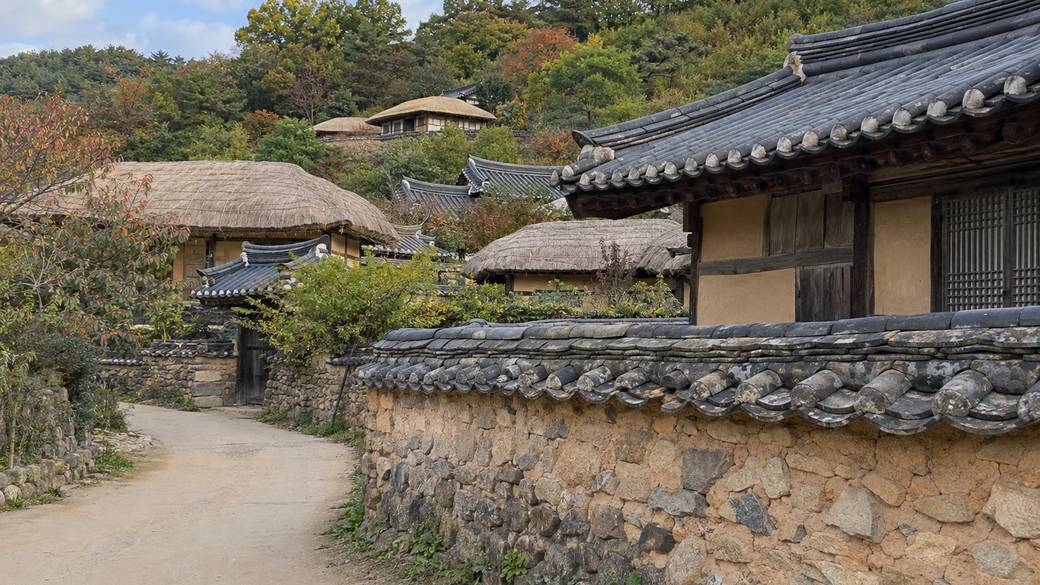
- You want the best-known traditional village in Korea. Hahoe’s preservation society says the village has been lived in for about 600 years and that about 150 households still live there. Thatched and tiled houses sit in a bend of the Nakdong River.
- You’d like to see the mask dance. The Hahoe Byeolsingut Talnori is performed at its own hall by the village, free, 14:00–15:00. In 2026 it runs Tuesday to Sunday from March to December, and on Saturdays and Sundays only in January and February.
- You’re doing a longer loop through Korea. Andong fits between Seoul and Gyeongju. Our 3-week itinerary gives it two nights and adds Byeongsan Seowon, a UNESCO-listed Confucian academy down the river.
The flaw: it’s the hardest to reach of the three. You’ll need the KTX-Eum, then a bus or taxi, and the day is short without a night in Andong.
When should you pick Yangdong?
- You’re staying in Gyeongju anyway. From Gyeongju’s intercity bus terminal, city buses 200, 202–208 and 212 run about every 15 minutes, per the village website. They take about 40 minutes to the Yangdong Village entrance stop.
- You’d rather have fewer tour coaches. Newsis reported in July 2026 that Yangdong gets about 187,000 visitors a year, around 10% of them foreigners. The village describes itself as Korea’s largest Joseon-era yangban (aristocratic) village, with about 150 old houses spread over hillsides.
- You like walking and photographing. The lanes climb between houses, so you get views over the roofs that flat Hahoe doesn’t give. Guided walks (no booking needed) start at 10:00, 11:00, 13:00, 14:00, 15:00 and 16:00, per KTO listing data.
The flaw: it’s hilly and spread out, which is harder for older travellers and pushchairs, and there’s no regular show.
What does a day at each cost?
These examples are for one adult, travelling at mid-range comfort. They cover entry and the main transport only, not food or hotels.
Entry plus main transport for one adult (fares and fees checked 26 Oct 2026; US$1 ≈ ₩1,324)
| Trip | Main transport | Entry | Total |
|---|---|---|---|
| Korean Folk Village from Seoul | Direct bus each way (fare varies by route) | ₩22,000 with foreign passport | ≈ ₩22,000 + 2 bus fares (≈ US$17 + bus) |
| Yangdong from a Gyeongju hotel | City bus ₩1,500 × 2 = ₩3,000 | ₩4,000 | ₩7,000 (≈ US$5) |
| Hahoe from Seoul, with a night in Andong | KTX-Eum ₩27,700 × 2 = ₩55,400, plus local bus or taxi | About ₩5,000 | ≈ ₩60,400 + local transport (≈ US$46) |
| Yangdong from Seoul on a Gyeongju trip | KTX ₩44,000–44,600 × 2, plus city bus | ₩4,000 | ≈ ₩95,000 (≈ US$72) |
The real villages are cheap to enter; what you’re paying for is the train. If Gyeongju or Andong is already on your route, either village costs less than the Korean Folk Village.
Gyeongju’s ₩1,500 city-bus fare applies to all routes since July 2025, as our where to stay in Gyeongju guide explains. The KTX fares come from the October 2026 timetable checks in our day-trip and itinerary guides.
Hahoe in detail
Getting there. KTX-Eum trains leave Seoul’s Cheongnyangni Station, not Seoul Station. In the week of 7 October 2026 there were nine a day, taking 1 h 48 min to 2 h 05 min for ₩27,700. Andong Station is on the edge of town, and Hahoe is further out to the west. City buses run from the station area, but listings give different route numbers, so check the current one on Naver Map. A taxi is the simplest option for a group of two to four.
Tickets. Visitor guides say you buy the ticket at the office by the car park, then ride a shuttle bus to the village entrance, and they list adults at ₩5,000. We couldn’t confirm the fee or the closing times on an official page, so arrive by mid-afternoon in winter.
What to see. Walk the lanes between the clan houses, then the pine grove along the river. Visitor guides describe a small boat that crosses to Buyongdae cliff when the river allows. The cliff gives the classic view down onto the whole village. Byeongsan Seowon, a Confucian academy also on UNESCO’s list, is a short taxi ride away.
Late September brings the Andong Mask Dance Festival, which in 2026 ran from 24 September to 4 October. It fills Andong’s hotels, so book early if your dates overlap the 2027 edition.
Yangdong in detail
Getting there. From Gyeongju Station, take a taxi or a bus into the centre. Then take bus 200, 202–208 or 212 from the intercity terminal to the Yangdong entrance and walk 1.2 km. Alternatively, ride bus 203 the whole way from Gyeongju Station. The village site lists 203’s first departure at 06:20 and its last at 20:15. Yangdong is also close to Pohang; the village site puts it 15 minutes from Pohang’s intercity terminal by car.
Tickets and hours. Adults pay ₩4,000, youths ₩2,000 and children ₩1,500 (village website, 26 Oct 2026). From October to March the village is open 09:00–18:00, with tickets sold until 17:00. From April to September it’s open 09:00–19:00, with tickets sold until 18:00. It’s open every day.
Rules. Bicycles and pets aren’t allowed. You may enter a house only with the owner’s permission, and the listed heritage houses open only their outer areas. Allow two to three hours for the lanes.
Combine it with the rest of Gyeongju: Bulguksa, the tomb park and Donggung Palace are covered in is Gyeongju worth a day trip. A Gyeongju night makes Yangdong an easy morning.
Korean Folk Village in detail
Getting there. Besides the three direct buses from Seoul, airport bus A8877 runs from Incheon Airport. From Suwon Station exit 4, buses 37 and 10-5 go to the village. From Sanggal Station on the Suin–Bundang Line, take the same buses from exit 3. That means you can pair the village with a Suwon Hwaseong Fortress day; see our day trips from Seoul guide.
Tickets. Bring your passport for the ₩22,000 foreigner rate. Otherwise, a day ticket costs ₩37,000 for adults and ₩30,000 for children on weekdays, and ₩39,000 and ₩32,000 at weekends. Children under 36 months enter free with proof of age. Weekend afternoon tickets are cheaper (from 14:00 or 16:00, depending on the season). You can’t re-enter after leaving.
Hours. On 26 October 2026 it was open 10:00–19:00; hours change by day and season, so check the homepage before you go. Its horror attractions run until 15 November and are for ages 13 and up.
What about Namsangol, Bukchon, Oeam and Nagan?
- Namsangol Hanok Village (Seoul): a cluster of restored Joseon-era houses and a garden near Chungmuro Station. It’s free and fine for an hour, but it’s a small display, not a village.
- Bukchon (Seoul): a real residential hanok area, but part of it is a red zone. Tourists may visit only from 10:00 to 17:00, and outside those hours you can be fined ₩100,000. Our hanok stay guide covers the rules.
- Oeam Village (Asan) and Naganeupseong (Suncheon): smaller lived-in villages, with listed entry fees of ₩2,000 and ₩4,000. They’re worth a stop if you’re already in Asan or Suncheon, but they’re not worth a separate trip on a first visit.
Bottom line
From Seoul with one spare day, go to the Korean Folk Village and bring your passport. If your trip already passes through Gyeongju or Andong, Yangdong or Hahoe gives you the real thing for ₩4,000–5,000, and they’re more memorable.
When this is wrong: the foreigner rate is listed only until the end of 2026. If it lapses, the theme park costs nearly ten times as much as Yangdong, and the real villages look even better value.
Questions people ask
- Is the Korean Folk Village a real village?
- No. It's an open-air museum and theme park in Yongin that opened in 1974, with about 270 traditional buildings, craft workshops, shows and an amusement area. Nobody lives there. Hahoe and Yangdong are the real thing: centuries-old clan villages where families still live.
- Can I visit Hahoe as a day trip from Seoul?
- Yes, but it's long. The KTX-Eum from Cheongnyangni to Andong takes about two hours each way, then you need a bus or taxi out to the village. That leaves around four hours there. A night in Andong lets you catch the 14:00 mask-dance show without rushing.
- Which is better, Hahoe or Yangdong?
- Hahoe is more famous, sits in a river bend with a cliff viewpoint and has the free mask-dance show. Yangdong is bigger, hillier and quieter, and it's an easy add-on to Gyeongju. Choose by route: Andong for Hahoe, Gyeongju for Yangdong.
- Can I go inside the houses at Hahoe and Yangdong?
- Mostly not. These are private homes. Yangdong's rules say you may enter a house only with the owner's permission, and the listed houses open only their outer areas. Walk the lanes quietly, don't photograph people without asking, and keep out of courtyards with closed gates.
- Is there a foreigner discount at the Korean Folk Village?
- Yes. The official price page lists ₩22,000 for foreigners who show a passport or alien registration card, valid through 2026. Adults otherwise pay ₩37,000 on weekdays and ₩39,000 at weekends, so bring your passport.
- Can I stay overnight in a folk village?
- Yes, in Hahoe and Yangdong, both of which have family-run minbak guesthouses inside the village. Rooms are usually traditional, with floor bedding on heated floors. The Korean Folk Village has no overnight rooms.
Next in your trip
- Where to stay in Gyeongju — the base that makes Yangdong a half-day add-on
- 3-week Korea itinerary — two Andong nights with Hahoe, then on to Gyeongju
- How to book KTX tickets — book the Andong or Gyeongju train from abroad
Sources
- 한국민속촌 – 이용 요금 (day, afternoon and foreigner prices) (Korean)
- 한국민속촌 – 교통 정보 (direct buses and subway transfers) (Korean)
- 한국민속촌 – 소개 (founded 1974, about 270 buildings) (Korean)
- 한국민속촌 – 운영 정보 and daily performances (homepage, 26 Oct 2026) (Korean)
- 경주 양동마을 – 관람안내 (fees, hours, visitor rules) (Korean)
- 경주 양동마을 – 찾아오시는길 (buses 200, 202–208, 212 and 203) (Korean)
- 경주 양동마을 – 일반현황 (about 150 old houses) (Korean)
- 안동하회마을보존회 – 2026년도 하회별신굿탈놀이 공연 일정 (Korean)
- 안동하회마을보존회 – 관광도우미 (about 150 households live in the village) (Korean)
- 뉴시스 – '박제되지 않은 유산'… 경주 양동마을·옥산서원 (18 Jul 2026) (Korean)
- 헤럴드경제 – 안동 '2026 하회선유줄불놀이' 5월 개막, 10회 시연 (12 Apr 2026) (Korean)
- UNESCO World Heritage Centre – Historic Villages of Korea: Hahoe and Yangdong
- Korea tourism data (ktriptips) – Asan Oeam Village and Suncheon Naganeupseong listings (Korean)
- European Central Bank – Euro foreign exchange reference rates (23 Oct 2026)
Updates
- Published with the Korean Folk Village's 2026 prices and foreigner rate, Yangdong's fees, hours and buses, Hahoe's 2026 mask-dance schedule and ECB rates of 23 Oct 2026.
About Korea Field Notes
An English guide to the practical side of visiting South Korea. Guides are researched from Korean-language official sources (Korail, T-money, Seoul Metro, the Korea Tourism Organization) and re-checked when rules or prices change. Each guide shows when its facts were last checked and lists its sources. About the site · How we research and update guides · Found something out of date? Tell us.