Best Temples in Korea Beyond Seoul: Which Fits Your Route
Fees, hours and buses checked on 7 Nov 2026 against the government policy briefing on the 2023 fee waiver, Seokguram, Bulguksa and Haedong Yonggungsa, Visit Korea, Gongju and Yeongju city pages and UNESCO; bus times marked third-party come from timetable listings.
Visit the temple already on your route: Bulguksa and Seokguram on a Gyeongju day, Haedong Yonggungsa or Beomeosa in Busan, and Haeinsa only with a spare day from Daegu. All five are free, because state-listed temples dropped heritage fees on 4 May 2023 and Yonggungsa doesn't charge; parking costs about ₩2,000–₩4,000 a car (checked 7 Nov 2026).
Best forFirst-timersPhotographersBudget
Your situation → do this
| If you… | Do this |
|---|---|
| Gyeongju is already on your trip | Bulguksa, then bus 12 up to Seokguram; allow half a day and finish by Seokguram's 17:00 winter last entry |
| You're only going to Busan | Haedong Yonggungsa for the sea view, or Beomeosa by metro and bus 90 for a quieter mountain temple |
| You have one spare day from Daegu or Busan | Haeinsa, for the 15th-century halls that store the Tripitaka Koreana woodblocks |
| You want to sleep at a temple, not just visit | Book a temple stay on templestay.com; Seoul overnights are cheaper than mountain temples |
| You're travelling in May | Time it for Buddha's Birthday, Thu 13 May 2027, when temples hang lanterns and open to everyone |
Key takeaways
- Bulguksa, Seokguram, Haeinsa, Tongdosa and Beomeosa have been free to enter since 4 May 2023; parking is still charged.
- Seokguram's last entry is 17:00 from November to January, so do Gyeongju's temple half before lunch.
- Haedong Yonggungsa opens 04:30–20:30 daily; bus 181 from Haeundae Station runs about every 20 minutes.
- Haeinsa's woodblock halls are UNESCO-listed (1995); allow about 1 h 20 min each way by bus from Daegu.
- Seven mountain temples, among them Tongdosa, Magoksa and Buseoksa, share a 2018 UNESCO listing; most need a slow bus or car.
| Entry fees | Free at 65 state-listed temples since 4 May 2023, including Bulguksa, Seokguram, Haeinsa, Tongdosa, Beomeosa, Songgwangsa and WoljeongsaSource: Korea.kr policy briefing |
|---|---|
| Seokguram last entry | Nov–Jan 17:00 · Feb and Oct 17:30 · Mar–Sep 18:00; may close in weather warningsSource: Seokguram |
| Haedong Yonggungsa | Free, 04:30–20:30 every day; bus 181 from Haeundae StationSource: Haedong Yonggungsa |
| UNESCO temples | Seokguram and Bulguksa (1995) · Haeinsa Janggyeong Panjeon (1995) · seven Sansa mountain monasteries (2018)Source: UNESCO World Heritage List |
| Buddha's Birthday 2027 | Thursday 13 May 2027 (public holiday) |
The best temple to add is the one that costs you the least travel, so this page sorts Korea’s famous temples by the city you’re already visiting. It’s part of our culture and etiquette section.
Which temple fits your route?
Most first trips run Seoul, then Gyeongju and Busan by KTX. On that line you can see Korea’s best-known temples with a city bus, and the famous mountain temples cost a full extra day each.
Temples on the Seoul to Gyeongju to Busan route, entry and access, checked 7 Nov 2026
| Temple | Base | Getting there | Time to allow | Pick it for |
|---|---|---|---|---|
| Bulguksa | Gyeongju | Bus 700 from Gyeongju Station, or 10/11 from town | 1.5–2 h | The classic stone stairs and pagodas |
| Seokguram | Gyeongju | Bus 12 from Bulguksa, then a 10-min walk | 1 h | The 8th-century granite Buddha |
| Haedong Yonggungsa | Busan (Haeundae) | Bus 181 from Haeundae Station | 1–1.5 h | A temple on sea rocks |
| Beomeosa | Busan (north) | Metro Line 1 to Beomeosa, then bus 90 | 1.5–2 h | A forest temple in the hills of the city |
| Tongdosa | Busan or Ulsan | Intercity bus to Tongdosa Sinpyeong, about 24 min from Busan | Half day | One of the three “jewel” temples, UNESCO 2018 |
If you only have time for one, choose Bulguksa on a Gyeongju day; in Busan alone, choose Yonggungsa for the view or Beomeosa for the atmosphere.
When this advice is wrong: if you’re driving or hiring a driver, the inland temples below stop being a whole-day commitment, and Haeinsa or Songgwangsa become better picks than a second Busan temple.
Are Bulguksa and Seokguram worth the bus ride?
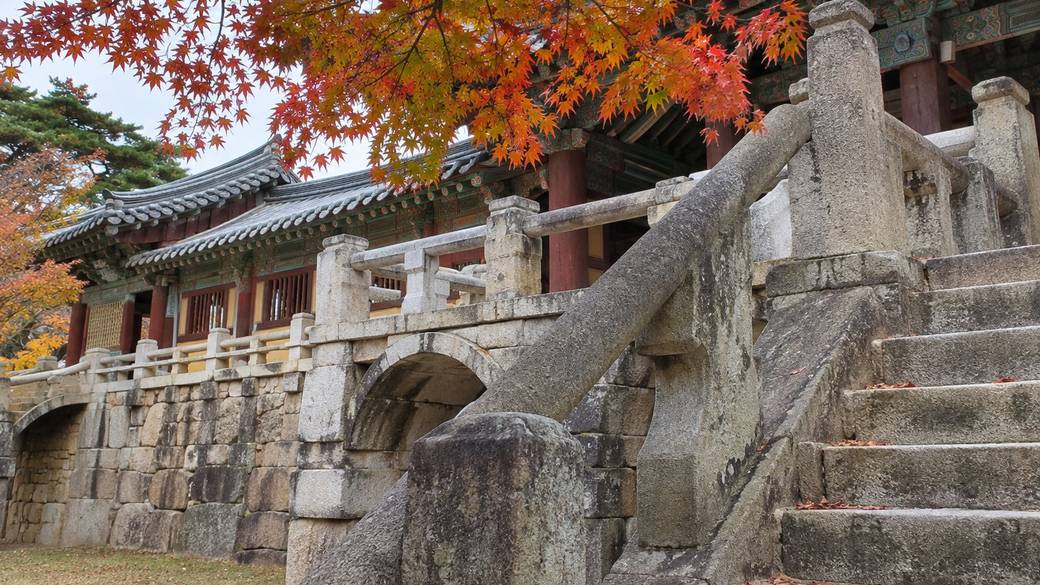
Yes, and they’re the reason most people put Gyeongju on the itinerary. UNESCO listed the two together in 1995. Bulguksa sits at the foot of Tohamsan with its stone terraces and two pagodas; Seokguram is the granite Buddha in an artificial grotto higher up the hill, seen from behind glass.
Both are free. The Seokguram site says entry has been free since 4 May 2023 and lists last entry by season: 17:00 from November to January, 17:30 in February and October, 18:00 from March to September. It also warns that the grotto may close during weather warnings.
- Ride to Bulguksa. Bus 700 runs direct from Gyeongju Station only a few times a day, so check the board first; otherwise take a bus to town and change to bus 10 or 11.
- See Bulguksa first, while the morning light is on the stone stairs. Allow 1.5–2 hours.
- Take bus 12 up to Seokguram. Board at the 불국사 or 불국사매표소 stop and ride to 석굴암주차장. Our Gyeongju page found it runs 08:40–16:40, every 60–80 minutes.
- Walk about 10 minutes from the car park to the grotto, then ride bus 12 back down.
In winter, board bus 12 by about 15:40, or you risk reaching the gate after the 17:00 last entry. The full day, including the tomb park downtown as an alternative, is in our Gyeongju 1-day itinerary, and is Gyeongju worth a day trip from Busan covers the KTX side.
Golgulsa, east of Gyeongju, is the temple known for Sunmudo, the Korean Buddhist martial art. We couldn’t confirm its performance schedule (one 2026 news report says weekend afternoons, another listing says daily) or a bus route, so treat it as a taxi or car trip and call the temple first.
Which temples can you see from Busan?
Three, and they suit different trips. Busan’s own two are in the city; the third, Tongdosa, is a short intercity bus ride north.
Haedong Yonggungsa is the one in every Busan photo: halls on the rocks above the sea at Gijang. The temple lists free entry and opening hours of 04:30–20:30 every day. From Haeundae Station take bus 181, which the temple says runs about every 20 minutes, then walk down from the stop. There are many steps on the way down to the halls and back up again, and the path gets busy at weekends. Our Busan 1-day itinerary pairs it with the beach train and Haeundae. If you’re staying around Seomyeon or visiting in May, read our Haedong Yonggungsa vs Samgwangsa comparison first: Samgwangsa is a village bus ride from Seomyeon and lights its lantern tunnels around Buddha’s Birthday.
Beomeosa is the opposite: a large mountain temple on Geumjeongsan in the north of the city. Take metro Line 1 to Beomeosa Station, walk to the bus stop by exit 5 or 7, and ride bus 90 to the temple entrance; travel guides put the bus at 10–30 minutes. Entry is free under the 2023 waiver. We couldn’t confirm its 2026 opening hours from the temple, so go in daylight.
Tongdosa, in Yangsan, is one of the seven monasteries in the 2018 UNESCO “Sansa” listing and one of Korea’s three “jewel” temples, with Haeinsa and Songgwangsa. A third-party timetable lists 24 buses a day from Busan Central Bus Terminal (Nopo, at the end of metro Line 1) to Tongdosa Sinpyeong, each about 24 minutes, adult ₩2,800, then a walk to the gate. Entry is free; its published hours differ between sources, so check before you go.
Is Haeinsa worth a whole day?
Only if the Tripitaka Koreana is a reason you came. Haeinsa on Gayasan, in Hapcheon county west of Daegu, keeps more than 80,000 13th-century woodblocks of the Buddhist canon in the Janggyeong Panjeon halls, which UNESCO listed in 1995. You view the halls from outside; it’s the building and the idea, not a museum display.
Getting there is the cost. A third-party timetable lists 14 buses a day from Haeinsa back to Daegu’s Seobu bus terminal, 06:40–19:20, about 1 h 18 min each, ₩9,700. We couldn’t verify the outbound times from Daegu, so check at the terminal. Entry is free since 2023 according to Korea Tourism Organization data; parking is ₩4,000 for a car.
Hours differ between listings: one gives 09:00–17:30 all year, an older one 08:30–18:00 in summer and 08:30–17:00 in winter. Arrive by mid-morning and you’ll be fine either way.
Which mountain temples are worth a detour?
These need a slow bus, a hire car or a night nearby. Each is free to enter, but none fits a Seoul-to-Busan KTX trip without a dedicated day.
Mountain temples worth a detour, access and fees, checked 7 Nov 2026
| Temple | Nearest town | How to get there | Fee and parking | Why go |
|---|---|---|---|---|
| Songgwangsa | Suncheon | Suncheon city bus, about 1 h (2026 timetable not confirmed) | Free | One of the three “jewel” temples; Nov–Mar 09:00–17:00 |
| Seonamsa | Suncheon | Suncheon city bus, then about 1 km on foot | Free, free parking | Stone bridge and old trees; 08:00–17:00 |
| Woljeongsa | Pyeongchang | Jinbu (Odaesan) KTX, then local bus or taxi | Free; parking ₩3,000 a car | Fir-tree path, on the Gangneung KTX line |
| Guinsa | Danyang | Bus from Danyang terminal, about 45 min | Free; paid parking | Multi-storey halls in a valley, open 24 h |
| Naesosa | Buan | Bus 330 from Buan terminal | Free; parking from ₩1,100 for the first hour | Fir avenue; winter 07:00–18:00 |
| Magoksa | Gongju | Bus 770 from Gongju terminal, about 40 min | Free, free parking | UNESCO 2018 Sansa temple by a stream |
| Buseoksa | Yeongju | City bus 27 or 55 from Yeongju | Free | UNESCO 2018; 10 and 11 buses a day |
Pick from this table by the route you already have: Woljeongsa if you’re riding the KTX to Gangneung, Magoksa if you go via Gongju, the Suncheon pair if the south coast is on your plan.
Songgwangsa and Seonamsa sit on opposite sides of Jogyesan and are both free since the 2023 waiver. Their winter hours come from Korea Tourism Organization data updated in November 2026. The bus details we found are from a blog several years old, so ask at Suncheon station.
Woljeongsa’s temple grounds are open at all times; the on-site museum is closed on Mondays. We found no 2026 timetable for the bus from Jinbu Station, so plan a taxi as the fallback.
Guinsa, head temple of the Cheontae order, is the odd one out: large multi-storey halls lining a narrow valley, open around the clock, with an uphill walk from the gate.
Buseoksa’s buses come from Yeongju city’s own page, which lists route 27 with 10 daily departures (06:10–19:20) and route 55 with 11 (06:20–18:50). Magoksa’s bus 770 and its free parking are on the Gongju city page.
Do Korean temples charge entry fees?
Not the big ones any more. On 4 May 2023 a change to the heritage law ended the viewing fees that temples in national and provincial parks had charged for about 60 years. The government’s policy briefing says 65 temples dropped the fee, and names Haeinsa, Tongdosa, Bulguksa, Seokguram, Songgwangsa, Beomeosa and Woljeongsa among them. The old ticket booths became information desks.
What a temple visit costs in 2026, checked 7 Nov 2026
| Item | Cost | Notes |
|---|---|---|
| Entry | Free | At the 65 waived temples; Yonggungsa and Guinsa are free too |
| Parking, car | ₩2,000–₩4,000 | Seokguram ₩2,000, Haeinsa ₩4,000, Woljeongsa ₩3,000 |
| Bus | ₩1,500–₩2,800 | Gyeongju ₩1,500 cash, Busan ₩1,550 card, Busan to Tongdosa ₩2,800 |
| Temple stay overnight | ₩70,000–₩130,000 | Per adult, booked on templestay.com |
On a bus-and-walk day the only real cost is transport, so a temple is one of the cheaper half-days on a Korea trip.
A handful of temples whose heritage is designated by a city or province rather than the state still charge, according to Korean press reports, but none of the temples on this page are among them. Parking fees, temple museums and experience programs are separate. If you want to stay the night, see how to book a temple stay, which compares overnight prices by temple.
How should you behave at a temple?
Temples are working monasteries, and visitors are welcome in the courtyards. Common guidance for visitors, also given in English temple guides:
Temple manners
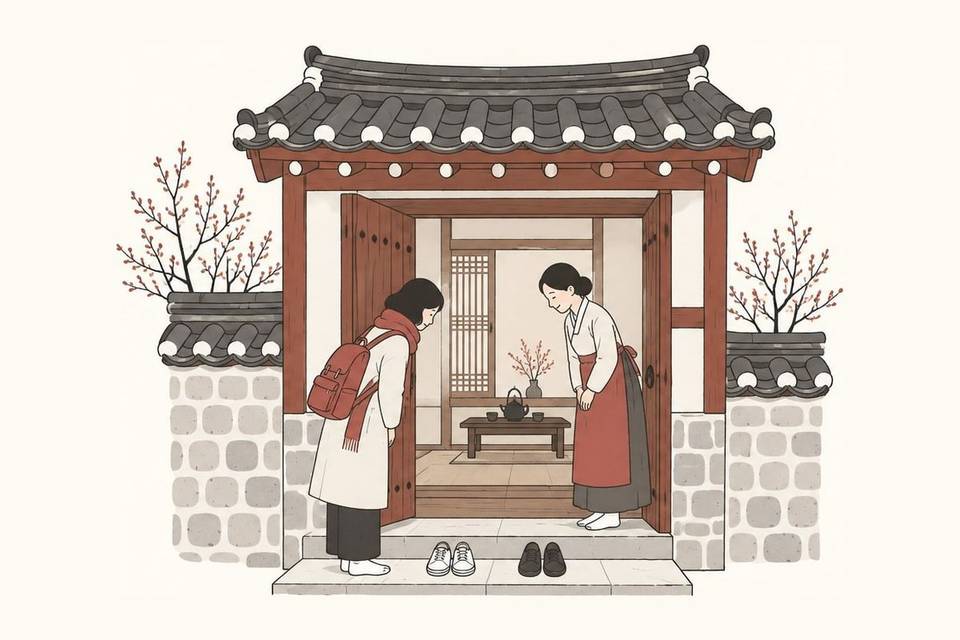
- Take your shoes off before stepping into a hall, and leave them neatly outside.
- Use the side doors of the main hall; the centre door is for the monks.
- Keep your voice down, and don’t walk in front of people bowing to the altar.
- Ask before photographing monks or the inside of a hall.
We found no published dress code for day visitors, but modest clothing is the safe choice. Temple meals and temple-stay food are vegetarian, with no meat, eggs, garlic or onion, which helps vegetarian travellers from India, Singapore or Malaysia; see our vegetarian food guide for the rest of the trip.
When is the best time to visit?
Two windows stand out. Late October to mid-November brings maple colour to the mountain temples (see our autumn foliage guide for this year’s timing), and Buddha’s Birthday, on Thursday 13 May 2027, fills every temple with paper lanterns. The Korea festivals calendar lists the Lotus Lantern parade in Seoul the weekend before.
For school-holiday travellers: Australia’s summer holidays fall in Korea’s cold season, when Seokguram closes earliest (17:00 last entry) and coastal Yonggungsa is windy, so go in the morning. Visitors from Singapore, Malaysia and the Philippines should pack a warm layer for mountain temples from November.
What do first-timers get wrong?
If you’re planning the trip between cities, our comparison of KTX and intercity buses helps with the Daegu and Suncheon legs.
Questions people ask
- Do you have to pay to enter temples in Korea?
- Mostly not. Since 4 May 2023 the state pays the heritage viewing fee at 65 temples, including Bulguksa, Seokguram, Haeinsa and Tongdosa, so entry is free. Parking is often still charged, and temple stays, museums and special programs cost extra.
- What is the most famous temple in Korea?
- Bulguksa in Gyeongju, listed by UNESCO in 1995 together with the Seokguram grotto on the hill above it. Haeinsa, which stores the Tripitaka Koreana woodblocks, is the other big name. Both are free to enter.
- Is Haedong Yonggungsa worth it?
- Yes if you want a temple on the sea and you're staying near Haeundae, since bus 181 gets you there. Expect crowds and a lot of steps. If you want a quiet mountain temple, Beomeosa is the better Busan pick.
- Can you visit a Korean temple without booking a temple stay?
- Yes. The temples on this page are open to walk-in visitors during their opening hours, with no booking. You only book for an overnight or a scheduled day program, through templestay.com.
- What should you not do at a Korean temple?
- Don't walk through the centre door of a hall, keep your shoes outside, and keep your voice down. Don't walk in front of people who are bowing, and ask before photographing monks or the inside of a hall.
Next in your trip
- How to book a temple stay — Overnight and day programs, prices and refund rules
- Gyeongju 1-day itinerary — Bulguksa and Seokguram by bus, with the bus 12 timing
- Busan 1-day itinerary — Yonggungsa, the beach train and Haeundae in one day
Sources
- 대한민국 정책브리핑 – 전국 65개 사찰, 이젠 무료로 들어갈 수 있습니다 (May 2023) (Korean)
- 석굴암 – 관람료·관람시간 (free since 4 May 2023, seasonal hours) (Korean)
- 불국사 – 관람 안내 (hours, free entry, buses) (Korean)
- 해동용궁사 – 참배안내 (hours, admission) (Korean)
- 해동용궁사 – 주요교통안내 (bus 181, metro, taxi) (Korean)
- UNESCO – Seokguram Grotto and Bulguksa Temple
- UNESCO – Haeinsa Temple Janggyeong Panjeon, the Depositories for the Tripitaka Koreana Woodblocks
- UNESCO – Sansa, Buddhist Mountain Monasteries in Korea
- Korea Trip Tips (KTO data) – 해인사: 무료 입장, 주차요금 (updated Jul 2026) (Korean)
- Korea Trip Tips (KTO data) – 송광사: 관람시간, 무료 (updated Nov 2026) (Korean)
- Korea Trip Tips (KTO data) – 월정사: 무료, 주차요금 (updated Jun 2026) (Korean)
- Visit Korea – Guinsa Temple (free, open 24 hours)
- Visit Korea – Naesosa Temple (hours, parking)
- Visit Korea – Buseoksa Temple
- 공주시 – 마곡사 (bus 770, parking) (Korean)
- 영주시 – 부석사 방면 시내버스 (routes 27 and 55) (Korean)
- 전국 시외버스 운행정보 – 해인사 → 대구 서부정류장 (third-party timetable listing, times only) (Korean)
- 전국 시외버스 운행정보 – 부산종합버스터미널 → 통도사신평 (third-party timetable listing, times only) (Korean)
- 아시아경제 – 불국사 대웅전 E등급, 해체 보수 (23 Feb 2026) (Korean)
Updates
- Published with fees, hours and bus links checked on 7 Nov 2026.
About Korea Field Notes
An English guide to the practical side of visiting South Korea. Guides are researched from Korean-language official sources (Korail, T-money, Seoul Metro, the Korea Tourism Organization) and re-checked when rules or prices change. Each guide shows when its facts were last checked and lists its sources. About the site · How we research and update guides · Found something out of date? Tell us.