Korea Autumn Foliage 2026: Peak Dates & Best Spots
This guide contains affiliate links. If you book through them we may earn a commission at no extra cost to you. How this works.
Korea's 2026 autumn colour peaks between mid-October in the northern mountains and mid-November in the far south. The Korea Forest Service's 22 September forecast puts the peak at Seoraksan on 20 October, Songnisan on 28 October, Naejangsan on 4 November and Hallasan on 6 November, with ginkgo trees peaking on 30 October on average. Seoraksan's first colour was officially observed on 28 September, exactly on its normal date.
Key takeaways
- Forest Service 2026 peaks: Seoraksan 20 Oct, Songnisan 28 Oct, Naejangsan 4 Nov, Hallasan 6 Nov (peak = 50% of leaves turned).
- The weather agency counts peak at 80% turned, so its dates run later: Seoraksan's normal KMA peak is 17 Oct; in 2025 it came on 24 Oct.
- Seoul's ginkgo streets usually peak from late October to mid-November; the national ginkgo average for 2026 is 30 Oct.
- Booking needed: Seoraksan's Heullimgol trail (5,000 a day, 1 Oct–30 Nov) and Naejangsan's Seoraebong trail (520 a day).
- Seoraksan cable car: ₩16,000 adult return, sold on the day at the station only, no advance booking.
| Seoraksan peak, 2026 | 20 Oct (Forest Service forecast); first colour observed 28 Sep (KMA)Source: Korea Forest Service; Korea Meteorological Administration |
|---|---|
| Naejangsan peak, 2026 | 4 Nov (Forest Service forecast)Source: Korea Forest Service |
| Hallasan (Jeju) peak, 2026 | 6 Nov (Forest Service forecast)Source: Korea Forest Service |
| Ginkgo / maple / oak, national average | 30 Oct / 31 Oct / 31 OctSource: Korea Forest Service |
| Live status of 21 famous mountains | KMA Weather Nuri, 21 Sep–27 Nov 2026Source: Korea Meteorological Administration |
| Seoraksan cable car | ₩16,000 adult return; on-site same-day tickets onlySource: Seorak Cable Car |
Korea’s autumn foliage peaks in 2026 between about 20 October in the northern mountains and mid-November on Jeju and the south coast. The Korea Forest Service’s forecast map, published on 22 September, gives Seoraksan 20 October, Songnisan 28 October, Naejangsan 4 November and Hallasan 6 November. Seoul’s ginkgo-lined streets usually fall in between.
That is the short answer. The rest of this guide explains why the published dates disagree by up to a week, where to check the real colour before you travel, and the practical details at the three places most visitors aim for: Seoul, Seoraksan and Naejangsan. Every date and price below was checked on 5 October 2026.
2026 peak dates by mountain
The most useful official forecast is the Korea Forest Service’s 2026 Korean Peninsula Foliage Peak Prediction Map (2026년 한반도 단풍절정 예측지도). It combines plant observations from public arboretums since 2009 with the National Institute of Forest Science’s mountain weather network. The Forest Service says this year’s peak is about 0.8 days later than the average of the last five years, so 2026 is a fairly normal year.
Forest Service peak forecast, whole mountain (published 22 Sep 2026, checked 5 Oct 2026)
| Mountain | Region | Forecast peak | Notes |
|---|---|---|---|
| Seoraksan | Gangwon, east coast | 20 Oct | First colour observed 28 Sep |
| Songnisan | Chungbuk, centre | 28 Oct | Ginkgo there peaks 23 Oct |
| Naejangsan | Jeonbuk, south-west | 4 Nov | Most famous maple valley in the south |
| Hallasan | Jeju | 6 Nov | Latest of the big four |
The colour arrives at different times for different trees, and the Forest Service publishes those too. Oaks turn the hillsides brown-gold, maples give the red, and ginkgo gives the bright yellow you see on city streets.
Forest Service peak forecast by tree type (published 22 Sep 2026)
| Tree | National average peak | Earliest site | Latest sites listed |
|---|---|---|---|
| Ginkgo | 30 Oct | Geumwonsan, 16 Oct | Wando Arboretum 12 Nov, Halla Arboretum (Jeju) 16 Nov |
| Maple | 31 Oct | — | — |
| Oak | 31 Oct | Sobaeksan, 16 Oct | Geumgang Arboretum 3 Nov |
The gaps inside one mountain matter. At Seoraksan the whole-mountain peak is 20 October, but its oaks peak on 25 October. At Naejangsan the oaks are forecast for 26 October, more than a week before the maples that make the valley famous. If you are going for red maples rather than general colour, lean towards the later date.
Why the forecasts disagree
Search “Korea foliage 2026” and you will find dates that differ by several days for the same mountain. Nobody is wrong; they are counting different things.
- Korea Forest Service: peak = the day 50% of leaves have changed colour. This is the map above.
- Korea Meteorological Administration (KMA): first colour = about 20% of the mountain turned, counting down from the summit; peak = about 80% of the whole mountain turned. KMA observes rather than forecasts: it announces the dates when they happen.
- Kweather (a private forecaster): uses the same 20% / 80% definitions as KMA, and does publish a forecast.
Because 80% takes longer to reach than 50%, KMA-style peaks fall later. Seoraksan shows the gap clearly. KMA’s normal peak there is 17 October, and in 2025 it came on 24 October. Kweather’s 11 September outlook put the 2026 peak in the central region between 19 October and 1 November and in the south between 1 and 11 November, about two weeks after first colour in each place.
The first colour has already arrived. The Forest Service recorded this year’s very first turning leaves on 14 September in the Jeombongsan forest reserve in Inje, Gangwon, from a citizen observer. KMA’s official first colour on Seoraksan came on 28 September 2026, exactly on the normal date and four days earlier than in 2025 (2 October). Kweather had forecast 30 September.
Temperature drives all of this. Kweather notes that leaves start to turn once daily minimum temperatures fall below about 5°C, and that in 2021–2025 September and October averaged 2.3°C and 1.4°C warmer than in the 1990s. That is why peaks have been creeping later, and why a warm spell can push this year’s dates back by a few days.
Check the real colour before you go
Two free official tools show what the mountains actually look like right now. Both are in Korean, but they are mostly photos and maps.
- KMA Weather Nuri, famous-mountain foliage status (유명산 단풍현황): on weather.go.kr go to 현재날씨 (current weather) → 봄꽃·단풍 (spring flowers and foliage) → 유명산 단풍현황. It covers 21 major mountains from 21 September to 27 November 2026, with photos taken before the colour, at first colour and at peak, pinned on a map.
- Gangwon foliage and weather service (강원 단풍·기상 융합서비스) at kma.go.kr/gangwon/maple: live status and weather on the trails of Seoraksan, Odaesan, Chiaksan and Taebaeksan, including live video of the main peaks.
- Check the trail and the transport the night before: booking-only trails close online at 14:00 the day before (see below), and cable-car hours are posted daily.
Seoul: ginkgo streets, palaces and parks
You don’t need to leave the city for autumn colour. Ginkgo is the most common street tree in Seoul (34.7% of them, according to the city), and it turns a clean yellow. The Seoul Metropolitan Government publishes a list of foliage streets every autumn. Its latest, from 29 October 2025, named 110 routes covering 167 km and about 72,000 trees, viewable on the city’s Smart Seoul Map. That article estimated last year’s peak at around 25 October on Bukhansan and late October to mid-November in the city centre. A 2026 list had not been published when we checked on 5 October.
Places from the city’s list that are easy to reach and combine with sightseeing:
- Samcheong-dong-gil (Dongsipjagak to Samcheong Tunnel, 1.2 km): ginkgo along the east wall of Gyeongbokgung, past galleries and museums.
- Jeongdong-gil and Deoksugung-gil: ginkgo beside Deoksugung’s stone wall and early-modern buildings, next to City Hall.
- Seoul Forest: a grove of 600 ginkgo trees.
- Namsan Park: the car-free roads around the mountain, good for an easy walk.
- Wiryeseong-gil in Olympic Park (Peace Gate to South Gate 2, 2.7 km): double rows of ginkgo.
- Yangjaecheon stream (Seocho/Gangnam): cherry trees and reeds along the water.
The palaces are the other classic. The Secret Garden (Huwon) at Changdeokgung is the best-known autumn view in central Seoul, but it can only be seen on a guided tour, and the Korea Heritage Service warns that October and November tours sell out quickly. Tickets go online six days ahead at 10:00 Korea time, and the tour costs ₩5,000 on top of the ₩3,000 palace ticket. Our 7-day Seoul itinerary has the booking steps, palace closing days and the integrated ticket.
October is also the easiest month for walking around: Seoul averages a 20.2°C high and 10.6°C low with little rain, as our Korea weather by month guide shows. Bring a warm layer for evenings and for any mountain.
Seoraksan: the first big peak
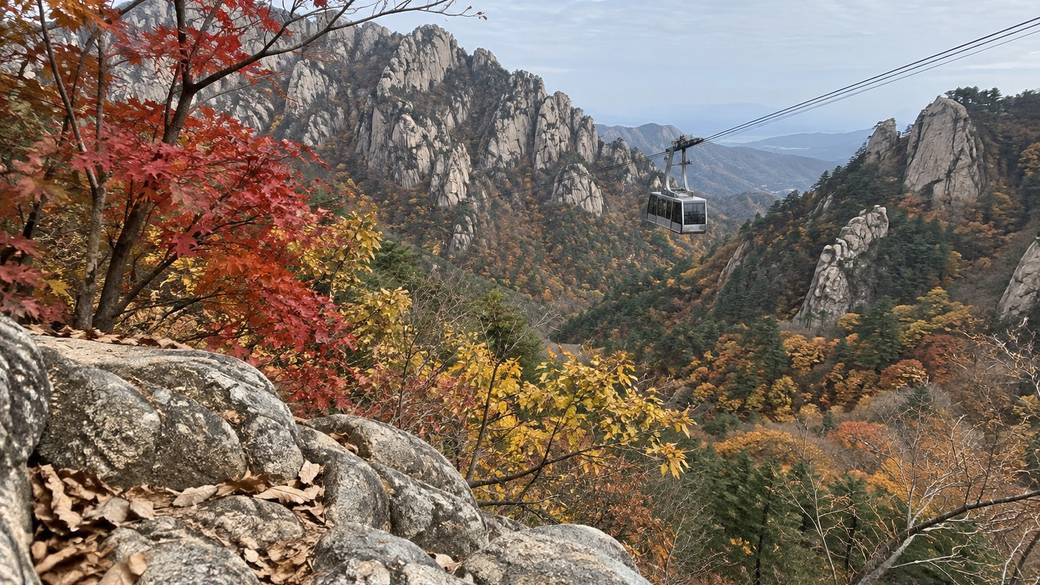
Seoraksan National Park, above Sokcho on the east coast, is where the season starts and the one most visitors try for. The Forest Service forecast is 20 October; on KMA’s 80% measure expect a few days later. Weekends around the peak are the busiest of the year.
Getting there from Seoul. The Seorak Cable Car’s directions give about 2 hours 30 minutes by express bus or 2 hours 10 minutes by intercity bus to Sokcho, with buses about every 30 minutes. From Sokcho, city buses 7 and 7-1 run from the bus terminals to the Seoraksan car park at the end of the line, next to the Sogongwon area where the cable car and the main trails start.
The cable car to Gwongeumseong is the easy way to get a ridge-top view. It runs 1,128 m from Sogongwon to an upper station at 699 m in about five minutes.
Seorak Cable Car fares, return only (checked 5 Oct 2026)
| Ticket | Price | Who |
|---|---|---|
| Adult | ₩16,000 | Middle-school age and over |
| Child | ₩12,000 | 37 months to elementary school |
| Infant | Free | Under 36 months |
| Senior (65+) | ₩14,000 | Not offered 19 Sep–15 Nov 2026 (peak season) |
Cars run every 10–15 minutes when it is quiet and every 5 minutes when busy. A ticket can be refunded in full up to 10 minutes before your boarding time, and missing your slot costs 20% to rebook. Operating hours change with the weather and are posted on the homepage each day.
Heullimgol, on the south side near Osaek, is one of the classic foliage walks, and it is booking-only in autumn (details in the next section). It is a one-way, 3.1 km route downhill from the Heullimgol trail centre to the Yongso junction. Plan how you will get back to your car or bus before you book. If it’s full, nearby Jujeongol needs no reservation.
Naejangsan: the southern classic
Naejangsan National Park, near Jeongeup in North Jeolla, is the best-known maple valley in the south, and the Forest Service forecasts its peak for 4 November. It is a long day trip from Seoul. The usual route is the KTX to Jeongeup Station, then a city bus or taxi to the park; our guide to booking KTX tickets covers how to get seats before a busy weekend.
In foliage season, KTO’s listing advises parking in the car parks and riding the return shuttle bus run by the national park office. Inside the valley, the cable car runs from near the visitor centre to the middle of Yeonjabong. The top station is about 10 minutes’ walk from an observatory looking over the valley.
Naejangsan Cable Car (KTO data updated 14 Apr 2026, checked 5 Oct 2026)
| Item | Detail |
|---|---|
| Return fare | Adult ₩10,000 · child ₩7,000 |
| One way | Adult ₩7,000 · child ₩5,000 |
| Hours | 08:00–17:30, may change; call 063-538-8120 |
| Frequency | Every 20 min off-peak; continuous in foliage season |
| Booking | None; buy on the day |
These cable-car prices come from Korea Tourism Organization data (via K-Trip Tips), last updated in April 2026; the operator’s own site did not show a fare table when we checked, and some Korean blogs quote older, lower prices.
The ridge walk from Seorae to Seoraebong and Byeongnyeonam (2.8 km) is booking-only in October and November, capped at 520 people a day. Weekend places go fast.
Trails you must book in autumn 2026
Korea’s national parks cap numbers on some sections in autumn, and you need a reservation on the Korea National Park Service booking site before you walk them. According to Maeil Shinmun’s 5 October 2026 summary of the rules, 16 national parks run booking-only sections this autumn.
Booking-only foliage trails (checked 5 Oct 2026)
| Trail | Season | Daily cap | Notes |
|---|---|---|---|
| Seoraksan Heullimgol | 1 Oct–30 Nov | 5,000 (1,000 an hour) | Entry 08:00–15:00 in October; one-way 3.1 km |
| Naejangsan Seoraebong–Byeongnyeonam | Oct–Nov | 520 | Weekend places sell out |
| Jirisan Chilseon Valley | Mon, Thu, Sat, Sun | 60 | Guided only |
| Hallasan Seongpanak and Gwaneumsa (Jeju) | All year | — | Separate Jeju booking site, below |
How the national-park system works:
- One person can book for up to 10 people, first come, first served.
- Online booking closes at 14:00 the day before. Unpaid and cancelled places are released in real time, so check again around midnight and early in the morning.
- There is a 24-hour automated phone line (1670-9202), in Korean. In past seasons the park service has also taken phone bookings from foreign visitors through each park office (a 2022 notice); the 2026 notices we found didn’t repeat this, so call the park office to check.
- No-shows are banned from booking for one month, two no-shows for three months. Cancel even on the morning if the weather turns.
- Walking a closed or booking-only section without a reservation, or leaving the marked trail, costs ₩200,000 the first time, ₩300,000 the second and ₩500,000 after that.
- Screenshot the QR code before you go; mountain valleys often have no signal.
Jeju and Hallasan: the last peak
Hallasan’s forecast peak is 6 November, and Jeju’s lowland ginkgo at Halla Arboretum peaks around 16 November, the latest date on the Forest Service map. That makes Jeju a good choice if you can only travel in mid-November.
The two summit trails, Seongpanak and Gwaneumsa, need a reservation on Jeju’s own Hallasan booking site (not the national-park one). Bookings for a month open at 09:00 on the first working day of the month before, so November places have been open since 1 October. The booking QR code is sent to your phone, and a no-show bans you for three months (a second for a year).
Trailheads close to new hikers around midday, but the booking site currently shows two different tables. One gives 11:30 at Seongpanak for October to March; the other gives 12:30 for September–October and 12:00 for November. Plan to start by 11:30 to be safe. Trails open at 05:30 in September–October and 06:00 in November. For where to base yourself on the island, see our Jeju area guide.
A simple foliage plan for a 2026 trip
Where to go by travel date, 2026 (forecasts, checked 5 Oct 2026)
| If you travel | Go to | Why |
|---|---|---|
| 10–19 Oct | Seoraksan upper ridges, Gangwon | First colour from 28 Sep; Forest Service peak 20 Oct |
| 20–27 Oct | Seoraksan, Songnisan | Seoraksan oaks 25 Oct, Songnisan ginkgo 23 Oct |
| 28 Oct–7 Nov | Seoul streets and palaces, Songnisan, Naejangsan | National ginkgo average 30 Oct; Naejangsan 4 Nov |
| 8–16 Nov | Naejangsan (late), southern arboretums, Jeju | Wando ginkgo 12 Nov, Halla Arboretum 16 Nov |
A few practical rules:
- Go on a weekday if you can. Peak weekends fill the Seoraksan buses, the cable-car queues and the booking-only trails first.
- Start early. Booking slots, cable-car waits and Hallasan cut-offs all reward a morning start.
- Dress for the mountain, not the city. It is much colder on the ridges than in Seoul’s 20°C afternoons, and the Seorak cable car’s cabins have no heating.
- Keep one flexible day. Rain or strong wind can stop the cable cars, and a warm week can push the peak back by several days.
- Add a night festival in the south. The Jinju Namgang Yudeung (Lantern) Festival runs from 3 to 18 October 2026 on the Namgang river in Jinju, South Gyeongsang, according to the city’s confirmed 2026 schedule. Jinju is far from Seoraksan, so it fits better with a southern loop that includes Naejangsan or Busan than with a Gangwon trip. For a Gangwon trip, the Gangneung Coffee Festival (21–25 October) starts the day after the Forest Service’s forecast Seoraksan peak (20 October); our autumn festivals calendar lists every confirmed October–November 2026 date.
More seasonal guides, including festivals and holiday travel, are collected in our Seasons & Festivals section.
Questions people ask
- When is the best time to see autumn leaves in Korea in 2026?
- Mid-October to early November. The Korea Forest Service forecasts the peak at Seoraksan on 20 October, Songnisan on 28 October, Naejangsan on 4 November and Hallasan on Jeju on 6 November. Seoul's city streets usually peak a little later than the mountains, from late October into November.
- When do Seoul's autumn leaves peak?
- Seoul's own estimate for 2025 was around 25 October on Bukhansan and late October to mid-November in the city centre; the 2026 city list had not been published when we checked on 5 October. Ginkgo, a third of Seoul's street trees, peaks on 30 October on average nationwide in the 2026 Forest Service forecast.
- Why do foliage forecasts give different dates?
- They measure different things. The Korea Forest Service calls the peak the day half the leaves have turned, while the weather agency (KMA) and the private forecaster Kweather wait until 80% of the whole mountain has turned, so KMA-style peaks come several days later.
- Do I need to book hiking trails for autumn foliage?
- Only on some sections. In autumn 2026, Seoraksan's Heullimgol trail takes 5,000 hikers a day by reservation from 1 October to 30 November, and Naejangsan's Seoraebong–Byeongnyeonam section takes 520 a day. Bookings are made on reservation.knps.or.kr and close at 14:00 the day before.
- Can I reserve the Seoraksan cable car in advance?
- No. The Seorak Cable Car sells only same-day return tickets at the station, at ₩16,000 for adults in 2026. Hours change with the weather and are posted on its homepage each day, and in peak foliage weeks there can be a wait for a boarding slot.
Sources
- 경남도민일보 – 진주시, 남강유등축제 등 대표 축제 일정 확정 (30 Jul 2026) (Korean)
- 기상청 강원지방기상청 – 오늘(28일) 설악산 첫 단풍 (press release, 28 Sep 2026) (Korean)
- 경향신문 – 산림청 '2026년 한반도 단풍절정 예측지도', 설악산 10월 20일 (22 Sep 2026) (Korean)
- 위키트리 – 산림청 2026 단풍 예측지도: 수종별 절정 시기 (22 Sep 2026) (Korean)
- 경향신문 – 케이웨더 첫 단풍·절정 전망, 설악산 9월 30일 (11 Sep 2026) (Korean)
- 매일신문 – 설악산 흘림골 하루 5000명 제한, 가을 국립공원 탐방로 예약제 (5 Oct 2026) (Korean)
- 설악 케이블카 – 이용안내 (fares, hours, boarding, directions) (Korean)
- 한라산탐방 예약시스템 – 예약안내 (booking window, trail cut-off times) (Korean)
- 내 손안에 서울 – 서울 단풍길 110선 (29 Oct 2025) (Korean)
- K-Trip Tips (Korea Tourism Organization data) – 내장산 케이블카 (updated 14 Apr 2026) (Korean)
- 대한민국 정책브리핑 – 단풍철 국립공원 탐방로 예약제 (2022, phone booking for foreign visitors) (Korean)
Updates
- 6 Oct 2026: added the Jinju Namgang Yudeung (Lantern) Festival dates, 3–18 Oct 2026. First published 5 Oct 2026 with the Korea Forest Service peak map (22 Sep), KMA's first-foliage report (28 Sep) and 2026 trail-booking rules.
About Korea Field Notes
An English guide to the practical side of visiting South Korea. Guides are researched from Korean-language official sources (Korail, T-money, Seoul Metro, the Korea Tourism Organization) and re-checked when rules or prices change. Each guide shows when its facts were last checked and lists its sources. About the site · How we research and update guides · Found something out of date? Tell us.