Convenience Store Ramen in Korea: What to Buy & How to Cook
Cooking instructions and allergen lines checked against Nongshim's product pages, prices against Newsis and SBS Biz (24 Jul 2026) and Financial News (Apr 2025), stores against Bizwatch and Seoul Mediahub, and import rules against CFIA, USDA APHIS and SFA, on 17 Oct 2026.
Start with a Shin Ramyun big bowl (400 ml water, about 3 minutes) for classic beef-broth heat, or a Buldak cup if you want dry, fiery noodles. Cups cost roughly ₩1,100–1,800, Nongshim's cups can't go in the microwave, and both Shin and Buldak list beef (checked 17 Oct 2026).
Best forFirst-timersBudgetLate arrivalSolo
Your situation → do this
| If you… | Do this |
|---|---|
| First ramyeon, medium spice tolerance | Shin Ramyun big bowl: hot water to the inside line, lid shut, 3 minutes, stir |
| You want the viral spicy one | Buldak stir-fried cup: fill, wait, drain through the lid holes, then add the sauce |
| You want the Han River experience | Buy a bag of ramyeon and a paper bowl at the counter and use the store's cooker machine |
| You eat halal, vegetarian or no pork | Read the Korean allergen line (알레르기) for 돼지고기 (pork) and 쇠고기 (beef); we found no halal-marked cups in stores |
Key takeaways
- Shin Ramyun big bowl: 400 ml boiling water to the inside line, about 3 minutes (Nongshim).
- Nongshim prints "no microwave" on its Shin cup and Yukgaejang big bowl; use the hot-water dispenser.
- Nongshim raised 18 cup-noodle brands by about 6% on 1 Aug 2026; Yukgaejang went to ₩1,200.
- Shin cup lists beef; Yukgaejang big bowl lists beef, chicken and pork in its allergen line.
- CU's ramyeon-themed stores at the Yeouido and Jamsil Han River bus piers opened 31 May 2025.
| Shin Ramyun big bowl | 400 ml boiling water to the inside line, lid shut, about 3 minutesSource: Nongshim Shin Ramyun brand page (Korean) |
|---|---|
| Microwave | Not allowed for Nongshim's Shin cup and Yukgaejang big bowlSource: Nongshim product QR pages (Korean) |
| Price change | 18 Nongshim cup-noodle brands +6.0% on average from 1 Aug 2026; bag Shin Ramyun unchangedSource: Newsis, 24 Jul 2026 (Korean) |
| Example shelf price | Yukgaejang sabalmyeon ₩1,100 → about ₩1,200 (retail, varies by store)Source: SBS Biz, 24 Jul 2026 (Korean) |
| Spice (SHU) | Shin Ramyun about 3,400; Buldak original 4,404 (Samyang's own 2017 measurement)Source: Smart Today, Jul 2023; iNews24, Jan 2017 (Korean) |
| 24-hour stores | About 76–82% of GS25, CU and 7-Eleven stores (2025)Source: Smart Today, 15 Oct 2026 (Korean) |
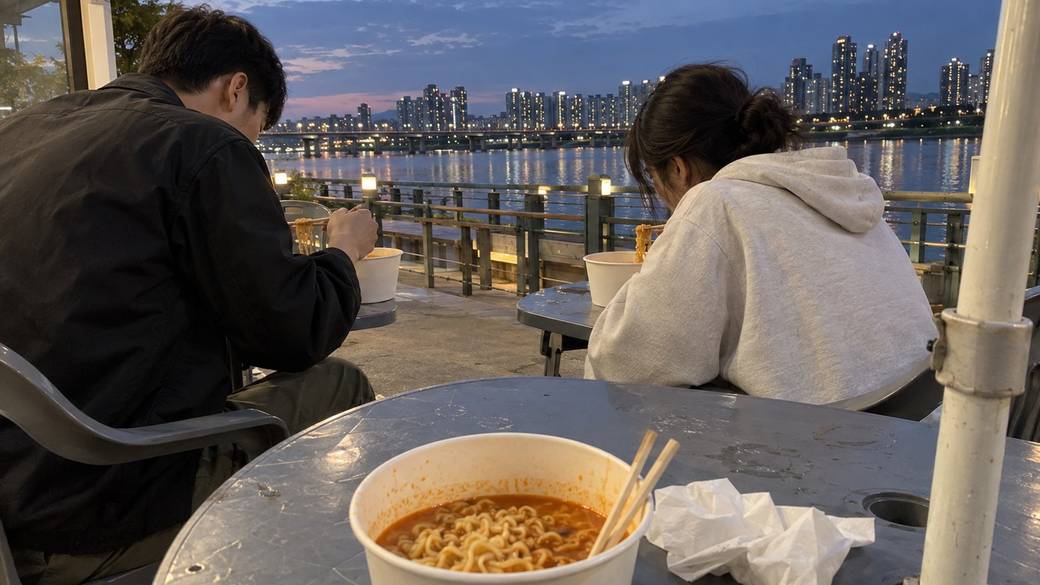
Convenience-store ramyeon is the cheapest hot meal in Korea and the easiest one to get at midnight. This page covers which cup to pick, how to cook it at the counter and what’s inside each one. It’s part of our shopping section.
Which cup ramyeon should you pick?
Pick by two things: how much heat you can take, and whether you want soup or dry noodles. The table below covers the cups you’ll find in almost every CU, GS25, 7-Eleven or emart24. “Contains” is the meat listed in the pack’s allergen line, which matters if you avoid pork or beef.
Common convenience-store cups: heat, meat, cooking and shelf price (checked 17 Oct 2026)
| Cup | Style · heat | Contains (allergen line) | How to cook | Shelf price seen |
|---|---|---|---|---|
| Shin Ramyun big bowl (신라면 큰사발) | Beef-broth soup · medium-hot | Beef (Shin cup) | 400 ml, ~3 min, no microwave | ₩1,500 (Apr 2025) |
| Shin Ramyun cup (신라면 컵) | Same, smaller · medium-hot | Beef | 240 ml, ~3 min, no microwave | ₩1,250 (Apr 2025) |
| Shin Ramyun The Red big bowl | Soup · hotter | Not checked | Follow the cup | ₩1,800 (Apr 2025) |
| Yukgaejang big bowl (육개장 큰사발) | Spicy beef-soup flavour · mild-medium | Beef, chicken, pork | 400 ml, ~3 min, no microwave | ≈ ₩1,200 small cup (Aug 2026) |
| Jin Ramen cup (진라면) | Soup · mild or spicy versions | Not checked | Follow the cup | ₩1,100 (Apr 2025) |
| Buldak Bokkeummyeon big cup (불닭볶음면) | Stir-fried, no soup · very hot | Chicken, beef | Fill, wait, drain, add sauce | Not confirmed |
The prices are what news reports gave as convenience-store shelf prices; Nongshim raised 18 cup-noodle brands by about 6% from 1 August 2026, so expect roughly ₩1,100–1,800 a cup now and read the shelf tag.
A few notes on the picks:
- Shin Ramyun big bowl is the safe first choice. Nongshim describes it as a spicy soup on a rich beef broth; it has been sold since December 1997, and it’s filling at 114 g.
- Buldak is the one you’ve seen on social media. It’s a stir-fried noodle, so the sauce coats the noodles instead of being diluted in soup, which makes it feel hotter than its numbers suggest.
- Yukgaejang is the gentle soup option, but it lists pork, chicken and beef, so it’s no good for halal or no-pork diets.
- Seaweed-soup ramyeon (Paldo Yangban miyeokguk ramyeon, 양반 미역국라면) was the No. 1 ramyeon with foreign shoppers at Lotte Mart’s Seoul Station store in January 2026 (Segye Ilbo). That’s supermarket data, and it’s mostly sold in bags, so look for it at a larger store.
How hot is “spicy” in Korea?
Hotter than most visitors expect, though only a few makers publish numbers. Shin Ramyun is usually quoted at about 3,400 Scoville heat units (SHU) and The Red at 7,500 (Smart Today, 2023). Samyang measured its original Buldak at 4,404 SHU when it launched the extra-hot “Haek” version in 2017 (iNews24). Figures for the hottest versions conflict between sources, and a food-industry official quoted in the Korean press said many SHU numbers online aren’t reliable, so we’ve left them out.
What this means at the shelf:
- Mild: Jin Ramen mild, Yukgaejang, cheese or jjajang (black-bean) flavours.
- Medium-hot: Shin Ramyun, the original Buldak if you eat chilli at home.
- Very hot: The Red, and any Buldak marked with extra fire, “2x” or “Haek” (핵, nuclear).
If you come from a chilli-eating country (Malaysia, Singapore, India, the Philippines), Shin Ramyun will probably feel medium; start Buldak with the original before trying the stronger versions.
How do you cook it in the store?
Most stores have a hot-water dispenser next to the noodle shelf and a narrow counter by the window where you can stand and eat. The cooking line is printed inside the cup, so you don’t need to read Korean to get the water right.
Soup cups (Shin, Jin, Yukgaejang)
- Pay first at the till, and pick up chopsticks (젓가락) if they’re not with the cups.
- Peel the lid halfway, to the arrow, and tip the powder packet onto the noodles.
- Fill from the hot-water dispenser to the line inside the cup: 400 ml for a big bowl, 240 ml for the small Shin cup.
- Close the lid and wait about 3 minutes. Weigh it down with the chopsticks if it won’t stay shut.
- Stir and eat at the counter, or take it outside.
Buldak and other stir-fried cups
Stir-fried cups (볶음면) work differently: you fill the cup with hot water, wait, then pour the water out through the small holes in the lid before mixing in the liquid sauce and flakes. Instructions differ between versions (some say leave a couple of spoonfuls of water, some say drain it all), so follow the pictures on your cup. Pour the water into a sink or soup bin if the store has one, not into the rubbish bin; ask the staff if you can’t see one.
How does the ramyeon cooker machine work?
The “Han River ramyeon” (한강라면) you see in K-dramas is bag ramyeon cooked in a paper bowl by a cooker machine. The habit started at convenience stores in the Han River parks, and the machines are now in tourist-area stores too.
- Buy a bag of ramyeon and a cooker paper bowl (종이 용기) at the till.
- Open the bag into the bowl: noodles in, soup powder on top.
- Put the bowl on the machine’s plate and follow the on-screen or printed steps. Machines vary; some read a barcode, others have a start button.
- Wait for it to finish. The Han River machines add about 400–450 ml of water, around 100 ml less than the pack says, and cook for about 3 minutes 30 seconds (GQ Korea, May 2026). The water reaches boiling point in under 50 seconds (Hankyung, 2025).
Because the machine uses less water than the pack asks for, the soup comes out a little stronger than when you cook the same bag at home.
What can go wrong?
Common mistakes
- Water above the line: the soup turns bland. The line inside the cup is the measure, not the brim.
- Draining a soup cup: only stir-fried cups (볶음면) get drained. If the lid has no drain holes, keep the water.
- Soup in the rubbish bin: pour leftovers into the sink or soup bin if there is one (ask the staff), then bin the cup.
- Assuming 24 hours: in 2025 about 18–24% of GS25, CU and 7-Eleven stores were not open all night. In quiet areas, check the hours on the door.
- Buying a bag ramyeon to eat in the store: you can only cook bags if the store has a cooker machine. Otherwise buy a cup.
What if you eat halal, vegetarian or no pork?
Then read the label: almost all mainstream Korean ramyeon uses meat in the soup.
- Beef: the Korean Shin Ramyun cup’s allergen line (알레르기 유발물질) lists beef (쇠고기). The bag version’s soup also lists pork-bone seasoning (돈골), according to Costco Korea’s listing of the pack.
- Pork: Nongshim’s Yukgaejang big bowl lists pork (돼지고기), chicken (닭고기) and beef. Buldak’s big cup lists chicken and beef but not pork; it’s made in a factory that also handles pork.
- Halal: Nongshim makes a halal Shin Ramyun without beef stock (KMF certified in 2011), and Samyang’s Buldak has been KMF certified, but these are export products. Samyang said in 2024 that domestic demand was not yet enough to sell halal lines in Korea (Al Jazeera). We found no halal-marked ramyeon confirmed on convenience-store shelves in October 2026. If you see a KMF halal logo printed on the pack, that’s the one to trust. For proper meals, see our halal food in Korea guide.
- Vegetarian and vegan: a few vegan-certified bag noodles exist, such as Ottogi’s Chaehwang (채황), relaunched as fully plant-based in 2022, and Pulmuone’s Jeongmyeon (정면). We couldn’t confirm that convenience stores stock them, so look in a supermarket. Our vegetarian and vegan guide covers what else to eat.
Where are the best stores for ramyeon?
Any convenience store will do; these are worth a detour if you want the full ramyeon wall and a cooker machine.
Ramyeon-focused convenience stores for visitors (checked 17 Oct 2026)
| Store | Where | What’s there | Source |
|---|---|---|---|
| CU Ramyeon Library, Yeouido pier | Han River Bus pier, Yeouido | Ramyeon-themed store with cooker machines, opened 31 May 2025 | Bizwatch, Jun 2025 |
| CU Ramyeon Library, Jamsil pier | Han River Bus pier, Jamsil | Same concept, opened 31 May 2025 | Bizwatch, Jun 2025 |
| CU Hongdae Sangsang (CU 홍대상상점) | 25 Janda-ri-ro, Mapo-gu | “Ramyeon library” display, cooker, eat-in area, open every day | Seoul Mediahub, Mar 2024 |
| CU Myeongdong Station | Near Exit 8, Myeongdong Station (Line 4) | Wall of 40 kinds of ramyeon, three cookers, signs in English | Byline Network, Nov 2024 |
| 7-Eleven Myeongdong | Myeongdong | Six ramyeon cookers | SBS Biz, Jan 2026 |
The Han River piers are the best setting, because you can carry the bowl straight to the riverside; CU planned the same store at all seven piers, but we could only confirm the first two as open.
CU Hongdae Sangsang branch (CU 홍대상상점)Naver MapGoogle MapsPaying is the same as for any convenience-store snack: overseas Visa and Mastercard, Alipay and WeChat Pay work at the till, and so does a T-money card. Our convenience store snacks guide covers payment, 1+1 deals and what to buy with your noodles.
Can you take Korean ramyeon home?
Often, but the meat in the soup packet is what customs officers look at. Check your country’s official rule before you fill a suitcase:
- United States: USDA APHIS asks travellers not to bring food containing pork because of African swine fever, and CBP may take and destroy it. Check the label for 돼지고기 or 돈골.
- Canada: CFIA does not permit fresh, dried or cured meats in personal imports and sets personal-use limits; it doesn’t list noodles specifically, so declare them.
- Singapore: SFA counts “all forms of food products containing meat” as meat products, with their own conditions.
- Australia: declare all food on your incoming passenger card and check the Department of Agriculture’s rules before packing noodles with meat seasoning.
- UK, Malaysia, Philippines, India: we couldn’t confirm a noodle-specific rule; check the official customs page.
Bag ramyeon packs flatter than cups and crush less. Multipacks work out cheaper: Pulmuone’s Seoul Ramyeon cost ₩5,450 for four at supermarkets against ₩1,500 a bag at CU Hongdae (Seoul Mediahub, 2024). Our Daiso must-buys guide has more ideas for cheap things to pack.
Is convenience-store ramyeon a good dinner?
As a late snack or a cheap lunch, yes: a big bowl and a triangle kimbap is a full meal for a few thousand won. As your only dinner every night, no: bunsik (snack-food) restaurants cook ramyeon to order with egg and vegetables, and our restaurant ordering guide shows how to order there. For the rest of a cheap day, see Korea on a budget.
Questions people ask
- Can you cook ramen inside a Korean convenience store?
- Yes. Most stores have a hot-water dispenser and a standing counter where you can eat. Peel the lid to the line, pour boiling water to the line printed inside the cup, close the lid and wait the time on the pack. Some stores also have a cooker machine for bag ramyeon.
- Can I microwave Korean cup ramen?
- Not the Nongshim cups we checked: the Shin cup and Yukgaejang big bowl both say microwave cooking is not possible. Some other makers print a microwave method on specific cups, so only microwave a cup whose own instructions show one.
- Is Shin Ramyun halal or vegetarian in Korea?
- No. The Korean Shin cup's allergen line lists beef, and the bag version's soup lists pork-bone seasoning too. Nongshim makes a halal Shin Ramyun without beef stock, but it's an export product; we found no halal-marked Shin on Korean store shelves.
- What is Han River ramen?
- Bag ramyeon cooked in a paper bowl by a cooker machine, a habit that started at convenience stores in the Han River parks. The machine adds about 400–450 ml of water and cooks for roughly 3 minutes 30 seconds, then you carry the bowl to a bench or the riverbank.
- How spicy is Buldak compared with Shin Ramyun?
- Hotter, and it stays on the noodles because there's no soup to dilute it. Samyang measured the original Buldak at 4,404 SHU; Shin Ramyun is usually quoted at about 3,400. Add a cheese slice or drink milk if it's too much.
- Can I take Korean instant noodles home?
- Often yes, but meat in the soup packet is the problem. The US asks travellers not to bring pork-containing food, Canada bans meat products, and Australia requires you to declare all food. Check your country's official rule before packing.
Next in your trip
- Korean convenience store snacks — what to grab with your noodles, and how to pay at the till
- Korea on a budget — where a ₩1,500 dinner fits in a cheap day
- How to order at a Korean restaurant — when you want ramyeon cooked for you at a bunsik shop
Sources
- 신라면큰사발 제품 정보·조리법 — Nongshim Shin Ramyun brand site (Korean)
- 신라면 컵 조리법·알러지 정보 — Nongshim product QR page (Korean)
- 육개장 큰사발면 조리법·알러지 정보 — Nongshim product QR page (Korean)
- 농심, 8월 1일부터 컵라면 등 43개 브랜드 가격 인상 — Newsis, 24 Jul 2026 (Korean)
- 농심 컵라면·스낵 가격 인상 — SBS Biz, 24 Jul 2026 (Korean)
- 편의점 컵라면 가격 인상 — Financial News, 14 Apr 2025 (Korean)
- CU, 한강버스 선착장에 '라면 특화점' 선보인다 — Bizwatch, 2 Jun 2025 (Korean)
- CU홍대상상점 라면 라이브러리와 서울라면 — Seoul Mediahub, Mar 2024 (Korean)
- 본격 한강 라면의 계절 — GQ Korea, May 2026 (Korean)
- 한강라면 조리기 — Hankyung, Feb 2025 (Korean)
- 편의점 24시간 미운영 점포 비중 — Smart Today, 15 Oct 2026 (Korean)
- 신라면 더 레드 스코빌 지수 — Smart Today, 28 Jul 2023 (Korean)
- 삼양 핵불닭볶음면 출시, 불닭 4,404 SHU — iNews24, 23 Jan 2017 (Korean)
- 외국인 관광객 라면 구매 순위 (롯데마트 제타플렉스 서울역점) — Segye Ilbo via Daum, 26 Jun 2026 (Korean)
- 불닭볶음면 큰컵 원재료·알레르기 — Costco Korea product listing (Korean)
- Going halal poses challenge to Korean firms — Korea JoongAng Daily, 15 May 2017
- South Korea loves pork and booze. It wants to be the next halal powerhouse — Al Jazeera, 7 Feb 2024
- 오뚜기 채황 100% 식물성 리뉴얼 — Vegan News, 28 Sep 2022 (Korean)
- CU 명동역점 K-푸드 특화 매장 — Byline Network, 26 Nov 2024 (Korean)
- 세븐일레븐 명동점 라면 조리기 — SBS Biz, 30 Jan 2026 (Korean)
- African swine fever: traveling with food — USDA APHIS
- Bringing food into Canada for personal use — CFIA
- List of food & food products allowed for personal use — Singapore Food Agency
Updates
- Published with Nongshim's cooking and allergen lines, the 1 Aug 2026 cup-noodle price change, CU's ramyeon stores and US, Canada and Singapore import rules.
About Korea Field Notes
An English guide to the practical side of visiting South Korea. Guides are researched from Korean-language official sources (Korail, T-money, Seoul Metro, the Korea Tourism Organization) and re-checked when rules or prices change. Each guide shows when its facts were last checked and lists its sources. About the site · How we research and update guides · Found something out of date? Tell us.