Jeju Food Guide: What to Eat and What It Costs (2026)
Prices checked on 15 Nov 2026 against the Korea Consumer Agency dining-out survey (September 2026), Visit Jeju's good-price restaurant page (edited 28 Sep 2026), KTO and Korean press; FX is the ECB rate of 13 Nov 2026.
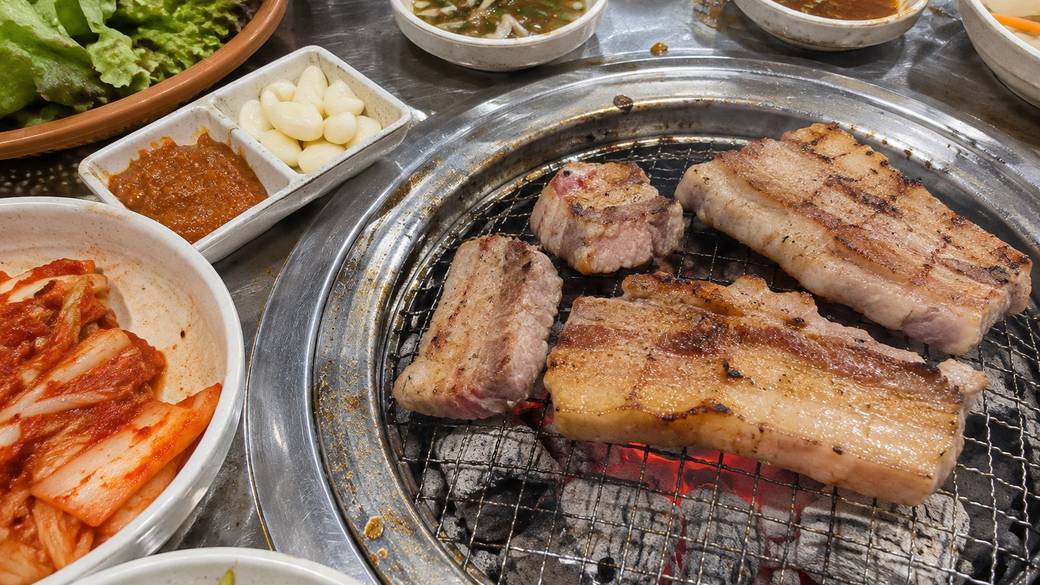
Eat black pork, braised hairtail, pork-broth noodles and in-season citrus first: a 200 g black pork portion costs about ₩20,000 (≈ US$15), and Jeju's average single dish ran ₩7,750–₩10,500 in September 2026. Seafood pots are priced per person, so check the portion before ordering; prices checked 15 Nov 2026.
Best forFirst-timersBudgetFamilies
Your situation → do this
| If you… | Do this |
|---|---|
| You have one dinner in Jeju City | Black pork grill (about ₩20,000 per 200 g), then Dongmun Night Market from 18:00 |
| You are sharing a hairtail (galchi) pot | Ask how many pieces come per portion before you order |
| You don't eat pork | Skip the pork broths too; order tilefish, hairtail or abalone porridge |
| You visit between November and April | Buy citrus at the markets: field tangerines now, hallabong from January |
Key takeaways
- Visit Jeju's good-price black pork grills charge ₩20,000 per 200 g portion (page edited 28 Sep 2026).
- Jeju averages in September 2026: bibimbap ₩10,500, kalguksu ₩10,375, kimchi-stew set ₩9,625 (Korea Consumer Agency).
- Hairtail pots are priced per person: a four-portion Seogwipo pot cost ₩72,000 in a September 2026 dispute.
- Dongmun Night Market runs 18:00–24:00 from November to April; stalls shut early when food sells out.
- Field tangerines are in full harvest in November 2026; hallabong ships January to April.
| Black pork, good-price grills | ₩20,000 per 200 g portion; one butcher-grill sells ₩6,800 per 100 g (300 g minimum) plus a ₩4,000 table chargeSource: Visit Jeju good-price restaurants, edited 28 Sep 2026 |
|---|---|
| Jeju average dish prices | Bibimbap ₩10,500 · kalguksu ₩10,375 · naengmyeon ₩9,750 · kimchi-stew set ₩9,625 · jajangmyeon ₩7,750 · gimbap ₩3,625Source: Korea Consumer Agency Chamgagyeok, Sep 2026 (provisional) |
| Pork belly average (200 g) | ₩17,944 in Jeju, all pork belly, not only black porkSource: Korea Consumer Agency Chamgagyeok, Sep 2026 |
| Dongmun Market | Shops 07:00–21:00 (varies by store); night market 18:00–24:00 Nov–Apr, 19:00–24:00 May–OctSource: KTO; Visit Jeju |
| Citrus | Field tangerines: full harvest Nov 2026, 443,000 t forecast · hallabong Jan–Apr · cheonhyehyang Jan–MarSource: Monthly Eco (10 Nov 2026); Segye Ilbo (9 Mar 2026) |
This page is for planning what to eat on a 2–4 day Jeju trip: which dishes are worth a meal slot, what they cost in 2026, and where to eat them. More island planning is in the Jeju section.
Prices are in won. At the ECB rate of 13 Nov 2026, ₩10,000 is about US$7.50, £5.70, A$11.00, S$9.60 or RM30.60.
Which Jeju dishes should you eat first?
Jeju’s food comes from pork farming and the sea. If you only have a few meals, eat dishes you can’t easily get on the mainland, and leave Korean BBQ chains and fried chicken for Seoul.
Jeju dishes worth a meal slot, with 2026 prices where an official or dated source gives one (checked 15 Nov 2026)
| Dish | Korean | What it is | Price guide | Pork? |
|---|---|---|---|---|
| Black pork grill | 흑돼지 구이 | Thick-cut belly or neck from Jeju’s black pigs, grilled at the table | ₩20,000 per 200 g at good-price grills | Yes |
| Braised hairtail | 갈치조림 | Long silver fish braised with radish and chilli, shared from one pot | Per portion; a four-portion pot cost ₩72,000 in Sep 2026 | No |
| Grilled tilefish | 옥돔구이 | Half-dried red tilefish, salted and grilled | Not confirmed for 2026 | No |
| Abalone porridge | 전복죽 | Rice porridge cooked with abalone and its innards, often green-tinted | Not confirmed for 2026 | No |
| Pork-broth noodles | 고기국수 | Thick wheat noodles in pork bone broth with sliced boiled pork | Not confirmed; Jeju kalguksu averaged ₩10,375 | Yes |
| Pork and seaweed soup | 몸국 | Pork broth thickened with sargassum seaweed, from Jeju feast days | Not confirmed for 2026 | Yes |
| Citrus | 감귤 · 한라봉 | Field tangerines in late autumn, hallabong and other hybrids in winter and spring | Varies by market and season | No |
Three of the seven dishes contain pork, so your pork rules matter more on Jeju than anywhere else in Korea.
Where we write “not confirmed”, we found no official or dated 2026 price. Blog price lists vary too much to print. As a rough guide, Jeju’s average for an ordinary single dish in September 2026 was ₩7,750–₩10,500 (next section).
How much does a meal cost in Jeju?
The Korea Consumer Agency publishes average restaurant prices by region every month. These are Jeju’s provisional September 2026 figures, the latest month on its site when we checked.
Average restaurant prices in Jeju, September 2026, Korea Consumer Agency (checked 15 Nov 2026)
| Dish | Jeju average | ≈ US$ |
|---|---|---|
| Pork belly, per 200 g | ₩17,944 | 13.40 |
| Samgyetang (ginseng chicken soup) | ₩17,000 | 12.70 |
| Bibimbap | ₩10,500 | 7.90 |
| Kalguksu (knife-cut noodles) | ₩10,375 | 7.80 |
| Naengmyeon (cold noodles) | ₩9,750 | 7.30 |
| Kimchi stew set meal | ₩9,625 | 7.20 |
| Jajangmyeon | ₩7,750 | 5.80 |
| Gimbap, one roll | ₩3,625 | 2.70 |
A noodle or rice lunch costs about ₩10,000, and a pork dinner for two with rice and drinks easily passes ₩50,000.
The agency notes that its regional figures are not like-for-like, since the shops surveyed differ by region. Jeju’s kalguksu was still the most expensive of any region that month. The pork-belly figure covers ordinary pork belly. Black pork usually costs a little more, as the next section shows.
How do you order black pork without overpaying?
Black pork (heukdwaeji, 흑돼지) is the dinner most visitors plan around, and it’s where tourist pricing varies most. Compare grills by price per gram, not per portion.
Visit Jeju’s list of good-price restaurants (착한가격업소) is the safest place to start. Jeju’s governor picks these places twice a year for keeping prices low as costs rise. The black pork page, last edited on 28 September 2026, lists:
- Kkamdon Heukdwaeji (깜돈흑돼지) near Sinjeju Rotary: belly, neck and other cuts at ₩20,000 per 200 g; a mixed platter of 800 g is ₩76,000.
- Dutumhan Gogi Dondwaeji, Hamdeok (두툼한고기돈돼지 함덕점): neck and belly at ₩20,000 per 200 g, grilled over coal briquettes, with free kimchi stew.
- Halla Chuksan Jeongyuk Sikdang, Nohyeong (한라축산정육식당 노형점): a butcher with a dining room, ₩6,800 per 100 g with a 300 g minimum, plus a table charge (₩4,000 per person from middle-school age, ₩3,000 for primary-school children, free for younger children).
The page warns that prices may have changed since it was written. Use it as a benchmark: if a grill’s menu works out far above ₩100 per gram, you are paying for the location or the view.
- Check the weight on the menu board. A portion (인분) on the good-price list is 200 g; work out the price per gram.
- Ask about a minimum order. Butcher-style grills can require 300 g or more.
- Look for a table charge (상차림비). It covers side dishes and is charged per person.
- Let staff cut the meat if they offer. It’s part of the service; Korea has no tipping.
- Add rice or noodles at the end. They are priced separately from the meat; check the menu before you order.
Our Korean BBQ guide covers grill etiquette and how to order by pointing. If you’re nervous about ordering in Korean, see how to order at a Korean restaurant.
What should you know about hairtail and other seafood?
Hairtail (galchi, 갈치) is Jeju’s signature fish, sold braised (jorim) or grilled whole (gui). Restaurants price braised hairtail by the portion, and a pot for two or four is served to share. In September 2026, a diner at a Seogwipo restaurant posted a ₩72,000 four-portion pot that came to about ₩90,000 with steamed egg and boiled pork (Aju News, 10 Sep 2026). The diner counted 8–10 pieces of fish. The restaurant said its standard is 22 pieces for four portions and 7 for one portion. Commenters pointed out that four single portions would be 28 pieces.
Other seafood dishes are cheaper:
- Grilled tilefish (okdom-gui, 옥돔구이) is lightly dried and salted before grilling; Dongmun sells it dried to take home.
- Abalone porridge (jeonbok-juk, 전복죽) is a light first meal after an early flight.
- Raw hairtail. KTO’s Dongmun Market page lists sliced raw hairtail among the market’s foods. It’s only possible on an island where the catch arrives fresh.
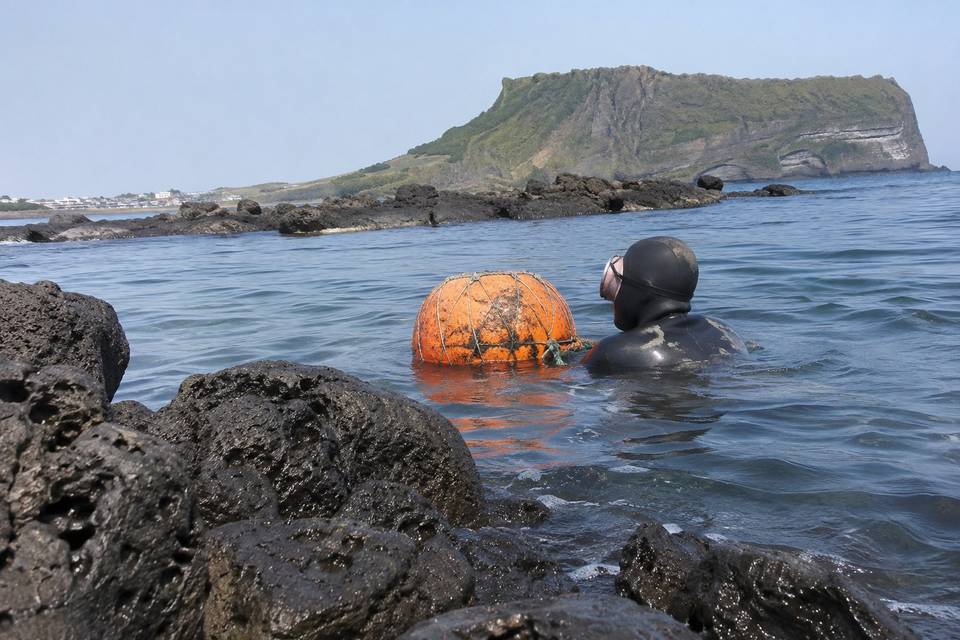
If you want to see where the shellfish comes from, our haenyeo divers guide covers shows and diver-run restaurants. Don’t pick shellfish off the rocks yourself: village fishing grounds belong to the cooperatives.
Where should you eat: markets or restaurants?
Markets are the cheapest way to try several Jeju foods in one stop, and you don’t need a reservation.
Jeju food markets, hours from KTO and Visit Jeju (checked 15 Nov 2026)
| Market | Where | Hours | Best for |
|---|---|---|---|
| Dongmun Traditional Market | Jeju City, 20 Gwandeok-ro 14-gil | 07:00–21:00, varies by store; open all year | Citrus, raw hairtail, dried tilefish, first or last day |
| Dongmun Night Market | Inside Dongmun, stalls near gate 8 | 18:00–24:00 Nov–Apr, 19:00–24:00 May–Oct | Snacks, black pork rolls, grilled seafood |
| Seogwipo Maeil Olle Market | Seogwipo old town, over 620 m long | Daytime into early evening; shops close from about 20:00 | Dinner on a south-coast night |
Dongmun is the easier of the two for most trips, because it’s a short taxi ride from the airport.
We give more detail on the night stalls, including what a seafood pack costs, in our night market guide. We could not find official 2026 hours for Seogwipo Maeil Olle Market. Listings based on KTO data give 07:00–20:00 in winter, but individual shops close earlier, so eat there by about 19:30. The market sits on the route in our Jeju 3-day itinerary.
When is Jeju citrus in season?
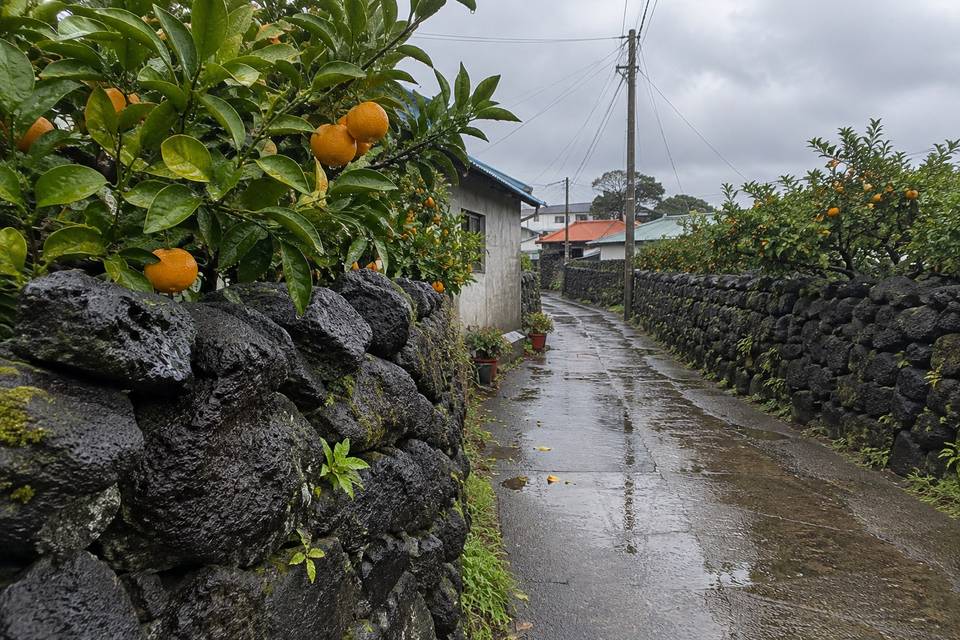
Citrus is Jeju’s best-value food. It’s cheap at the markets in season, and you can eat it on a bus. The 2026 field tangerine harvest was in full swing by early November. The province forecasts 443,000 tonnes, 7.8% more than last year (Monthly Eco, 10 Nov 2026). Rain and heat in late October spoiled some fruit, which pushed prices around.
Jeju citrus by month, from Korean press reports 2025–2026 (checked 15 Nov 2026)
| Fruit | Korean | Main season | Notes |
|---|---|---|---|
| Field tangerine | 노지감귤 | Full harvest in November 2026 | The everyday small mandarin |
| Hwanggeumhyang | 황금향 | November to January | Thin peel, very juicy |
| Redhyang | 레드향 | November to April | Flat, red-orange, low acid |
| Hallabong | 한라봉 | January to April | The big one with a bump on top |
| Cheonhyehyang | 천혜향 | January to March (one report says from late February) | Thin peel, sweet-sour |
| Karahyang | 카라향 | March to June | Late-season hybrid |
On a November–December trip you get tangerines, hwanggeumhyang and redhyang; hallabong is better from January.
The hallabong and cheonhyehyang months come from a March 2026 Segye Ilbo report on the Jeju citrus federation. The other months come from a December 2025 Nongmin Shinmun explainer. Fresh citrus can be restricted by your home country’s customs rules. Check before you pack a box for home, or buy citrus chocolate and juice instead.
What if you don’t eat pork or meat?
This matters more on Jeju than in Seoul, because pork runs through the classic dishes. Gogi-guksu and momguk use pork broth, and boiled pork (dombe-gogi) is a standard side.
- Halal (Malaysia, Singapore, India and others): sources disagree on how many certified or Muslim-friendly restaurants Jeju has, and lists from 2020–21 are out of date. Check the KTO Muslim-friendly restaurant finder and confirm with the restaurant before you go. Our halal food guide explains the certification levels.
- Pork-free but not strict: hairtail, tilefish and abalone porridge contain no pork, but grills, pots and broths are often shared. Say “돼지고기 빼 주세요” (no pork, please) and check side dishes.
- Vegetarian: Jeju is harder than Seoul. Citrus, market fruit and bingtteok (buckwheat crêpes rolled around radish) are easy. For full meals see our vegetarian guide, and consider a room with a kitchen.
Common mistakes
Avoid these
- Ordering a “per person” hairtail pot without asking the piece count.
- Comparing black pork prices per portion instead of per gram.
- Forgetting the per-person table charge at butcher-style grills.
- Arriving at Dongmun Night Market at 23:00 and finding the best stalls sold out.
- Planning a pork-free trip around gogi-guksu or momguk, which are pork broths.
- Packing fresh citrus for home without checking your country’s customs rules.
Without a car, most of these places are reachable by bus; our Jeju without a car guide has the routes.
Questions people ask
- What food is Jeju famous for?
- Black pork (heukdwaeji) grilled in thick slices, braised or grilled hairtail (galchi), grilled tilefish (okdom), abalone porridge, gogi-guksu (pork-broth noodles), momguk (pork and seaweed soup) and citrus such as hallabong. Pork and seafood dominate, so plan ahead if you avoid either.
- How much does Jeju black pork cost?
- About ₩20,000 (≈ US$15) per 200 g portion at the grills on Visit Jeju's good-price list, edited September 2026. Butcher-style grills sell by weight, for example ₩6,800 per 100 g with a 300 g minimum and a ₩4,000 table charge. Popular tourist grills often price higher; check the menu board.
- Is food in Jeju more expensive than in Seoul?
- Somewhat, for a few dishes. In September 2026 Jeju had the highest average kalguksu price of any region (₩10,375), and its kimchi-stew set was among the highest. The Korea Consumer Agency warns that regional comparisons are rough because the surveyed shops differ.
- When is hallabong season in Jeju?
- January to April is the main shipping season for hallabong, and January to March for cheonhyehyang, according to a March 2026 report on the Jeju citrus federation. Ordinary field tangerines come first: they were in full harvest in November 2026.
- Can Muslim travellers find halal food in Jeju?
- Only a handful of places, mostly in Jeju City, and sources disagree on which are certified. Use the Korea Tourism Organization's Muslim-friendly restaurant finder and confirm status with the restaurant. Seafood dishes avoid pork, but kitchens and grills are usually shared.
Next in your trip
- Jeju without a car — buses to the markets and the black pork streets
- Jeju 3-day itinerary — fits Dongmun and Olle Market into a route
- Where to stay in Jeju — Jeju City puts you closest to Dongmun and the airport
Sources
- Visit Jeju – 제주 착한가격업소 추천: 흑돼지편 (edited 28 Sep 2026) (Korean)
- Korea Consumer Agency Chamgagyeok – 외식비 by region (September 2026, provisional) (Korean)
- Aju News – 갈치조림 4인분 9만원? 제주 식당 해명 영상 (10 Sep 2026) (Korean)
- Monthly Eco (월간친환경) – 노지감귤 본격 출하, 가락시장 점검 (10 Nov 2026) (Korean)
- Segye Ilbo – 제주감귤연합회 한라봉·천혜향 제철 홍보 (9 Mar 2026) (Korean)
- Nongmin Shinmun – 한라봉·천혜향·황금향 어떻게 다를까? (3 Dec 2025) (Korean)
- Visit Jeju – 동문야시장 (Dongmun Night Market) (Korean)
- Korea Tourism Organization – Dongmun Traditional Market
- Korea Tourism Organization – Muslim-friendly restaurants
- Frankfurter – KRW reference rates (13 Nov 2026)
Updates
- Published with September 2026 dining-out prices and the 2026–27 citrus season.
About Korea Field Notes
An English guide to the practical side of visiting South Korea. Guides are researched from Korean-language official sources (Korail, T-money, Seoul Metro, the Korea Tourism Organization) and re-checked when rules or prices change. Each guide shows when its facts were last checked and lists its sources. About the site · How we research and update guides · Found something out of date? Tell us.