How to Take the Bus in Seoul: Fares, Colours & Apps (2026)
Fares, bus types, transfer rules, night bus routes and the food and drink rule checked against Seoul Metropolitan Government transport pages on 14 Nov 2026.
Ride Seoul city buses with a T-money card: tap at the front door, tap again at the back door, and a blue or green bus costs ₩1,500 a ride. Transfers to the subway are discounted within 30 minutes of tapping off, while foreign contactless cards still don't work on board (checked 14 Nov 2026).
Best forFirst-timersBudgetLate arrival
Your situation → do this
| If you… | Do this |
|---|---|
| Want to get on your first Seoul bus | Load a T-money card, search the trip in Naver Map and check the stop name and next stop before you board |
| Are going somewhere the subway skips, such as Namsan or a hillside café | Take the bus: it often stops closer than the nearest station and costs ₩50 less |
| Are out after the last train | Look for an N-numbered night bus (₩2,500, from about 23:30) before you pay for a taxi |
| Only have a Visa or Mastercard | Buy a T-money card with cash or a Climate Card pass at a station machine; the bus reader won't take your bank card |
| Carry a big suitcase | Skip city buses; use the airport limousine bus or the subway elevators |
Key takeaways
- Blue and green city buses cost ₩1,500 by card, yellow ₩1,400, village buses ₩1,200 and red express buses ₩3,000.
- Tap your card again when you get off; otherwise the next bus or train charges a full new fare.
- Transfers count if you board within 30 minutes of tapping off (60 minutes from 21:00 to 07:00), up to five rides.
- Single-use takeaway cups are banned on Seoul city buses under a 2018 rule; drivers may refuse you.
- Fourteen N-numbered night buses run from about 23:30 to 04:00 and cost ₩2,500 by card.
| Adult fare, blue and green buses | ₩1,500 by card or cash (≈ US$1.12)Source: Seoul city bus fare table |
|---|---|
| Red wide-area / night / village bus | ₩3,000 / ₩2,500 / ₩1,200 by cardSource: Seoul city bus fare table |
| Transfer window | 30 min after tapping off (60 min from 21:00 to 07:00); up to 4 transfersSource: Seoul city integrated transfer page |
| Longest ride on one tap | 5 hours on a city bus, 1 hour on a village bus, then a new base fareSource: Seoul city integrated transfer page |
| Night buses | 14 N routes, 140 buses, first departures about 23:30Source: Seoul city night bus page (Mar 2026) |
- Time
- About 2 min to board once you have a card
- Cost
- ₩1,500 per ride on blue and green buses (card)
- What you need
- T-money card with won balance · Naver Map in English · Mobile data · Lidded bottle, not a takeaway cup
This page takes you through one Seoul city bus ride, from finding the stop to tapping off, using Seoul city’s own fare table and transfer rules. For trains, airport links and intercity travel, start at the Getting Around hub. Prices are in won; we use US$1 = ₩1,337 (13 Nov 2026).
When is the bus better than the subway?
Most first-timers can do Seoul on the subway alone. The bus earns its place in four situations:
- The subway leaves you with a long walk or a climb. Hillside areas such as Namsan, Bukchon’s upper lanes, Buam-dong and Seongbuk-dong sit far above the nearest station. Naver Map will often offer a green village bus that stops at the top.
- The trip is short and crosses town at an angle. A direct bus can beat two subway transfers, especially outside rush hour.
- It’s after the last train. Seoul’s N-numbered night buses run when the subway doesn’t, at a fraction of a taxi fare. See night buses below.
- You want to see the city. A bus ride down Jongno or along the river is free sightseeing on top of the fare.
The subway wins when you carry big luggage, when roads are jammed at weekday rush hours, or when you need exact timing for a train or show. Both use the same card, and a transfer between them within 30 minutes costs far less than two fares, so most real trips mix the two. Our Seoul subway guide covers the train half.
What do you need before you start?
Have these ready
- A T-money card (about ₩3,000 at convenience stores) with won loaded, or a Climate Card short-term pass. See T-money vs WOWPASS vs Climate Card.
- Naver Map set to English, for routes and live arrival times.
- Mobile data, so the map updates on the move. Our eSIM vs SIM vs pocket Wi-Fi comparison helps you pick.
- Your destination’s name in Korean, saved in the map, in case you need to show the driver.
- Drinks in a sealed bottle or closed tumbler, not a takeaway cup.
How do you ride a Seoul bus, step by step?
- Search the trip in Naver Map. Pick a route with a bus icon; the app shows the route number, the stop name and how many minutes until the next bus.
- Walk to the right side of the road. Stops with the same name often face each other. Check the “next stop” in the app matches the sign’s direction.
- Read the route number on the front of the bus. Several routes share busy stops, so step forward as yours arrives so the driver sees you are waiting for it.
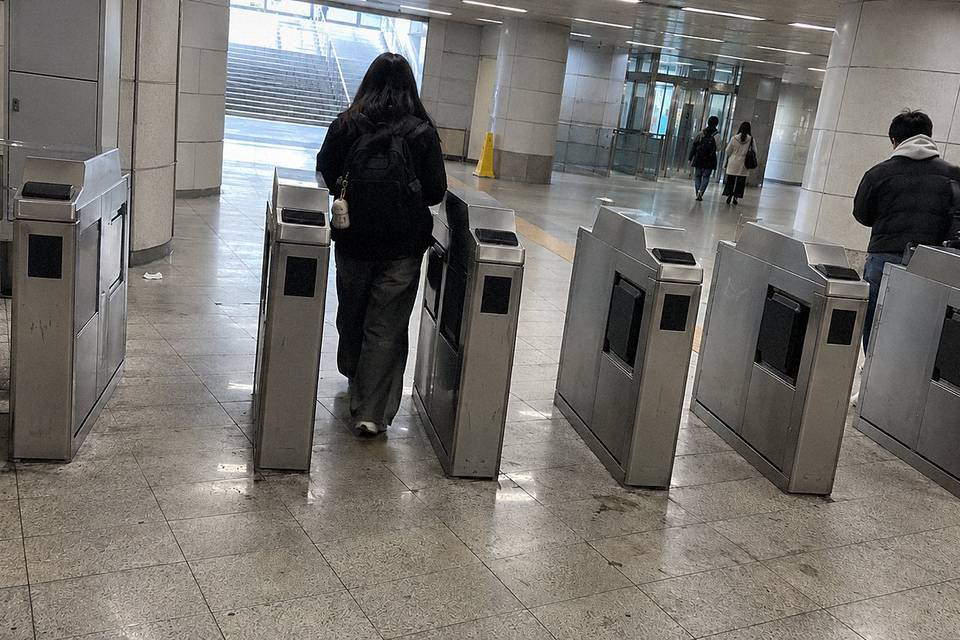
- Board at the front door and tap your card. Hold it flat on the reader beside the driver until it beeps. Two people on one card? Tell the driver before tapping.
- Hold on or sit down before the bus moves off. Keep your bag off the seats and leave the priority seats near the front for older, pregnant and disabled passengers.
- Press a stop button before your stop. The buttons are on poles and seat backs; watch Naver Map’s live position so you ring in time.
- Exit by the middle or rear door and tap again. Tap the reader by the door before you step off. This is what keeps your transfer discount.
- Transfer within 30 minutes. Board the next bus or train within 30 minutes (60 minutes between 21:00 and 07:00) and you pay only the distance extra, not a new base fare.
Lonely Planet notes that queuing is loose at busy stops and some people use the “wrong” door at rush hour; follow the front-in, back-out rule anyway and nobody will mind.
What do the bus colours mean?
Seoul sorts its buses into five types, and the colour on the side tells you which one you are looking at.
Seoul bus types by colour, adult card fares (Seoul city, checked 14 Nov 2026)
| Colour | Type (Korean) | What it does | Adult card fare | Visitor use |
|---|---|---|---|---|
| Blue | Trunk (간선) | Long routes linking outer districts, downtown and sub-centres | ₩1,500 (≈ US$1.12) | Cross-town trips, Jongno and Gangnam corridors |
| Green | Branch (지선) | Feeds trunk buses and subway stations within a district | ₩1,500 | Getting from a station to your hotel or a sight |
| Yellow | Circular (순환) | Loops round downtown and sub-centres for work and shopping | ₩1,400 | Short hops in the centre (few routes) |
| Red | Wide-area (광역) | Express from the suburbs into central Seoul | ₩3,000 (≈ US$2.24) | Day trips to Gyeonggi towns |
| Green, small | Village (마을) | Short neighbourhood loops to the nearest station | ₩1,200 (≈ US$0.90) | Hillside cafés, Namsan, upper Bukchon |
In practice you will mostly ride blue and green buses; red buses are for leaving the city, and the app tells you when a village bus is the shortcut.
How much does it cost?
Seoul charges a flat fare when you ride one bus, and a distance-based fare once you transfer. Fares haven’t changed since 12 August 2023; the June 2025 rise to ₩1,550 applied only to the subway.
Seoul bus fares by passenger type, card and cash (Seoul city, checked 14 Nov 2026)
| Bus | Adult card / cash | Teen (13–18) card / cash | Child (6–12) card / cash |
|---|---|---|---|
| Blue / green | ₩1,500 / ₩1,500 | ₩900 / ₩1,000 | ₩550 / ₩550 |
| Yellow circular | ₩1,400 / ₩1,400 | ₩800 / ₩800 | ₩500 / ₩500 |
| Village | ₩1,200 / ₩1,200 | ₩600 / ₩600 | ₩400 / ₩400 |
| Night (N) | ₩2,500 / ₩2,500 | ₩1,600 / ₩1,800 | ₩1,400 / ₩1,400 |
| Red wide-area | ₩3,000 / ₩3,000 | ₩1,700 / ₩1,800 | ₩1,500 / ₩1,500 |
For an adult the card and cash prices match, so the card’s real value is the transfer discount, not a cheaper ride.
- Transfers. Up to four transfers (five rides) count as one trip. You pay the base fare for the first 10 km, then ₩100 per extra 5 km (₩80 teens, ₩50 children). When you mix modes, the highest base fare applies, which is why a red bus leg costs more.
- No transfer on the same route. Getting off and back on the same route, or the same bus, charges a new fare.
- Early-bird discount. Your first ride before 06:30 is 20% cheaper by transit card.
- Children. Under-6s ride free, up to three per paying adult. Teen and child fares need a T-money card registered as a teen or child card; an adult card pays adult fares.
Can you pay with cash or a foreign card?
- Cash: the official fare table still lists cash prices, so most buses take notes and coins. But Seoul also keeps a list of cash-free bus routes (현금 없는 버스), last updated in January 2026, where only cards work. Treat cash as an emergency backup.
- Top-ups: T-money is loaded with won cash at convenience stores and station machines.
- Climate Card short-term pass: since 17 March 2026 you can buy the 1–7 day pass and single subway tickets with a foreign Visa or Mastercard at 440 machines in Line 1–8 stations. It covers Seoul-licensed city and village buses but not red wide-area or airport buses; prices and limits are in our card comparison.
Country notes: if you tap a bank card or phone on buses at home (London, Sydney, Singapore, Kuala Lumpur), this is the habit to break in Seoul until the 2027 launch.
How do Seoul night buses work?
Seoul’s night buses, called owl buses (올빼미버스), carry an N before the route number. Seoul city’s March 2026 list shows 14 routes and 140 buses: N13, N15, N16, N26, N30, N31, N37, N51, N61, N62, N64, N72, N73 and N75.
- Hours: first departures between about 23:30 and 23:40 from each route’s start; last departures between about 03:10 and 04:10.
- Gaps: usually 10–40 minutes, so check the live arrival before you walk to the stop.
- Fare: ₩2,500 by card (≈ US$1.87); transfers still apply, with the 60-minute night window.
- Coverage: each route runs 70–90 km across the city (N61, for example, from Sinjeong-dong in the west to Sanggye-dong in the north-east), but not every neighbourhood is on one.
If your hotel is off an N route, a taxi is the backup; our taxi app guide explains the late-night surcharge.
What can go wrong?
Which tips matter for your trip?
- With luggage: city buses have no luggage racks and steps at the door. Take the airport limousine bus or the subway instead; our Incheon Airport to Seoul guide compares them.
- Families: children under 6 ride free, and a registered child card cuts the blue and green bus fare to ₩550 for ages 6–12. Fold strollers when the bus is full.
- Budget: pair one T-money card with bus and subway transfers. A cross-town trip with one transfer usually costs well under ₩2,000.
- Late arrival: for a late flight into Incheon, compare the airport bus and AREX times in our airport guide first, then use a night bus or taxi for the last leg inside Seoul.
- Solo and first-timers: sit near the front on your first ride so you can see the next-stop display and the driver.
When this advice changes: once foreign cards can be tapped on Seoul buses (planned from January 2027) you won’t need T-money for the bus, and any fare rise would make the table above out of date.
Common mistakes
Avoid these
- Not tapping off at the back door, then paying a full fare on the next ride.
- Waiting on the wrong side of the road for a stop with the same name.
- Boarding with a takeaway coffee cup.
- Tapping a foreign Visa or Mastercard and holding up the queue.
- Taking a red bus for a trip inside Seoul and paying ₩3,000 instead of ₩1,500.
- Getting off and back on the same route and expecting a free transfer.
More transport guides are in the getting-around section.
Questions people ask
- How much is a Seoul bus ride in 2026?
- An adult pays ₩1,500 on a blue or green bus, ₩1,400 on a yellow circular bus, ₩1,200 on a village bus, ₩2,500 on a night bus and ₩3,000 on a red express bus, all by T-money card. Seoul has not changed bus fares since August 2023.
- Can I tap my Visa or Mastercard on a Seoul bus?
- Not yet. A Hana Card and T-money plan with Visa, Mastercard, UnionPay and JCB aims to start contactless bank-card payment on Seoul city buses from January 2027. Until then, use a T-money card or a Climate Card pass.
- Do I have to tap my card when I get off the bus?
- Yes. Seoul city calls the tap when getting off mandatory for transfers. If you skip it, the transfer chain breaks and your next bus or train charges the base fare you avoided, so you pay twice.
- Can two people use one T-money card on a Seoul bus?
- Yes, on the bus only: tell the driver how many people are riding before you tap, and the driver sets the reader. Transfers then work only if the same group gets off and boards together, and a shared card can't carry the transfer onto the subway.
- Can I bring coffee on a Seoul bus?
- Not in a single-use takeaway cup. Since 2018 Seoul lets drivers refuse passengers carrying drinks in takeaway cups, open cans or bottles with straws. A sealed bottle, a closed tumbler or boxed food you aren't eating is fine.
Next in your trip
- T-money vs WOWPASS vs Climate Card — pick the card you will tap on the bus
- How to ride the Seoul subway — the other half of every bus–subway transfer
- Korea taxi apps — your plan B when the night bus doesn't fit
Sources
- 서울시 – 시내버스 요금·환승규칙·버스 노선체계 (Seoul city bus fares, transfer rules and route colours) (Korean)
- 서울시 – 통합환승 할인제도 (integrated transfer discount, updated 2 Feb 2026) (Korean)
- 서울시 – 교통 요금 안내 (transport fares, including early-bird discount) (Korean)
- 서울시 – 심야버스(올빼미버스) 노선 현황 (night bus routes, updated Mar 2026) (Korean)
- 서울시 – 시내버스 음식물 반입 금지 세부기준 (bus food and drink rules, 2018) (Korean)
- 서울시 – 지하철 요금 1,550원 조정 (subway fare change, June 2025; bus fares unchanged) (Korean)
- 서울시 – 기후동행카드·일회용 승차권, 해외 신용카드로 구매 가능 (16 Mar 2026) (Korean)
- 시사경제 – 하나카드·티머니, 비자·마스터·유니온페이·JCB와 오픈루프 MOU, 2027년 1월 출시 (22 Sep 2026) (Korean)
- MTN – 서울 시내버스 노사 협상 극적 타결, 첫차 정상 운행 (16 Sep 2026) (Korean)
- Seoul city – Climate Cards and single-journey tickets now accept international credit cards
- 서울시 – 현금 없는 버스 노선 안내 (cash-free bus routes, Jan 2026) (Korean)
- Lonely Planet – Getting around Seoul
- Frankfurter – USD/KRW reference rate (13 Nov 2026)
Updates
- Published with Seoul city's bus fare table, route colours, transfer rules, night bus routes and the takeaway-cup rule checked on 14 Nov 2026.
About Korea Field Notes
An English guide to the practical side of visiting South Korea. Guides are researched from Korean-language official sources (Korail, T-money, Seoul Metro, the Korea Tourism Organization) and re-checked when rules or prices change. Each guide shows when its facts were last checked and lists its sources. About the site · How we research and update guides · Found something out of date? Tell us.