Korean Etiquette for Visitors: Do's and Don'ts (2026)
Rules and fines checked against Seoul Metropolitan Government notices, the Minor Offenses Act fine table (law.go.kr), korea.kr, Visit Seoul and VisitKorea on 13 Nov 2026.
Most Korean etiquette for visitors comes down to a few habits: shoes off at homes and temples, two hands when giving or receiving, wait for the eldest to eat, keep quiet on trains and don't tip. The rules with fines are smoking in no-smoking zones (up to ₩100,000) and littering (₩30,000–50,000), checked 13 Nov 2026.
Best forFirst-timersSoloFamilies
Your situation → do this
| If you… | Do this |
|---|---|
| You want to smoke or vape in Seoul | Use a marked smoking booth; bus stops, subway exits (10 m) and big plazas are no-smoking zones |
| You're boarding a city bus with a takeaway coffee | Finish it or put it in a sealed tumbler; drivers can refuse open cups |
| You're eating with Korean friends or a host family | Wait for the eldest to start, don't stand chopsticks in rice, pour for others |
| You're about to enter a home, temple hall or guesthouse | Take your shoes off at the door |
Key takeaways
- Smoking at a Seoul bus stop or within 10 m of a subway exit costs ₩50,000–100,000, e-cigarettes included.
- Dropping a cigarette butt or spitting is a ₩30,000 fine; dumping other rubbish is ₩50,000 (Minor Offenses Act).
- Seoul city buses can turn you away with an open takeaway cup; sealed bottles and lidded tumblers are fine.
- Visit Seoul's basics: shoes off at homes and temples, two hands, and wait for the eldest to start eating.
- Toilet paper goes in the bowl: public toilets removed the bins from cubicles in 2018.
| Smoking in a no-smoking zone | Fine up to ₩100,000; Seoul districts charge ₩50,000 or ₩100,000; liquid e-cigarettes covered from 24 Apr 2026Source: Seoul Metropolitan Government; Dailian, 9 Apr 2026 |
|---|---|
| Littering and spitting | ₩30,000 for a cigarette butt, gum, tissue or spitting; ₩50,000 for other rubbishSource: Minor Offenses Act enforcement decree, fine table |
| Jaywalking | ₩20,000 fine for pedestriansSource: Newspim, 19 Mar 2021; News1, 18 Feb 2024 |
| Seoul city buses | Drivers may refuse open takeaway cups and unpackaged food (rule since 4 Jan 2018)Source: Seoul Metropolitan Government traffic news |
| Tipping | Not required or expectedSource: VisitKorea |
| Drones in Seoul | No flying within 3.7 km of Gwanghwamun or 9.3 km of an airport without approval; fine up to ₩5,000,000Source: Seoul Metropolitan Government |
This page covers the Korean etiquette and rules a first-time visitor actually runs into: streets, buses, meals, homes, temples and photos. It sits in our Korea travel guides; drinking and restaurant habits have their own detailed pages, linked below.
Which etiquette rules actually matter?
Most Korean etiquette is the same everyday politeness you’d use at home, with a few local habits on top. Visit Seoul’s official etiquette page says most Koreans understand that a foreigner’s minor slip isn’t meant as disrespect, so you don’t need to memorise a rulebook. A handful of habits do matter, and a few street rules come with fines.
Korean etiquette for visitors by situation, what happens if you skip it (checked 13 Nov 2026)
| Situation | Do | Avoid | If you get it wrong |
|---|---|---|---|
| Smoking or vaping | Use a marked smoking booth | Bus stops, 10 m from subway exits, plazas, parks | Fine ₩50,000–100,000 |
| Litter | Carry it until you find a bin (they’re rare) | Dropping butts, gum or tissues; spitting | Fine ₩30,000–50,000 |
| City bus | Board with sealed drinks only | Open takeaway cups, eating on board | Driver can refuse you |
| Subway | Keep calls short, use earphones | Priority and pink seats, loud video | Looks, sometimes a complaint |
| Homes, temples, guesthouses | Shoes off at the door | Shoes on the raised floor | Embarrassment |
| Meals with Koreans | Let the eldest start; pour for others | Chopsticks standing in rice | Mild awkwardness |
| Paying, gifts, cards | Give and take with two hands | Tossing cash or cards on the counter | Seen as careless |
| Tipping | Pay the menu price | Adding 10–20% | Staff may hand it back |
The rows that can cost money are smoking and litter (plus jaywalking, below); an open cup gets you refused at the bus door, and the rest is about how people see you.
Which habits can get you fined?
These are real fines, mostly charged on the spot by district enforcement officers or police. Amounts are in won, about US$75 per ₩100,000 at roughly ₩1,330 to the dollar (ECB rate, 11 Nov 2026).
Fines a visitor can realistically get in Korea, won (checked 13 Nov 2026)
| Offence | Fine | Where it applies | Source |
|---|---|---|---|
| Smoking in a no-smoking zone | Up to ₩100,000 (Seoul districts: ₩50,000 or ₩100,000) | Bus stops, 10 m around subway exits, Gwanghwamun and Seoul plazas, 24 city parks, named streets | Seoul city |
| Cigarette butt, gum or tissue on the ground | ₩30,000 | Anywhere public | Minor Offenses Act |
| Spitting | ₩30,000 | Streets, parks | Minor Offenses Act |
| Dumping other rubbish | ₩50,000 | Anywhere public | Minor Offenses Act |
| Urinating in public | ₩50,000 | Anywhere public | Minor Offenses Act |
| Jaywalking | ₩20,000 | Crossing off a crosswalk or on red | Court and press reports |
| Flying a drone in a no-fly zone | Up to ₩5,000,000 | 3.7 km around Gwanghwamun, 9.3 km around airports, above 150 m | Seoul city |
Smoking is the fine visitors are most likely to get, because the no-smoking zones cover so much of Seoul.
A few details catch people out:
- E-cigarettes count. Seoul’s notice treats vaping in a zone like smoking, and liquid-type e-cigarettes became legal tobacco products on 24 April 2026, with the same fine (Dailian).
- Bins can be hard to find on Seoul streets, so carry a small bag for wrappers rather than leaving them on a ledge.
- Drinking in parks is mostly allowed, but some sites ban it. Tapgol Park in Jongno has charged ₩100,000 since April 2026; details are in our Korean drinking culture guide.
For overcharging and scams rather than rules you might break, see how to avoid tourist scams in Korea.
How should you behave on the subway and bus?
Public transport is where visitors are most visible, and where the unwritten rules are firmest.
City buses. Since 4 January 2018, Seoul’s bus ordinance has let drivers refuse anyone carrying food or drink that could spill. The city’s guidelines name hot or iced drinks in takeaway cups, cup snacks like tteokbokki or chicken, cup carriers, and open cans or bottles with a straw. Bottles with closed lids, unopened cans, sealed tumblers and boxed food such as pizza are fine, as are groceries in a bag. Eating on board can get you asked to leave.
Subway. Seoul Metro’s passenger terms bar items that are unhygienic or smell bad enough to bother others. Kyunghyang reported in November 2025 that this falls short of an outright ban on eating. In practice locals don’t eat on trains, and Seoul Metro logged 4,197 food complaints over five years. Noise is the bigger issue: Segye reported 7,520 noise complaints in the first half of 2026 alone, most about videos played without earphones.
- Priority seats at the ends of each car are for older, disabled and pregnant passengers and people with small children. Leave them empty even on a full train.
- Pink seats on the long benches are for pregnant passengers. Leave them free too.
- Escalators: Seoul Metro’s current campaign is “stand, don’t walk”. Many people still walk on one side, so if you stand, keep to the other side.
- Let people off first and take your backpack off in a crowded car.
Fares, transfers and tap-in mistakes are in our Seoul subway guide.
What are the table manners at a Korean meal?
At a restaurant on your own, almost none of this applies: order, eat, pay at the counter. It matters when you eat with Korean friends, a host family or colleagues. Visit Seoul lists four dining basics:
- Start once the eldest person at the table starts eating.
- Don’t touch food with your fingers, except when wrapping meat in lettuce or perilla leaves.
- Never leave chopsticks or a spoon standing upright in rice, and eat rice with the spoon. Upright chopsticks look like the offering at an ancestral rite.
- Put your chopsticks and spoon back where they were when you finish.
With alcohol, Korea.net describes the core habits: receive a glass with both hands, let the youngest pour for the elders, and turn your head slightly away when drinking with someone older. Don’t refill your own glass; refill other people’s. The full set of rules, plus the legal drinking age, is in our drinking culture guide.
Two money habits surprise visitors. Tipping isn’t expected, and VisitKorea adds that extra water and side dishes cost nothing. Paying usually happens at the counter on the way out, not at the table. See tipping in Korea and how to order at a Korean restaurant for call buttons, refills and splitting the bill.
How do you greet people and hand things over?
Visit Seoul’s general advice fits on one card:
- Greet with a short bow, essentially a nod. Visit Seoul pairs it with a soft handshake using both hands; follow the other person’s lead.
- Give and receive with both hands, whether it’s a credit card, cash, a business card, a gift or a drink. One hand with the other touching your wrist or forearm also works.
- Don’t point at people with your finger; gesture with an open hand.
- Stay formal at first. Use 안녕하세요 (annyeong-haseyo, hello) and 감사합니다 (gamsa-hamnida, thank you), and avoid calling someone “you” directly in Korean. Use their full name with 씨 (ssi) or their title instead; with Kim, Lee and Park covering 44.6% of Koreans, the surname alone rarely tells people apart.
Two superstitions are worth knowing but won’t get you in trouble. The number 4 sounds like the word for death, so some buildings label the fourth floor “F”. Writing someone’s name in red ink is avoided because red was once used for the names of the dead. Both points come from a Korea.net honorary reporter’s article, not an official rule.
What about toilets, homes and temples?
Toilets. Since 2018, public toilets have no bin beside the toilet: the government changed the public-toilet rules to remove them and cut smells. Put used paper in the bowl and flush. The small lidded bin in women’s cubicles is for sanitary products only.
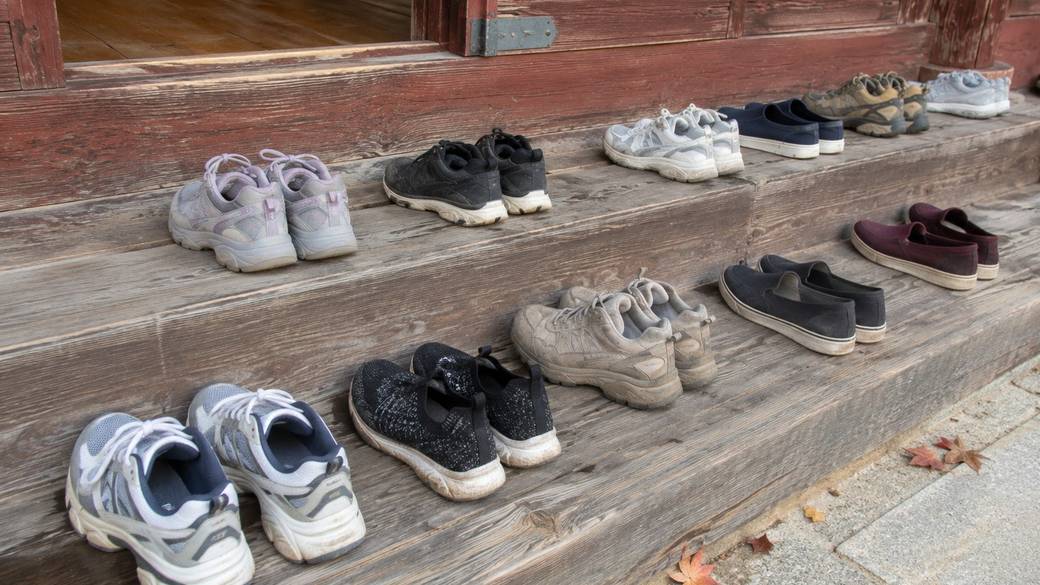
Homes and guesthouses. Take your shoes off at the door; Visit Seoul names homes, temples and guesthouses. Hanok stays and many guesthouses have a step or shoe rack at the entrance, which is your cue. Restaurants with a raised floor and floor cushions work the same way. Wear socks you’re happy to show.
Temples. Shoes come off before you step into a hall. Beyond that, keep your voice down and ask before photographing monks or people praying. The official Templestay site’s etiquette page wouldn’t load for us, so treat those two points as common courtesy rather than its wording. If you’re staying overnight, our temple stay guide covers the schedule and what to wear. Bathhouses have their own rules (shower first, no swimsuits), covered in the jjimjilbang guide.
Can you take photos of people or fly a drone?
Street photography is legal in Korea, but two rules are stricter than in many countries.
- Filming someone’s body without consent in a sexual or humiliating way is a serious crime under the Sexual Violence Punishment Act, with prison terms. Point cameras away from people’s bodies on escalators, beaches and in changing areas, and ask before close-up portraits.
- Phone shutter sounds. Phones sold in Korea play a camera shutter sound. Newsis reports this is a 2004 industry standard, not a law, so your own phone isn’t breaking anything, but a silent camera still looks suspicious in some places.
- Drones. Central Seoul is mostly a no-fly zone: Seoul city lists 3.7 km around Gwanghwamun and 9.3 km around airports, plus anything above 150 m. Flying there needs approval through the government’s drone portal (drone.onestop.go.kr), and aerial photos need a separate defence-ministry permit. The fine is up to ₩5,000,000.
Which home habits need adjusting?
- US, Canada, UK, Australia: Drop tipping and don’t hand over a card with one hand at the counter. Jaywalking is a fineable offence here, unlike in the UK.
- Singapore and Malaysia: The no-smoking zones and on-the-spot fines will feel familiar. Gum is legal, but dropping it on the ground costs ₩30,000.
- India and the Philippines: If you eat with your hand at home, use the spoon for rice and chopsticks for side dishes, apart from lettuce wraps.
- Muslim and vegetarian travellers: Saying no to pork or alcohol isn’t rude. Our halal food guide lists certified restaurants and prayer rooms.
If something goes wrong and you need an English speaker, the 24-hour tourist line is covered in our 1330 helpline guide.
Common mistakes
Avoid these
- Lighting up or vaping at a bus stop or right outside a subway exit
- Boarding a city bus holding an iced coffee in a takeaway cup
- Dropping a cigarette butt or tissue because there’s no bin in sight
- Sitting in a pink or priority seat on a full train
- Playing videos on the subway without earphones
- Sticking chopsticks upright in a bowl of rice
- Adding a 10–20% tip out of habit
- Wearing shoes onto a raised floor in a home, temple hall or guesthouse
Questions people ask
- Do I have to bow in Korea?
- A small bow, basically a nod, is the normal greeting, and Visit Seoul suggests pairing it with a soft handshake. Nobody expects a visitor to get the depth right. Visit Seoul notes that most Koreans don't read a foreigner's minor slip as disrespect.
- Can you eat or drink on the Seoul subway?
- It isn't explicitly banned, but it's frowned on. Seoul Metro's terms bar items that smell bad enough to bother other passengers, and the city's etiquette advice says not to eat on trains. A sealed water bottle is fine; save the tteokbokki for the platform exit.
- Is jaywalking illegal in Korea?
- Yes. Crossing outside a crosswalk or against the red light is a ₩20,000 fine for pedestrians, as reported in court and news coverage. Cross at the lights and you avoid both the fine and the traffic.
- Do you take your shoes off in Korean restaurants?
- Only where there's a raised floor with cushions and a shoe shelf or a row of shoes at the edge. At tables with chairs, keep them on. In homes, temples and guesthouses, shoes always come off at the door, so wear socks without holes.
- Can I walk up the escalator in Seoul?
- Many people do, but Seoul Metro's official line is to stand, not walk. In April 2026 staff at Yeouinaru Station were promoting exactly that. If you stand, keep to one side so people can pass, and hold the handrail.
- Can you smoke on the street in Seoul?
- Only outside no-smoking zones, and those cover a lot of the city: every bus stop, 10 m around subway exits, the main plazas and 24 city parks, plus streets each district names. Look for a marked smoking booth instead. The fine is ₩50,000 or ₩100,000.
Next in your trip
- Seoul subway guide — Fares, transfers and the seat rules in practice
- How to order at a Korean restaurant — Call buttons, side dishes and paying at the counter
- Tipping in Korea — Why the menu price is the final price
Sources
- 서울특별시 – 금연구역 지정 현황 및 과태료 (Seoul no-smoking zones and fines) (Korean)
- 데일리안 – 액상형 전자담배도 담배…서울시 금연구역 단속 (2026-04-09) (Korean)
- 국가법령정보센터 – 경범죄 처벌법 시행령 별표 (범칙행위 및 범칙금액) (Korean)
- 서울특별시 교통 – 시내버스 음식물 반입금지에 따른 세부기준 마련 (Korean)
- korea.kr – 공중화장실 변기 옆 휴지통 없앤다 (2017-12-26) (Korean)
- 뉴스핌 – 무단횡단 범칙금 2만원 (2021-03-19) (Korean)
- 헤럴드경제 – 에스컬레이터 '걷지 말고 서서' 캠페인 (2026-04-05) (Korean)
- 세계일보 – 지하철 소음 민원 상반기 7,520건 (2026-07-22) (Korean)
- 경향신문 – 지하철 음식물 민원 5년간 4,197건 (2025-11-12) (Korean)
- 뉴시스 – 카메라 촬영음, 법적 구속력 없는 표준 (2023-11-07) (Korean)
- 서울특별시 – 드론 비행 금지구역과 승인 절차 (Korean)
- Visit Seoul – The Basics of Korean Etiquette
- VisitKorea – About Korean food: visiting a Korean restaurant
- Korea.net – Alcohol in Korean Life (drinking etiquette, 2014-01-29)
Updates
- Published: everyday etiquette with official sources, the fines table (smoking, litter, spitting, jaywalking, drones), bus and subway rules, table manners and country notes.
About Korea Field Notes
An English guide to the practical side of visiting South Korea. Guides are researched from Korean-language official sources (Korail, T-money, Seoul Metro, the Korea Tourism Organization) and re-checked when rules or prices change. Each guide shows when its facts were last checked and lists its sources. About the site · How we research and update guides · Found something out of date? Tell us.