How to Ride the Seoul Subway: Fares, Apps & Exits (2026)
Fares, ticket and luggage rules checked against Seoul Metro's fare page, ticket page and passenger terms, plus Seoul city's March 2026 machine notice, on 30 Oct 2026.
Buy a T-money card, tap it at the gate going in and coming out, and plan each trip in Naver Map: a ride costs ₩1,550 for the first 10 km and transfers are free within 30 minutes. Foreign contactless cards still don't open the gates, so pay with T-money or a ₩1,650 single ticket (checked 30 Oct 2026).
Best forFirst-timersBudgetWith luggage
Your situation → do this
| If you… | Do this |
|---|---|
| Are riding more than once or twice | Buy a T-money card (about ₩3,000) at a convenience store and load won cash |
| Have no won cash yet | Buy a single ticket or Climate Card with Visa or Mastercard at a new Line 1–8 machine |
| Don't know which train to take | Search the trip in Naver Map in English: it gives the line, direction, transfers and exit |
| Went through the wrong-direction gate | Tap out and back in within 15 minutes with the same card; the base fare is waived once |
| Carry a big suitcase | Use elevators, avoid 08:00–09:00, or drop it at a T-luggage counter |
Key takeaways
- Adult fare is ₩1,550 by transit card for the first 10 km, ₩1,650 by single ticket plus a ₩500 deposit.
- Tap out at every exit: transfers to a bus within 30 minutes (60 at night) are then free or discounted.
- Visa or Mastercard contactless does not open Seoul gates; Seoul's open-loop plan starts with buses in 2027.
- Riding without a valid ticket costs the single fare plus 30 times that fare (Seoul Metro terms).
- Bags whose three sides add up to 158 cm or more, or over 32 kg, are not allowed on board.
| Adult fare, first 10 km | ₩1,550 by transit card; ₩1,650 single-journey ticket (+₩500 refundable deposit)Source: Seoul Metro fare page |
|---|---|
| Each further 5 km (up to 50 km) | +₩100Source: Seoul Metro fare page |
| Youth / child card fare | ₩900 (13–18) / ₩550 (6–12); under 6 free, up to 3 per adultSource: Seoul Metro fare page |
| Subway–bus transfer window | 30 min after tapping off (60 min from 21:00 to 07:00), card onlySource: Seoul Metro fare page |
| Fare evasion | Single fare plus 30 times that fareSource: Seoul Metro passenger terms, art. 27 |
| Luggage limit | Sum of sides under 158 cm and no more than 32 kg; strollers and wheelchairs allowedSource: Seoul Metro passenger terms, art. 36 |
- Time
- About 5 min to buy and load a card
- Cost
- ₩1,550 per ride (first 10 km, transit card)
- What you need
- T-money card or single-journey ticket · Won cash to top up T-money · Naver Map in English · Mobile data
This page walks you through one subway ride in Seoul, from buying a card to leaving by the right exit, using Seoul Metro’s own fare table and passenger terms. For airport trains, buses and intercity rail, start at the Getting Around hub.
What do you need before you start?
Have these ready
- A transit card. A T-money card costs about ₩3,000 at convenience stores (CU, GS25, 7-Eleven, Emart24). Which card suits you is covered in T-money vs WOWPASS vs Climate Card.
- Won cash. You top up a plastic T-money card with cash at station machines or convenience stores. ₩10,000–20,000 covers several days of central rides.
- Naver Map in English with mobile data. Google Maps shows routes in Korea but Naver Map is more complete; see Korea travel apps.
- Your destination’s station and exit number. Hotels, cafés and attractions usually write “Exit 3, Hapjeong Station” on their websites.
If you land at Incheon first, the airport railroad (AREX) is the first train you’ll ride; our Incheon Airport to Seoul guide covers that leg, and the same card works on it.
How do you pay at the gate?
Seoul’s gates read Korean transit cards only. A Visa or Mastercard that taps through the London Underground or Singapore’s MRT does nothing here, and the same goes for Apple Pay or Google Pay holding a foreign card. That is the one surprise most visitors from the UK, Australia, Singapore and the US run into on day one.
Ways to pay for a Seoul subway ride (adult, checked 30 Oct 2026)
| Option | First 10 km | Where to get it | Pay for it with | Best for |
|---|---|---|---|---|
| T-money card | ₩1,550 | Convenience stores, station machines | Won cash (card about ₩3,000) | Almost everyone |
| Single-journey ticket | ₩1,650 + ₩500 deposit | Station ticket machines | Cash; Visa/Mastercard at new Line 1–8 machines | One or two rides |
| Climate Card short-term pass | Unlimited rides in Seoul | Line 1–8 machines | Cash; Visa/Mastercard at new machines | 4+ rides a day inside Seoul |
| Mobile Tmoney (iPhone) | ₩1,550 | Tmoney app | Mastercard, Amex, UnionPay (not Visa) | iPhone users without cash |
| Foreign contactless card | Not accepted | — | — | Planned from 2027, buses first |
A T-money card saves ₩100 a ride over single tickets and, more usefully, gives you the free transfer to buses, which single tickets don’t.
A few details behind the table:
- The new machines. Since 17 March 2026, 440 new ticket machines at 273 stations on Lines 1–8 take overseas Visa and Mastercard cards, with a fee of about 3.7%. Seoul’s notice lists Climate Card purchases, short-term pass top-ups and single tickets; it does not list topping up a plain T-money card, so bring cash for that.
- iPhone Tmoney. The Tmoney app on iPhone tops up with Mastercard, Amex or UnionPay, but not Visa, per SBS Biz in March 2026. Android users can’t add a foreign card this way yet.
- Open-loop, eventually. Hana Card and T-money signed with Visa, Mastercard, UnionPay and JCB on 22 September 2026 for tap-your-own-card payment from January 2027. It starts with Seoul city buses; no date has been given for subway gates. Our credit card guide tracks which foreign cards work where.
How do you plan the route?
Search your trip in Naver Map before you go underground. It gives you four things you need: the line (each has a number and a colour), the direction (the name of a station further along the line), any transfer stations, and the exit to use at the end.
Station names are announced and shown in Korean and English, and every station also has a number (for example 201 for City Hall on Line 2). If the English name on your hotel booking doesn’t match a sign, search the station number or the Korean name.
How do you ride the subway, step by step?
- Get a T-money card and load it. Buy it at a convenience store, then add ₩10,000 or more in cash at the counter or at a station top-up machine (the screens have an English option).
- Find the right line and direction. Follow the line colour and the direction your app names to the right platform. Check the sign above the gate before you tap.
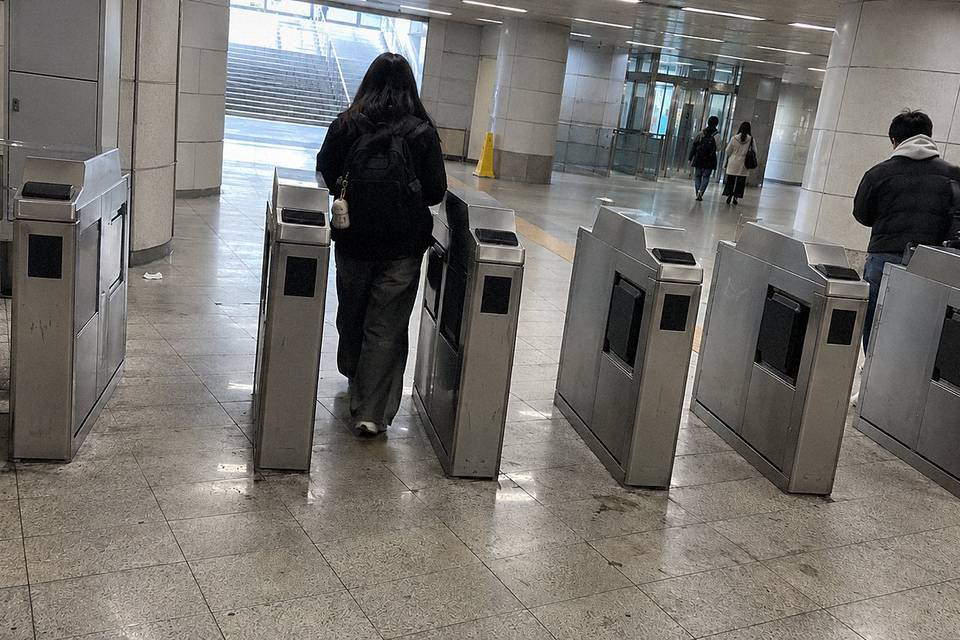
- Tap in at the gate. Hold the card on the reader until it beeps; the screen shows your balance. With a single ticket, tap it on the same reader.
- Board and watch the screens. Wait behind the platform doors, let passengers off first, and follow the in-car screens, which show the next station in English.
- Change lines inside the gates. Follow the coloured transfer signs. At a few stations where two operators meet you pass a transfer gate; tap the same card.
- Tap out at your destination. Tap again at the exit gate. The fare is worked out by distance here, so never skip it.
- Leave by the exit number. Follow the exit signs to the number your app gave you. With a single ticket, drop it in the deposit refund machine near the gates to get your ₩500 back.
How much does a ride cost?
Seoul subway fares by distance, adult (₩, Seoul Metro, checked 30 Oct 2026)
| Distance | Transit card | Single-journey ticket | Child (6–12), card or ticket |
|---|---|---|---|
| Up to 10 km | 1,550 | 1,650 | 550 |
| Up to 20 km | 1,750 | 1,850 | 650 |
| Up to 30 km | 1,950 | 2,050 | 750 |
| Up to 50 km | 2,350 | 2,450 | 950 |
Most rides inside central Seoul fall in the first two rows; Naver Map shows the exact fare for each trip before you go.
The fare system is one distance-based system across the whole Seoul metropolitan network, so the price is the same whichever operator runs the line. Above 10 km, the fare rises by ₩100 per 5 km up to 50 km, then ₩100 per 8 km. Youths (13–18) pay ₩900 and children (6–12) ₩550 for the first 10 km with a card; children under 6 ride free, up to three per adult. Your first boarding before 06:30 with a transit card gets 20% off the base fare.
The fare rose from ₩1,400 to ₩1,550 in June 2025, so older guides quoting ₩1,400 are out of date. We found no announced change for the rest of 2026.
Transfers are the part to understand. Changing lines inside the gates costs nothing extra beyond the distance you travel. Moving between subway and bus is free or discounted if you tap off and board the next vehicle within 30 minutes (60 minutes between 21:00 and 07:00), and it only works with a transit card.
Can you ride with luggage?
Yes. Seoul Metro’s passenger terms (article 36) allow any bag whose length, width and height add up to less than 158 cm and that weighs no more than 32 kg. That covers most large checked suitcases. Wheelchairs, strollers and folded bikes are allowed too. E-scooters and other lithium-battery vehicles are banned, as are batteries over 160 Wh; normal power banks are fine (see our power bank rules).
Allowed doesn’t mean easy. Rush hour on Line 2 is crowded, and not every exit has an elevator. If you’re moving hotels mid-trip, Seoul Metro’s T-luggage counters store bags or send them across Seoul or to Incheon Airport the same day.
T-luggage storage, first 4 hours (₩, Seoul Metro, checked 30 Oct 2026)
| Bag size | Weekday | Weekend | Each extra hour |
|---|---|---|---|
| S (up to 20”) | 3,000 | 4,000 | +1,000 |
| M (20–23”) | 4,000 | 6,000 | +1,000 |
| L (23–27”) | 6,000 | 9,000 | +1,000 |
| XL (27”+) | 9,000 | 13,000 | +1,000 |
Storage is cheap enough to use for a few hours between check-out and an evening train; same-day delivery to Incheon Airport starts at ₩20,000 on weekdays (₩29,000 at weekends) for a bag up to 23”.
The counters are at Seoul Station (Line 1), Hongik University, Jamsil (Line 2), Myeongdong (Line 4), Gimpo Airport (Line 5) and Jongno 3-ga (Line 5), open 09:00–22:00 every day, with online booking at tluggage.co.kr.
What are the unwritten rules on board?
- Priority seats at each end of the car are for older passengers, disabled passengers and people with small children. Locals leave them empty even when the train is full; do the same.
- Pink seats in the middle benches are for pregnant passengers. Seoul Metro has two per car, at either end of the seven-seat bench (Newsis, June 2026). Leave them free.
- Let people off first, then board. Stand to one side of the doors, not in front of them.
- Keep it quiet. Phone calls are short and low; speakerphone and loud music get looks.
- Backpacks off in crowded cars: hold them in front or put them on the rack.
The same habits apply above ground. For the rest, from table manners to the street-smoking and littering fines, see our Korean etiquette guide.
What can go wrong?
If you leave a bag on a train, note the time, the car or door number and the direction, then follow our lost items guide.
Which tips matter most for your trip?
- Short city break (2–4 days): a T-money card with ₩20,000 is enough for most first-timers. Only buy a Climate Card pass if you’ll ride four or more times a day inside Seoul.
- Arriving late with no cash: buy a single ticket at a new Line 1–8 machine with your Visa or Mastercard, or set up Mobile Tmoney on an iPhone with a Mastercard before you fly.
- Families: children 6–12 pay ₩550 for the first 10 km, and a child single ticket from the machine costs the same as the child card fare, so it is the easy option for a short stay. Under-6s ride free, up to three per adult. Strollers are allowed; use the elevators.
- Older travellers or limited mobility: the elevator exit is not always the closest one. Our limited-mobility guide covers station access.
- Staying in one area: pick a base near a transfer station; where to stay in Seoul compares areas by line.
When this advice changes: once foreign Visa and Mastercard cards work at subway gates (no date yet; buses come first from January 2027), you won’t need a T-money card for the subway at all.
Common mistakes
Avoid these
- Tapping a foreign contactless card at the gate and holding up the queue.
- Throwing away a single ticket instead of getting the ₩500 deposit back.
- Skipping the tap-out and paying twice on the next ride.
- Boarding a Line 9 express that doesn’t stop at your station.
- Leaving the station by the first exit you see instead of the one your app named; large stations have a dozen or more exits.
- Sitting in pink or priority seats on a full train.
More transport guides are in the getting-around section.
Questions people ask
- Can I tap my Visa or Mastercard at Seoul subway gates?
- No. In October 2026 the gates still take only Korean transit cards such as T-money, or Korean cards with a transit function. A Hana Card and T-money agreement with Visa, Mastercard, UnionPay and JCB plans open-loop payment from January 2027, starting with Seoul city buses, with subways to follow later.
- How much is a Seoul subway ride in 2026?
- ₩1,550 for an adult with a transit card for the first 10 km, plus ₩100 for each further 5 km up to 50 km. A single-journey ticket costs ₩100 more and needs a ₩500 deposit, which a refund machine returns after you exit. Children aged 6 to 12 pay ₩550.
- Do I need to tap out when I leave the station?
- Yes. The gate charges by distance when you tap out, and the free transfer to a bus only works if you did. If you forget, your next ride is charged an extra base fare. On a Climate Card, two missed tap-outs in one pass period lock the card for 24 hours.
- What time does the Seoul subway stop running?
- Lines 1–8 have run from about 05:30 until roughly 01:00, when the last trains reach their terminus, but last departures from your station are earlier and vary by line and direction. A 2025 plan to move both 30 minutes earlier stalled. Check the last train in Naver Map before a late evening.
- Can I take a large suitcase on the Seoul subway?
- Yes, if its length, width and height add up to less than 158 cm and it weighs no more than 32 kg, which covers most checked suitcases. Use the station elevators, avoid the 08:00–09:00 rush, and stand near the door ends of the car rather than blocking the aisle.
Next in your trip
- T-money vs WOWPASS vs Climate Card — pick the card before your first ride
- Korea travel apps — set up Naver Map and the other apps that work without a Korean number
- Korea taxi apps — your plan B after the last train
Sources
- Seoul subway union warns of general strike Nov. 25, threatening commutes and college entrance exams — Herald Business, 10 Nov 2026
- Seoul Metro union threatens Nov. 25 general strike over wage, hiring disputes — Korea Times, 10 Nov 2026
- 운임안내 – 서울교통공사 (Seoul Metro fares) (Korean)
- 승차권안내 – 서울교통공사 (single-journey ticket and deposit) (Korean)
- 여객운송약관(1~8호선) – 서울교통공사 (passenger terms: re-entry, penalty fare, luggage) (Korean)
- 또타러기지(T-luggage) – 서울교통공사 (locations and prices) (Korean)
- 서울시 – 기후동행카드·일회용 승차권, 현금없이 해외 신용카드로 구매가능해진다 (16 Mar 2026) (Korean)
- 통합환승 할인제도 – 서울특별시 (Korean)
- 시사경제 – 하나카드·티머니, 비자·마스터·유니온페이·JCB와 오픈루프 MOU, 2027년 1월 출시 (22 Sep 2026) (Korean)
- SBS Biz – 아이폰 모바일 티머니 해외카드 충전 (Mar 2026) (Korean)
- 뉴시스 – 서울 지하철 임산부 배려석·교통약자석 운영 현황 (4 Jun 2026) (Korean)
- 뉴스토마토 – 출근 지하철 30분 당긴다더니…시행 방안 '감감무소식' (28 Jul 2025) (Korean)
- 서울시 – 지하철 9호선 급행·일반열차 운행 안내 (Korean)
- Seoul's subway ticket kiosks to accept overseas cards from March 17 – The Star / Reuters (16 Mar 2026)
Updates
- Strike callout: forecast service of about 50% on Lines 1, 3 and 4 and 70–80% on Line 2 and Lines 5–8, work-to-rule delays from 20 Nov, and the 21–22 and 28–29 Nov university exam weekends (Herald Business, 10 Nov).
- Added a strike warning: Seoul Metro's unions threatened an indefinite strike from 25 Nov 2026, with work-to-rule from 20 Nov (Korea Times, 10 Nov).
- Published with Seoul Metro's fare table, ticket rules, luggage limits and T-luggage prices checked on 30 Oct 2026.
About Korea Field Notes
An English guide to the practical side of visiting South Korea. Guides are researched from Korean-language official sources (Korail, T-money, Seoul Metro, the Korea Tourism Organization) and re-checked when rules or prices change. Each guide shows when its facts were last checked and lists its sources. About the site · How we research and update guides · Found something out of date? Tell us.