Best Shoes for Walking in Korea: What to Pack
Checked on 20 Nov 2026 against Visit Seoul and VisitKorea etiquette and climate pages, KMA Seoul normals and the 2026 monsoon release, Korea.kr and Seoul Media Hub safety advice, Nike Korea and Nike UK size data, KTO tax refund pages and JoongAng Daily (Aug 2026).
Pack one broken-in pair of cushioned sneakers you can slip off in seconds, plus a non-slip or waterproof second pair for December–February ice or July, Seoul's wettest month at 414 mm. Korea labels shoes in millimetres, so a US women's 8 or men's 7 is a 250 (checked 20 Nov 2026).
Best forFirst-timersSeniorsFamiliesRainy day
Your situation → do this
| If you… | Do this |
|---|---|
| You visit Seoul and Busan in spring or autumn | One pair of broken-in, cushioned sneakers with laces you can leave tied, plus socks without holes |
| You travel between December and February | Sneakers or boots with a grippy rubber sole; VisitKorea says bring non-slip shoes for snow |
| You travel from late June to late July | Quick-dry shoes or sandals with a back strap, and a second pair so one can dry |
| You plan to hike Bukhansan or Seoraksan | Bring trail shoes, or borrow hiking boots free at national park visitor centres |
| You would rather buy shoes in Korea | Measure your foot in mm before you go and bring your passport for the tax refund from ₩15,000 |
Key takeaways
- Shoes come off in homes, temples, guesthouses and floor-seating restaurants, so pick a pair you can slip off fast.
- Korea sizes shoes in millimetres of foot length: a US women's 8 or men's 7 is 250 on Nike Korea.
- July is Seoul's wettest month, 414.4 mm on the 1991–2020 normal; leather shoes stay wet for days.
- National parks lend hiking boots, poles and crampons free since May 2026; return them the same day.
- Shoes qualify for the tourist tax refund; instant refunds apply from ₩15,000 to under ₩1,000,000 per payment.
| Where shoes come off | Homes, temples, guesthouses and some restaurants with floor seatingSource: Visit Seoul etiquette pages |
|---|---|
| Korean shoe size | Foot length in mm: 250 = US women's 8 = US men's 7 (Nike Korea)Source: Nike Korea product size data, 20 Nov 2026 |
| Seoul rainfall, July | 414.4 mm, the wettest month (1991–2020 normal); monsoon normally 25 Jun–26 JulSource: Korea Meteorological Administration |
| Free hiking boot rental | Mountain national parks, 9 items incl. boots, poles and crampons; same-day returnSource: Kyunghyang Shinmun, 27 May 2026 (Korean) |
| Tax refund on shoes | Instant refund for single payments of ₩15,000 to under ₩1,000,000Source: VisitKorea tax refund pages |
This page is for a first-time visitor packing for Korea and deciding which shoes earn a place in the bag, and whether to buy a pair there instead. More planning help is in Guides.
Which shoes should you pack?
For most trips, one pair does the work: cushioned sneakers you have already walked 20 km in, with laces you can leave tied so the shoes slip on and off. Add a second pair only when the season or a hike calls for it. The table sorts it by when you travel and what you plan to do.
Which shoes to pack for Korea, by season and plan (checked 20 Nov 2026)
| Your trip | Main pair | Second pair | Why |
|---|---|---|---|
| Spring (Mar–May) or autumn (Sep–Nov), cities | Broken-in cushioned sneakers | Optional light slip-ons | Hills, stairs and long days on foot; shoes off often |
| Late June–July | Quick-dry sneakers or sandals with a back strap | Any pair that can dry while you wear the other | Seoul gets 414.4 mm of rain in July on average |
| August | Breathable sneakers | Sandals with a back strap | Hot and humid; showers still common |
| December–February | Sneakers or boots with a deep rubber tread | Warm, waterproof pair if you go to snow | VisitKorea advises non-slip shoes for snow; pavements ice |
| Hiking day (Bukhansan, Seoraksan) | Trail shoes or hiking boots | Your city sneakers for the rest | Rock slabs and steps; boots can be borrowed free |
| Templestay or hanok night | Slip-on sneakers and clean socks | — | Shoes come off at every building door |
The pattern: in every season the deciding feature is the same, a pair you can walk in all day and remove in five seconds, and only winter ice and July rain justify a second pair.
What to leave at home: brand-new shoes (blisters on day two), smooth leather soles (slippery on wet stone and icy pavements), and anything with long laces you must retie every time you enter a temple or a restaurant with floor seating.
How often will you take your shoes off?
More than you expect. Visit Seoul’s etiquette guide says to take your shoes off at the door of any home, temple or guesthouse, and that some restaurants ask diners to remove their shoes and sit at low tables. Korean inns ask you to take them off before entering your room. VisitKorea’s climate page makes the same point for houses: there is no strict dress code, but shoes often come off indoors.
In practice, a day in Seoul can include a temple hall, a floor-seating barbecue dinner and a guesthouse room. That is why laced boots or shoes that need a shoehorn are tiring here. Pick shoes that you can step into with the laces tied, or ones with elastic laces.
Shoes-off checklist
- Socks without holes, and a spare pair in your day bag.
- Shoes you can remove standing up, without sitting down to unlace.
- A slip-on pair for a templestay or a hanok stay.
- Leave shoes at the edge of the raised floor or on the rack, toes pointing out.
Korea.net’s templestay guide notes it is customary to place your shoes facing outward so they are easy to put on when you leave. Some temples are stricter about footwear inside the grounds: Woljeongsa’s templestay page asks guests to bring socks, because bare feet are not allowed in the temple, and sneakers, because slippers and flip-flops are not allowed. Our temple stay guide covers the rest of the packing list. At a jjimjilbang, your shoes go into a small locker at the entrance before you reach the changing room; the jjimjilbang guide walks through it.
Why are Korean cities hard on your feet?
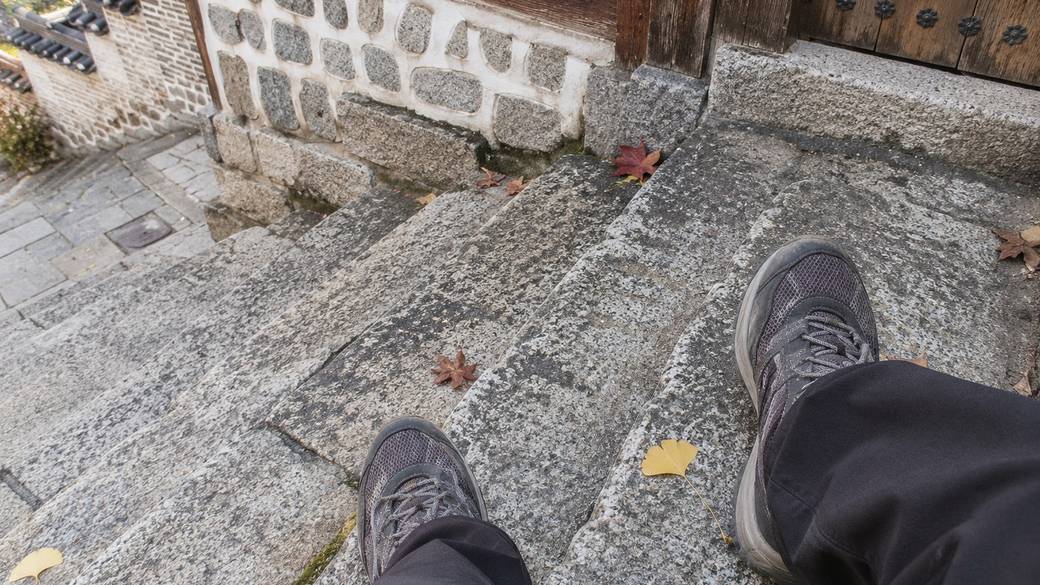
Seoul and Busan are built on hills, and many of the sights first-timers want are on the steepest parts. Bukchon’s hanok lanes climb from Anguk Station, Ihwa Mural Village sits on a hillside of slopes and steps, and Busan’s Gamcheon Culture Village was built by war refugees in staircase fashion on the foothills of a coastal mountain, as VisitKorea puts it. Seoul’s own Media Hub describes the Namsan city-wall route from the Jangchung Gymnasium side as about 3 km, mostly uphill, with slopes and bare-earth stretches, and recommends sneakers.
The subway adds distance underground. Transfers at big stations can be long walks with stairs, though Seoul says that since 29 December 2025 all 338 of its subway stations have an elevator route from the street entrance to the platform. If stairs are hard for you, that route exists at every station, but it may be at a different exit from the one your map app suggests; our Seoul subway guide and limited-mobility guide explain how to find it.
For a sense of how hilly a single walk gets, our Bukchon hanok walk and Seoul city wall walk give the distances and climbs.
What shoes work for winter ice and July rain?
These are the two seasons when your normal city sneakers may let you down.
Winter (December to February). VisitKorea’s climate page tells winter visitors to bring non-slip shoes for walking on snow. Korea’s government winter safety manual (Korea.kr, December 2024) says to wear non-slip shoes such as sneakers rather than slippery dress shoes or slippers, to take your hands out of your pockets and to walk in short steps. Seoul’s Media Hub gives the same advice: put your whole sole down, walk slowly and wear non-slip shoes. What this means for packing: a deep rubber tread matters more than insulation in the city, where you are in and out of heated shops and trains. If you are heading to a ski resort or a snow festival, add warm waterproof boots. The winter packing list has the rest of the cold-weather kit.
Monsoon (late June to late July). On the Korea Meteorological Administration’s 1991–2020 normals, Seoul’s July rainfall is 414.4 mm, its wettest month, against 16.8 mm in January. The KMA’s normal monsoon season in the central region runs from 25 June to 26 July; in 2026 it started on 1 July. Leather shoes and thick canvas stay wet for days in the summer humidity. Better choices are mesh sneakers that dry overnight or sandals with a back strap, plus a second pair so one can dry. The rainy season guide covers umbrellas, flash-flood warnings and indoor plans.
Do you need hiking boots?
Only if a mountain day is part of the plan. For Namsan, the city-wall paths and palace grounds, good sneakers are enough. For Bukhansan’s granite peaks or Seoraksan, Korea’s Ministry of the Interior and Safety tells hikers to keep the pack light and wear hiking boots that fit.
You may not have to pack them. Since May 2026 the Korea National Park Service lends nine items of safety gear free in Korea’s mountain national parks: hiking boots, poles, a backpack, knee guards, a first-aid kit, a seat cushion, a map, crampons and hand warmers (Kyunghyang Shinmun, 27 May 2026). Anyone can borrow them by filling in an application and a personal-data consent form at a park visitor centre, and gear must be returned the same day. Items and opening hours vary by park, so do not count on your size being in stock. In Seoul, the Seoul Hiking Tourism Center at Bukhansan also rents hiking shoes and clothing to foreign hikers, according to VisitKorea.
In winter, the crampons (아이젠) matter more than the boots: icy granite steps are common on Bukhansan from December. Our best hiking trails guide rates each trail’s difficulty.
Can you buy shoes in Korea instead?
Yes, and it can make sense if you are from Singapore, Malaysia or the Philippines and do not own winter shoes, or if you want a model released only in Asia. Two things to sort out first: your size in millimetres and the tax refund.
What is my shoe size in Korea?
Korean shops label shoes by foot length in millimetres. Nike Korea’s product pages list a US women’s 8 and a US men’s 7 as 250, and Nike’s own size charts give the matching UK and EU numbers.
Korean shoe sizes in mm vs US, UK and EU on Nike charts (checked 20 Nov 2026)
| Korea (mm) | Women: US / UK / EU | Men: US / UK / EU |
|---|---|---|
| 220 | 5 / 2.5 / 35.5 | — |
| 230 | 6 / 3.5 / 36.5 | — |
| 240 | 7 / 4.5 / 38 | — |
| 250 | 8 / 5.5 / 39 | 7 / 6 / 40 |
| 260 | 9 / 6.5 / 40.5 | 8 / 7 / 41 |
| 270 | 10 / 7.5 / 42 | 9 / 8 / 42.5 |
| 280 | — | 10 / 9 / 44 |
| 290 | — | 11 / 10 / 45 |
| 300 | — | 12 / 11 / 46 |
Read this as a starting point, not a guarantee: the mm and US figures come from Nike Korea, UK and EU from Nike UK’s charts, and other brands run differently (Nike Korea even notes that the Air Force 1 runs large and suggests half a size down).
Before you fly, measure your foot: stand on paper, mark the tip of your big toe and the back of your heel, and measure in millimetres. Use the longer foot.
Where do tourists buy shoes, and what does it cost?
The Myeongdong area is the easiest one-stop: ABC-Mart’s Myeongdong Jungang branch (12 Myeongdong 8-gil, 11:00–22:30 on its KTO tax-refund listing, updated March 2026) and Musinsa Standard’s Myeongdong store which offers instant tax refunds. JoongAng Daily reported in August 2026 that foreign customers’ share of transactions at Musinsa Kicks rose from the 40% range in January to 70% in July, with tourists typically buying one or two pairs at ₩100,000–200,000 each.
Shoe prices seen in Seoul in 2026, with source and date
| Shoe | Where | Price | Source |
|---|---|---|---|
| Nike Air Max Bia | ABC-Mart | ₩59,000 (US$95 on Nike US) | JoongAng Daily, Aug 2026 |
| Adidas Samba Jane | Musinsa Kicks | ₩118,990 | JoongAng Daily, Aug 2026 |
| Nike Air Force 1 ’07, white | Nike Korea online | ₩149,000 | nike.com/kr, 20 Nov 2026 |
The takeaway: discounted and Asia-only models can be good value, while full-price global models cost about what they do at home before the tax refund.
Shoes count as taxable goods for the tourist refund. VisitKorea says single payments of ₩15,000 to under ₩1,000,000 can be refunded instantly at the till, up to ₩5,000,000 per trip, if you show your passport. Our tax refund guide explains the airport kiosk for bigger receipts, and the Myeongdong shopping guide maps the streets.
Which country notes matter?
- Singapore, Malaysia, Philippines, India: if you are coming for December to February and own only tropical footwear, budget for a non-slip winter pair in Seoul on day one, or buy before you fly if your size is hard to find.
- Australia: Korea’s coldest months fall in your summer school holidays. Pack a closed, grippy pair even if it is 30 °C when you leave.
- US, Canada, UK: the shoes you would wear for a city break at home are fine; the difference is how often they come off, so favour slip-on convenience over ankle support.
When this advice is wrong: if your trip is mostly mountain hiking, or you have a foot condition that needs specific support, start from your own hiking or orthotic shoes rather than city sneakers.
Common mistakes
Avoid these
- Packing brand-new shoes and breaking them in on Namsan.
- Wearing smooth leather soles in January or on rainy temple steps.
- Bringing only one pair in July, so nothing dries.
- Lace-up boots on a day with temples, a floor-seating dinner and a hanok stay.
- Assuming your size number travels: check the mm figure on the box.
- Forgetting your passport when shoe shopping, so no instant tax refund.
For everything else that goes in the bag, see the Korea packing list and the month-by-month Korea weather guide.
Questions people ask
- What shoes do I need for Korea?
- One pair of broken-in, cushioned sneakers covers most trips. Add a non-slip pair for December to February, when pavements ice over, or a quick-dry pair for the late-June-to-July monsoon. Make sure your main pair slips off easily, because you remove shoes in temples, guesthouses and some restaurants.
- Do you have to take your shoes off in Korean restaurants?
- Only in some. Visit Seoul notes that restaurants with low tables and floor seating ask diners to remove their shoes; places with chairs do not. Look for a raised floor or a shoe rack at the edge of the seating area, and wear socks without holes.
- Are sandals OK in Korea?
- Yes in summer for city walking, and sandals with a back strap cope well with July rain. They are a poor choice on mountain trails, and at least one templestay programme asks for socks and sneakers and bans slippers and flip-flops in the temple.
- What is my shoe size in Korea?
- Korea uses foot length in millimetres. On Nike Korea, a US women's 7 is 240 and an 8 is 250; a US men's 9 is 270 and a 10 is 280. Brands differ, so measure your foot in millimetres before trying shoes on.
- Are shoes cheaper in Korea?
- Sometimes. JoongAng Daily found a Nike Air Max Bia at ₩59,000 at an ABC-Mart in August 2026, against US$95 on Nike's US site, and tourists can claim the VAT back. Mainline models such as the Air Force 1 cost ₩149,000 on Nike Korea, which is not a bargain.
Next in your trip
- Korea packing list — the rest of the bag, season by season
- Korea winter packing list — coats, layers and gloves for December to February
- Korea tax refund — how the instant refund works if you buy shoes in Seoul
Sources
- 기상청 – 서울 지역 기후 특성 (평년값 1991–2020) (Korean)
- 기상청 – 2026년 6월 기후특성 보도자료 (3 Jul 2026) (Korean)
- 경향신문 – 전국 국립공원에서 등산화·등산스틱·아이젠 무료로 빌린다 (27 May 2026) (Korean)
- 대한민국 정책브리핑 – 겨울철 안전 매뉴얼 (12 Dec 2024) (Korean)
- 대한민국 정책브리핑 – 꼭 알아야 할 산행 안전 국민행동요령 (행정안전부, 14 Oct 2022) (Korean)
- 서울 미디어허브 – 서울 지하철 전 역사 엘리베이터 설치 완료 (9 Jan 2026) (Korean)
- 서울 미디어허브 – 남산 성곽길 (오르막 3km, 운동화 권장) (8 Nov 2019) (Korean)
- Nike Korea – Air Force 1 '07 men's and women's product size data (checked 20 Nov 2026) (Korean)
- Visit Seoul – Korean Etiquette
- VisitKorea – Climate and Seasons
- Nike UK – Men's and women's shoe size charts
- VisitKorea – Tax refund for foreign tourists
- Korea JoongAng Daily – K-kicks: foreign tourists flock to Seoul shoe stores (28 Aug 2026)
- Templestay – Woljeongsa programme page (what to bring)
- VisitKorea – Seoul Hiking Tourism Center
Updates
- Published with the shoes-off rules, Korean mm sizes from Nike Korea and Nike UK charts, KMA rain normals, winter ice advice, the national park free boot rental and 2026 shoe prices.
About Korea Field Notes
An English guide to the practical side of visiting South Korea. Guides are researched from Korean-language official sources (Korail, T-money, Seoul Metro, the Korea Tourism Organization) and re-checked when rules or prices change. Each guide shows when its facts were last checked and lists its sources. About the site · How we research and update guides · Found something out of date? Tell us.