Korea Packing List: What to Pack for Every Season (2026)
Climate figures are KMA 1991–2020 normals; plug, clothing and tax-refund details are from VisitKorea's English pages; the power bank rule is MOLIT's 8 Apr 2026 announcement as reported by Kyunghyang; the toiletries rule is the 29 Mar 2024 resource-recycling law change; all checked 18 Oct 2026.
Pack for your month, not for Korea: Seoul swings from −5.5 °C January lows to 30 °C August highs, so winter needs a padded coat and summer an umbrella. Bring a Type C/F adapter for 220 V sockets and at most two power banks in your carry-on (rule since 20 April 2026, checked 18 Oct 2026).
Best forFirst-timersFamiliesWith luggageBudget
Your situation → do this
| If you… | Do this |
|---|---|
| You travel December to February | Padded coat, hat, gloves, thermal base layer and non-slip shoes |
| You travel March to May or September to November | Layers: T-shirts, a light knit and a jacket; nights drop to single digits |
| You travel June to August | Breathable clothes, a compact umbrella and sunscreen; monsoon late June to late July |
| Your plug is flat-pinned (US, Canada, UK, Australia, Singapore, Malaysia) | Bring a Type C/F adapter and check chargers say 100–240 V |
| You fly with a power bank | Two at most, 160 Wh or less each, in your carry-on, unused on board |
Key takeaways
- Seoul averages −5.5 °C lows in January and 30.0 °C highs in August: pack for your month.
- Sockets are 220 V, 60 Hz with two round holes; US, UK, Australian and Singapore plugs need an adapter.
- From 20 April 2026: two power banks per person, 160 Wh each at most, carry-on only, unused on board.
- Hotels with 50+ rooms may not hand out free toothbrushes, toothpaste, shampoo, conditioner or razors (since 29 March 2024).
- Leave bag space: instant tax refunds cover ₩15,000–₩1,000,000 purchases, up to ₩5,000,000 per trip.
| Seoul, coldest and hottest months | Jan 2.1 / −5.5 °C; Aug 30.0 / 22.9 °C (high / low)Source: KMA 1991–2020 normals |
|---|---|
| Electricity | 220 V, 60 Hz, two round pins (Type C/F)Source: VisitKorea, Electricity & Communications |
| Power banks on flights (from 20 Apr 2026) | Max 2 per person, ≤ 160 Wh each, carry-on only, no use on boardSource: MOLIT via Kyunghyang, 8 Apr 2026 |
| Free hotel toiletries | Banned at lodgings with 50+ rooms since 29 Mar 2024Source: Resource Recycling Act, via YTN |
| Monsoon (Seoul region), normal dates | 25 June–26 JulySource: KMA rainy-season normals |
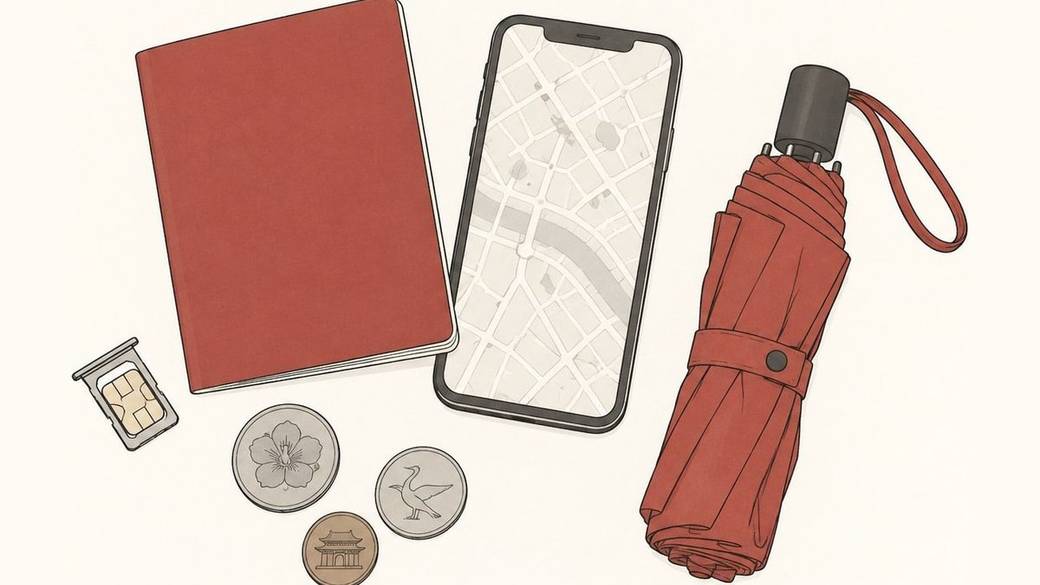
This list is sorted by what decides your bag: the month you travel, your plug, the 2026 flight battery rule and what is cheaper to buy on arrival. More planning basics are in Planning Guides.
What should you pack for your month?
Korea has four distinct seasons, and Seoul’s average swings by about 35 °C between the January low and the August high. The grid shows Seoul’s averages with the one-line clothing call for each month.
| Month | High / low °C | High / low °F | Rain | Verdict | Note |
|---|---|---|---|---|---|
| Jan | 2.1 / −5.5 | 36 / 22 | 17 mm | Fine with caveats | Padded coat, hat, gloves |
| Feb | 5.1 / −3.2 | 41 / 26 | 28 mm | Fine with caveats | Padded coat, thermals |
| Mar | 11 / 1.9 | 52 / 35 | 37 mm | Fine with caveats | Warm coat for evenings |
| Apr | 17.9 / 8 | 64 / 46 | 73 mm | Good | Jacket, knit, dust mask |
| May | 23.6 / 13.5 | 74 / 56 | 104 mm | Great | T-shirts plus a light layer |
| Jun | 27.6 / 18.7 | 82 / 66 | 130 mm | Good | Light clothes, umbrella |
| Jul | 29 / 22.3 | 84 / 72 | 414 mm | Fine with caveats | Quick-dry clothes, umbrella |
| Aug | 30 / 22.9 | 86 / 73 | 348 mm | Fine with caveats | Breathable clothes, sunscreen |
| Sep | 26.2 / 17.7 | 79 / 64 | 142 mm | Good | Summer clothes, light layer |
| Oct | 20.2 / 10.6 | 68 / 51 | 52 mm | Great | Layers and a light jacket |
| Nov | 11.9 / 3.5 | 53 / 38 | 51 mm | Good | Warm jacket or coat |
| Dec | 4.2 / −3.4 | 40 / 26 | 23 mm | Fine with caveats | Padded coat, hat, gloves |
If your month is labelled “Fine with caveats”, the caveat is cold (December to March) or heat and rain (July and August); the clothes in each cell are what deals with it.
Busan and Jeju run milder in winter and similar in summer, so a Seoul-ready bag covers the whole country. City-by-city numbers, monsoon and typhoon timing are in Korea weather by month.
What clothes do you need in each season?
The Korea Tourism Organization’s own advice matches the averages: a light jacket or trench coat in March, short sleeves plus outerwear in May, breathable clothes and rain gear in summer, layers in autumn and thick outerwear “at all times” in winter. Here is what that means in a bag.
Winter: December to February
- A padded or down coat that covers your hips. Seoul’s average low stays below freezing for three months, and wind along the Han River makes it feel colder.
- Thermal base layers, a hat, gloves and a scarf. VisitKorea also recommends non-slip shoes for snowy pavements.
- Lip balm and hand cream. December and January are Seoul’s driest months, with 22.6 mm and 16.8 mm of precipitation on average.
- Light inner layers. Metro carriages, shops and cafés are well heated, so a thin knit under the coat beats a thick jumper.
For the cold months in detail, see Korea in December.
Spring: March to May
- A jacket or trench coat for March and April evenings (lows of 1.9 °C and 8.0 °C), and short sleeves plus one layer for May.
- A few KF94 masks, or buy them there. Spring is the fine-dust and yellow-dust season; masks are sold in convenience stores and pharmacies.
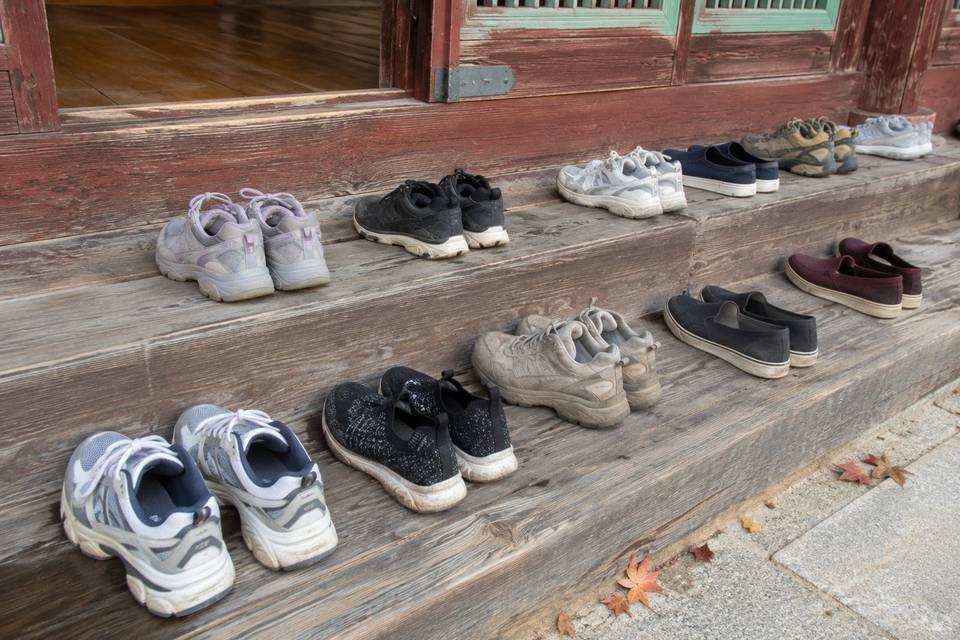
- Comfortable walking shoes. Cherry blossom walks and palace grounds mean long days on foot; our guide to the best shoes for walking in Korea covers hills, slip-off floors and buying a pair in Korean sizes. Blossom timing is in Korea cherry blossom season.
Summer: June to August
- Breathable, quick-dry clothes. August averages 30.0 °C highs and 22.9 °C lows, with high humidity.
- A compact umbrella or light rain jacket. The monsoon normally runs 25 June to 26 July around Seoul, and July averages 414.4 mm of rain. What that means day to day is in our Korea rainy season guide.
- Sunscreen, a hat and sandals that can get wet. Bring one long-sleeved layer: indoor air conditioning is strong.
Autumn: September to November
- Summer clothes for September, which still averages 26.2 °C highs.
- Layers from October: T-shirts or long sleeves, a light knit and a jacket. October nights average 10.6 °C.
- A warmer coat from mid-November, when Seoul’s average low falls to 3.5 °C. Foliage timing is in Korea autumn foliage.
Which plug adapter do you need?
Korean sockets supply 220 volts at 60 hertz and have two round holes, according to VisitKorea; that is the IEC’s Type C and Type F, the same as most of continental Europe. Whether you need an adapter depends on the pins on your plug.
Plug types by home country and whether they fit Korean sockets (IEC World Plugs, checked 18 Oct 2026)
| Home country | Your plug (IEC) | Adapter needed? | Watch out for |
|---|---|---|---|
| US, Canada | A, B (flat pins), 120 V | Yes | Single-voltage hair tools |
| UK, Singapore, Malaysia | G (three rectangular pins) | Yes | Bulky UK chargers in tight sockets |
| Australia | I (angled flat pins) | Yes | — |
| Philippines | A, B, C | Yes for flat pins | Type C fits as is |
| India | C, D, M | Yes for D and M | Type C fits as is |
| Most of Europe | C, E, F | No | — |
Almost everyone outside continental Europe needs a Type C/F adapter, and anyone from the US or Canada should also check their devices’ voltage label.
Phone, laptop and camera chargers are usually marked “100–240 V” and only need the adapter. A device marked 110–120 V only, such as many North American hair dryers and straighteners, needs a voltage converter or should stay at home. A multi-USB charger with one adapter is lighter than one adapter per device. Our plug and voltage guide walks through the label check device by device, with what to buy if you land without an adapter.
What are the 2026 power bank rules on flights?
Korea tightened its rules after a power bank fire on an Air Busan plane in January 2025. The Ministry of Land, Infrastructure and Transport (MOLIT) said on 8 April 2026 that a new standard, approved by ICAO on 27 March, would apply from 20 April 2026:
- Two power banks per person at most, each 160 Wh or less (about 43,000 mAh). Before this, there was no count limit for packs of 100 Wh or less.
- Carry-on only. Power banks of any size may not go in checked baggage, and packs over 160 Wh may not fly at all.
- No charging on board: you may not charge the power bank or use it to charge your phone or tablet.
Korean Air, Asiana, Jin Air, Air Busan and Air Seoul had already banned in-flight power bank use from 26 January 2026. They also ask passengers to tape the terminals or keep each power bank in its own pouch, and to keep it within reach (seat pocket or under the seat in front), not in the overhead bin. How to read a pack’s Wh rating, when a laptop pack needs airline approval and what happens at security are in our guide to flying with a power bank in Korea.
What can you skip and buy in Korea?
Korea is an easy place to buy what you forgot, and some things are cheaper or better there. Pack light on these and leave room for shopping.
Buy there or bring: common packing items for Korea (store types checked 18 Oct 2026)
| Item | Bring or buy? | Where in Korea | Note |
|---|---|---|---|
| Toothbrush, toothpaste | Bring | Convenience stores, Daiso | Larger hotels may not provide them free |
| Shampoo, body wash | Bring travel size or buy | Olive Young, Daiso | Many hotels use refill dispensers |
| Sunscreen, sheet masks | Buy | Olive Young | Wide choice of Korean brands |
| Umbrella | Either | Convenience stores | CU, GS25 and 7-Eleven stock them |
| Dust masks (KF94) | Buy | Convenience stores, pharmacies | Needed mainly in spring |
| Prescription medicine | Bring | — | Bring enough for the whole trip |
The only item you cannot easily replace is prescription medicine; everything else in a forgotten-items panic is a short walk away.
Shopping guides: Olive Young for skincare and toiletries and Daiso for cheap travel gear; for clothes, our Korean fashion stores guide sorts Seoul’s shops by budget. If you plan to shop seriously, pack a foldable bag. VisitKorea lists the immediate tax refund at participating stores for single purchases of ₩15,000 to ₩1,000,000, up to ₩5,000,000 per trip, so bigger buys are common.
Why your hotel may not have a toothbrush
Since 29 March 2024, lodgings with 50 or more rooms may not give guests disposable toothbrushes, toothpaste, shampoo, conditioner or razors free of charge, under the revised Act on the Promotion of Saving and Recycling of Resources (fine up to ₩3,000,000, as reported by YTN). Many large hotels switched to wall-mounted dispensers for shampoo and body wash, and some sell kits at the front desk or in the room. Smaller guesthouses vary, so pack a toothbrush and toothpaste whatever you book.
What goes in your carry-on?
Keep the things you need at the arrival hall, and the things you cannot replace, in the bag that stays with you.
Carry-on for arrival day
- Passport, plus your K-ETA approval or visa if your passport needs one
- Hotel address in Korean (a screenshot works) for the taxi or bus driver
- A Visa or Mastercard, plus a second card from another bank
- A phone with your eSIM installed before you fly
- Power banks (two at most), charging cable and adapter
- Prescription medicines in their original packaging, with a copy of the prescription
- One warm layer for arrival if you land between November and March
K-ETA: Korea’s temporary K-ETA exemption for 22 countries and regions, including the US, UK, Canada, Australia and Singapore, runs until 31 December 2026, according to the notice published by Korean missions. Malaysia, the Philippines and India are not on that list, so check k-eta.go.kr or your nearest Korean embassy for your passport.
Money and transit: buy a transit card on arrival rather than bringing cash for every fare. Which one suits you is in T-money vs WOWPASS vs Climate Card, and the trip from the airport is in Incheon Airport to Seoul.
Medicines: Korea Customs Service lists narcotics, psychotropic medicines, hemp products and “medicines that may be misused or abused” as goods to declare. Its passenger guide gives no simple personal-use quantity, so if your medicine is a controlled drug, ask the Korean embassy before you travel. Our guide to bringing medication into Korea covers the 6-bottle limit and the MFDS permit for controlled medicines.
What packing mistakes do first-timers make?
- No adapter on arrival day. You land with a dying phone and need maps. Pack it where you can reach it.
- Only one card. Overseas cards are usually accepted, but a card can get blocked when your bank sees spending abroad. Bring a backup.
- Heavy shoes for summer. In the July monsoon, sandals or quick-dry shoes beat leather that stays wet for days.
Questions people ask
- What should I wear in Korea in October?
- Layers. Seoul's October normals are 20.2 °C highs and 10.6 °C lows, so a T-shirt or long sleeves by day and a light jacket or knit for the evening. From late October and in November, add a warmer coat; Seoul's November low is 3.5 °C.
- Do I need a plug adapter in Korea?
- Only if your plugs are not two round pins. Korean sockets take Type C and F plugs at 220 V, 60 Hz. Travellers from the US, Canada, UK, Australia, Singapore, Malaysia and the Philippines (flat pins) need an adapter; most European plugs fit as they are.
- How many power banks can I take on a flight from Korea?
- Two per person, each 160 Wh (about 43,000 mAh) or less, under the rule in force since 20 April 2026. They must be in your carry-on, never checked, and you may not charge them or charge anything from them on board.
- Do Korean hotels give you toothbrushes and shampoo?
- Not for free at larger places. Since 29 March 2024, lodgings with 50 or more rooms may not give away disposable toothbrushes, toothpaste, shampoo, conditioner or razors. Many use refillable dispensers for shampoo, but bring your own toothbrush and toothpaste.
- Can I buy what I forgot in Korea?
- Almost everything. Convenience stores sell umbrellas, masks and plug adapters; Olive Young covers sunscreen and toiletries; Daiso covers cheap travel basics. Prescription medicines are the exception: bring enough for the whole trip.
Next in your trip
- Korea weather by month — Seoul, Busan and Jeju normals, monsoon and typhoon dates
- eSIM vs SIM vs pocket Wi-Fi — sort mobile data before you fly
- T-money vs WOWPASS vs Climate Card — the transit card to buy on arrival
Sources
- VisitKorea – Climate & Seasons (recommended seasonal attire, last updated 18 Sep 2026)
- VisitKorea – Electricity & Communications (220 V, 60 Hz, last updated 11 Sep 2026)
- 기상자료개방포털 – 우리나라 기후평년값 (1991~2020) (Korean)
- 기상자료개방포털 – 장마 평년 시작일·종료일 (Korean)
- 경향신문 – 보조배터리 기내 반입 1인당 2개·160Wh 이하, 기내 충전·사용 금지 (국토교통부, 8 Apr 2026) (Korean)
- 스마트투데이 – 한진 소속 5개 항공사 26일부터 보조배터리 기내 사용 금지 (23 Jan 2026) (Korean)
- YTN – 객실 50실 이상 숙박업소 일회용품 무상제공 금지 (29 Mar 2024) (Korean)
- IEC – World Plugs (plug types and voltage by country)
- Korea Customs Service – Customs Clearance Guide for Passengers
- VisitKorea – Duty Free & Tax Refunds (immediate refund limits)
Updates
- Published with KMA 1991–2020 Seoul normals, the 20 April 2026 power bank limits, plug types by country and the 2024 hotel toiletries rule.
About Korea Field Notes
An English guide to the practical side of visiting South Korea. Guides are researched from Korean-language official sources (Korail, T-money, Seoul Metro, the Korea Tourism Organization) and re-checked when rules or prices change. Each guide shows when its facts were last checked and lists its sources. About the site · How we research and update guides · Found something out of date? Tell us.