Busan Food Guide: 9 Local Dishes and Where to Eat Them
Hours, closures and prices checked against the Jagalchi Market operator (Busan Facilities Corporation), Visit Busan, VisitKorea, the Michelin Guide, Korea Consumer Agency data and Korean press on 30 Oct 2026.
Eat dwaeji gukbap (pork and rice soup), milmyeon (cold wheat noodles) and raw fish at Jagalchi Market first: a bowl of gukbap is about ₩10,000 and milmyeon is usually under ₩10,000. Jagalchi closes on the 1st, 3rd and 5th Tuesday, and the Bupyeong night market runs 19:30–24:00 (checked 30 Oct 2026).
Best forFirst-timersBudgetSolo
Your situation → do this
| If you… | Do this |
|---|---|
| You have one meal and want the dish Busan is known for | Dwaeji gukbap: about ₩9,000–₩10,000 a bowl, with rice and kimchi included |
| You are on the Nampo / Jagalchi side for a day | Lunch on raw fish at Jagalchi (not on a 1st, 3rd or 5th Tuesday), then the Bupyeong night market after 19:30 |
| You are staying in Haeundae or Gwangalli | Haeundae Market (09:00–22:00) for casual food, Millak Raw Fish Town for sashimi by the beach |
| You don't eat pork, or you eat halal or vegetarian | Skip gukbap and ask about the broth before milmyeon; fish cakes and raw fish are the easier picks |
Key takeaways
- Start with dwaeji gukbap, milmyeon, fish cakes and raw fish; together they cover Busan's best-known food.
- Dwaeji gukbap: ₩10,000 a bowl at Busan-named chains (Dec 2025); Michelin lists three gukbap shops as Bib Gourmand.
- Jagalchi Market opens about 05:00–22:00 and closes on the 1st, 3rd and 5th Tuesday of each month.
- Bupyeong Kkangtong night market runs daily 19:30–24:00, a 10-minute walk from Jagalchi Station exit 3.
- Carry cash in small notes: VisitKorea warns that traditional market stalls may not take cards.
| Jagalchi Market | About 05:00–22:00 (varies by shop); closed 1st, 3rd and 5th Tuesday; Jagalchi Station exit 10Source: Busan Facilities Corporation (Jagalchi Market), Visit Busan |
|---|---|
| Next Jagalchi closures | 3 and 17 Nov 2026; 1, 15 and 29 Dec 2026Source: Calculated from the market's 1st/3rd/5th-Tuesday rule |
| Bupyeong Kkangtong night market | Daily 19:30–24:00; 10 min walk from Jagalchi Station exit 3Source: Visit Busan |
| Dwaeji gukbap | ₩10,000 a bowl at two Busan-named gukbap chains (Dec 2025)Source: Hankyung Business, 5 Dec 2025 |
| Busan restaurant averages, June 2026 | Naengmyeon ₩11,857 · kalguksu ₩8,071 · kimbap ₩3,543 · samgyeopsal ₩18,175 per 200 gSource: Korea Consumer Agency, via haps Magazine (Stars and Stripes Korea), 18 Aug 2026 |
| Busan metro | ₩1,600 per ride with a transit card (zone 1, up to 10 km)Source: Busan Transportation Corporation |
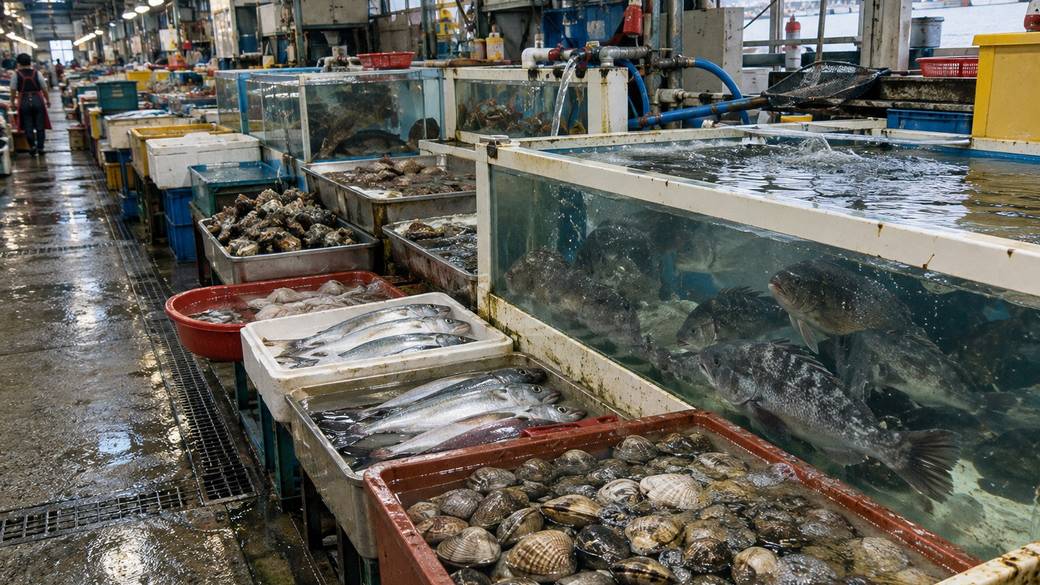
Busan’s food is cheaper and more local than Seoul’s: a pork soup that locals queue for, cold noodles born in the Korean War, fish cakes and a fish market where you buy downstairs and eat upstairs. This guide sits in our Busan section and is ordered by what to eat first, then where, then what it costs.
Which Busan dishes should you eat first?
If you have two or three days, these four are the ones to fit in. The rest are worth adding if they happen to be on your route. Ratings are ours, based on how closely each dish is tied to Busan and how easy it is for a first-timer to find.
Must
- What it is
- Pork-bone soup with sliced pork and rice
- Why go
- Busan's signature dish; about ₩9,000–₩10,000
- Time needed
- 30 min
- What it is
- Cold wheat noodles in iced broth or a spicy sauce
- Why go
- Only really found in Busan; usually under ₩10,000
- Time needed
- 20 min
- What it is
- Raw fish you choose live, cut and served upstairs
- Why go
- The country's best-known fish market
- Time needed
- 1.5 hours
- What it is
- Busan fish cakes, from skewers to bakery-style shops
- Why go
- Cheap, everywhere, easy for pescatarians
- Time needed
- 15 min
Worth it
- What it is
- Fried sweet pancake split and filled with seeds
- Why go
- The BIFF Square street snack
- Time needed
- 10 min
- What it is
- Spicy octopus, beef tripe and shrimp hotpot
- Why go
- Busan-born; ₩11,000–₩14,000 per person
- Time needed
- 1 hour
If time
- What it is
- Glass noodles with fish cake and chilli sauce
- Why go
- A Kkangtong Market stall snack
- Time needed
- 15 min
- What it is
- Grilled hagfish, spicy or salted
- Why go
- Adventurous; about ₩18,000–₩19,000 a serving
- Time needed
- 1 hour
- What it is
- Thick green-onion and seafood pancake
- Why go
- Old Dongnae speciality, off the main tourist loop
- Time needed
- 1 hour
Dwaeji gukbap (pork and rice soup)
This is the dish to eat if you only eat one. It is a milky or clear pork-bone broth with sliced pork, served with rice (in the bowl or on the side), kimchi, raw onion, chives and salted shrimp so you can season it yourself. Add the chives and a little shrimp before you taste it; the broth is mild on purpose.
Busan treats it as civic property. In October 2026 the city and the Busan Tourism Organization ran the 2026 Busan Pork Gukbap Festival: residents nominated shops, the public voted on a shortlist of 20 during a “gukbap week” from 28 September to 14 October, and KNN reported on 16 October that about 38,000 people had voted, with the top three shops given plaques (Herald Kyungje, KNN). The Michelin Guide’s Busan Bib Gourmand list, its good-value category, includes three dwaeji gukbap shops: Jeongjitgan, Hapcheon Gukbapjip and Anmok. Search those names on Naver Map for the current address and hours.
On price, two Busan-named gukbap chains charged ₩10,000 a bowl in December 2025 (Hankyung Business). Busan shop menus listed on busantaste.com in October 2026 mostly sat at ₩9,000–₩10,000, with a few older places at ₩7,000–₩8,000 and some Haeundae shops at ₩13,000. Ask for suyuk baekban (수육백반) if you want the pork on a separate plate.
Milmyeon (cold wheat noodles)
Milmyeon is Busan’s own cold noodle. After the Korean War, refugees from the North who had sold naengmyeon found buckwheat and potato starch hard to get, so they used wheat flour from US aid instead (Busan’s Provisional Capital Memorial Hall, via Segye Ilbo, August 2026). Shops such as Gaegeum Milmyeon in Busanjin-gu and Gaya Milmyeon near Dong-eui University spread the style in the 1970s.
You will see two versions. Mul milmyeon (물밀면) comes in a chilled, slushy broth; bibim milmyeon (비빔밀면) comes in a chilli-paste sauce. Add vinegar and mustard at the table. Most shops serve it all year, not only in summer.
It is also cheap. Most shop menus on busantaste.com in October 2026 listed milmyeon at ₩7,000–₩9,000, with the best-known Haeundae shop at ₩10,000–₩11,000. Compare that with Busan’s average naengmyeon price of ₩11,857 in June 2026 (Korea Consumer Agency).
How much does food cost in Busan?
Busan is a little cheaper than Seoul for everyday meals, but prices are rising faster: the Korea Consumer Agency found Busan’s eight benchmark dishes up 5.4% in a year to March 2026, against 3.9% in Seoul (haps Magazine).
Busan food prices, ₩ (official averages June 2026; shop menus checked 30 Oct 2026)
| Dish | What you pay | Source type | Note |
|---|---|---|---|
| Dwaeji gukbap | ₩9,000–₩10,000 | Chain prices, shop menus | Rice and side dishes included |
| Milmyeon | ₩7,000–₩9,000 | Shop menus | Large size about ₩1,000 more |
| Naengmyeon (for comparison) | ₩11,857 | Korea Consumer Agency average | June 2026 |
| Kalguksu | ₩8,071 | Korea Consumer Agency average | June 2026 |
| Kimbap | ₩3,543 | Korea Consumer Agency average | Up 11.2% in a year |
| Samgyeopsal | ₩18,175 per 200 g | Korea Consumer Agency average | Often a 2-serving minimum |
| Nakgopsae | ₩11,000–₩14,000 per person | Shop menus | Often a 2-serving minimum |
| Kkomjangeo | ₩18,000–₩19,000 a serving | Shop menus (Jung-gu) | Sets for two are more |
| Busan metro ride | ₩1,600 | Busan Transportation Corporation | Transit card, up to 10 km |
A day of local food (gukbap for lunch, milmyeon or fish cakes in the afternoon, a shared hotpot at night) comes to roughly ₩35,000–₩45,000 per person before drinks, while a raw-fish dinner is the one meal that can easily cost several times that. For whole-trip numbers, see our Korea travel budget.
Where should you eat in Busan?
Busan’s food is spread out, so match the market to where you are staying rather than crossing the city for one dish. Most first-timers split their days into the old-port side (Nampo, Jagalchi) and the beach side (Haeundae, Gwangalli); our where to stay in Busan guide explains the bases.
Busan food markets: hours and nearest station (Visit Busan, VisitKorea, market operator; checked 30 Oct 2026)
| Market | Hours | Closed | Nearest station | Go for |
|---|---|---|---|---|
| Jagalchi Market | About 05:00–22:00 | 1st, 3rd, 5th Tuesday | Jagalchi (Line 1) exit 10, 6 min | Raw fish, grilled fish |
| Bupyeong Kkangtong night market | 19:30–24:00 daily | None listed | Jagalchi (Line 1) exit 3, 10 min | Stall snacks, bibim dangmyeon |
| Gukje Market / BIFF Square | 09:00–20:00 (varies) | Many shops on Sundays | Jagalchi or Nampo (Line 1) | Ssiat hotteok, eomuk |
| Haeundae Market | 09:00–22:00 | Varies by shop | Haeundae (Line 2) exit 3, 5 min | Gukbap, fish cakes, tteokbokki |
| Millak Raw Fish Town | 09:00–02:00 | Varies by shop | Gwangan (Line 2) exit 3, 18 min | Sashimi near Gwangalli Beach |
| Gijang Market | 07:00–22:00 | Varies by shop | Gijang (Donghae Line) | King crab, seafood |
The Nampo side gives you the most food in the smallest area: Jagalchi, Gukje Market, BIFF Square and the night market are all within a 15-minute walk of each other.
A one-day Nampo food loop. Raw fish or grilled fish at Jagalchi for lunch, a ssiat hotteok and fish cakes around BIFF Square in the afternoon, then the Bupyeong Kkangtong night market after 19:30. If your Nampo day falls on a 1st, 3rd or 5th Tuesday, swap it with your Haeundae day.
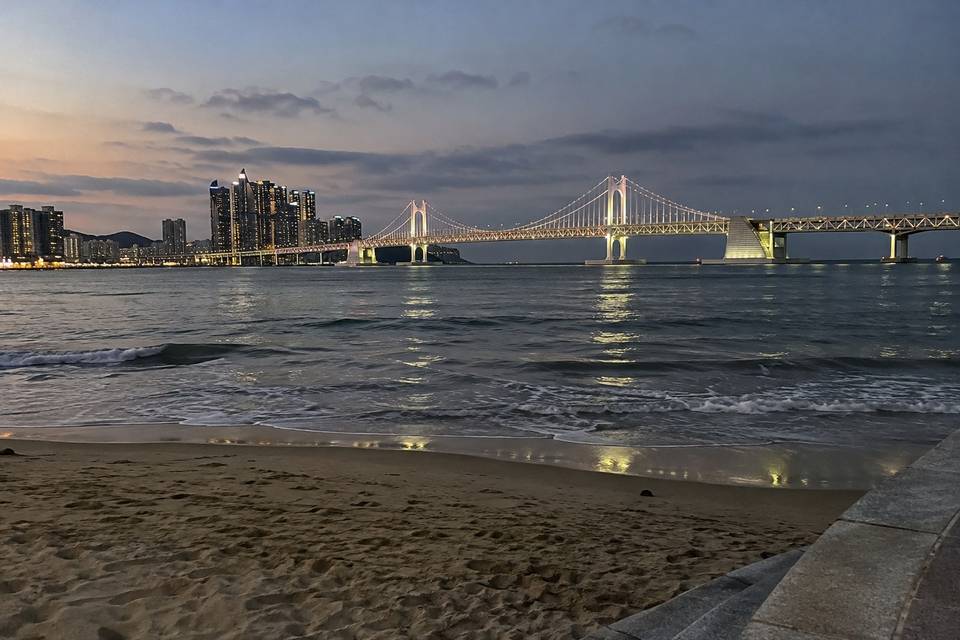
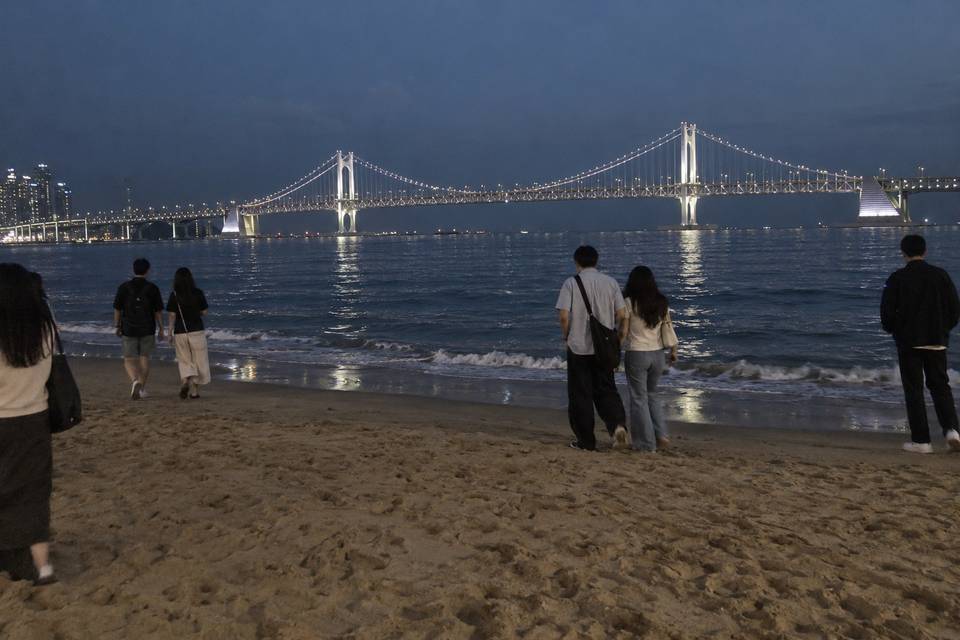
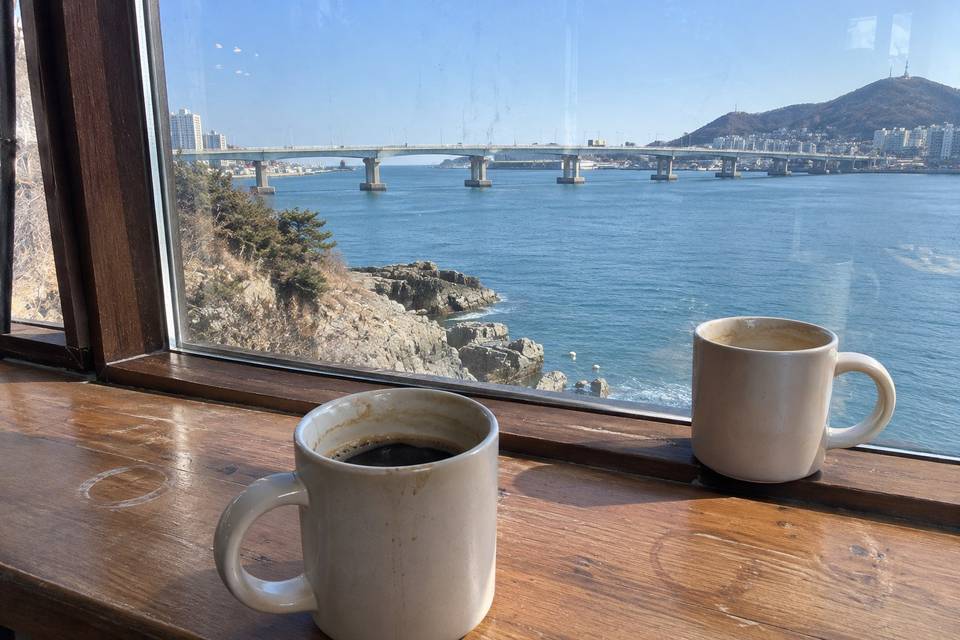
On the beach side. Haeundae Market is a market lane about 5 minutes from Haeundae Station with gukbap, fish cakes and snack stalls, and it is open 09:00–22:00. For sashimi with a view of Gwangan Bridge, Millak Raw Fish Town uses the same buy-downstairs, eat-upstairs system as Jagalchi and stays open until 02:00. For coffee after a meal, the sea-view cafes on Dalmaji Hill are an uphill walk from Haeundae Beach; our Busan view cafe guide lists hours by area.
How does Jagalchi’s buy-downstairs, eat-upstairs system work?
The market operator’s floor guide is simple: the ground floor of the main Jagalchi building sells fresh fish, shellfish, dried and salted seafood, and the second floor is restaurants. You pick the fish below and a restaurant upstairs prepares it.
- Walk the ground floor first. Compare a few stalls before you choose; ask “얼마예요?” (eolmayeyo, how much?) and get the price per fish or per kilo.
- Agree the total before anything is cut. Say how many people are eating and confirm whether the price includes cutting.
- Ask which restaurant it goes to. Stalls usually walk you up or send the fish to a partner restaurant upstairs.
- Ask the restaurant’s table charge before you sit. Upstairs restaurants add a per-person setting fee for sauces, lettuce and side dishes; Visit Busan says only that it “differs by store”.
- Order the extras deliberately. A spicy fish-bone soup (maeuntang, 매운탕) made from the leftover frame is the classic finish, priced separately.
- Pay and keep the receipt. If anything looks wrong, raise it with the market office while you are still there.
If choosing live fish feels like too much, the second-floor restaurants also serve set menus and grilled fish, which come with a fixed price on the menu.
The other five dishes
Eomuk (어묵) — fish cakes. Busan is Korea’s fish-cake city. You will find skewers simmering in broth at every market, and bakery-style shops such as Samjin Eomuk in Yeongdo and Goraesa where you pick pieces with tongs and pay at the till. Many are plain fish paste; others have cheese, sausage or vegetables inside, so read the label if that matters to you.
Ssiat hotteok (씨앗호떡) — seed pancake. A sweet fried pancake that the stall cuts open and stuffs with mixed seeds. Visit Busan names BIFF Square as the place for it. Recipes vary by stall, so ask if you avoid dairy or animal fat.
Nakgopsae (낙곱새) — octopus, tripe and shrimp hotpot. The name stacks three ingredients: nakji (small octopus), gopchang (beef tripe) and saeu (shrimp), cooked at the table in a spicy sauce and eaten over rice. Expect ₩11,000–₩14,000 per person and many shops require two servings.
Bibim dangmyeon (비빔당면) — glass-noodle snack. Sweet-potato glass noodles with fish cake, vegetables and a red chilli sauce, sold as a cheap stall snack in Bupyeong Kkangtong Market. Think of it as a spicy, quick japchae.
Kkomjangeo (꼼장어) and dongnae pajeon (동래파전). Grilled hagfish is a Busan drinking food, usually sold either spicy or salt-grilled; it is chewy and not for everyone. Dongnae pajeon is a thick green-onion pancake with seafood from the old Dongnae district in the north of the city. Both are evening meals with friends rather than snacks, and both are easy to skip on a short trip.
What if you don’t eat pork, or you’re vegetarian?
Busan is harder than Seoul for restricted diets, because its two signature dishes are built on meat.
- No pork / halal (common for Malaysian, Indonesian and some Indian and Singaporean travellers): dwaeji gukbap is pork by definition. Milmyeon broth is meat stock or dongchimi (radish water kimchi), depending on the shop (Segye Ilbo), and it is usually topped with sliced meat. Raw fish, grilled fish and plain fish cakes are the realistic local options, but ask about the sauces and the soup. The most recent official Busan Muslim-friendly restaurant list we found dates from November 2017, so check any name from it before you go. Our halal food in Korea guide lists the Busan mosque and how to plan meals around it.
- Vegetarian: most broths, including the fish-cake skewer broth, are made from anchovy or meat. Ssiat hotteok is the easiest local snack. For a sit-down meal, ARP, a vegan restaurant, is on Michelin’s Busan Bib Gourmand list. Our vegetarian Korea guide has the Korean phrases to show staff.
- Seafood allergies: Busan’s food is mostly seafood. Fish cakes, hotpots and many broths contain fish or shellfish even when you can’t see them.
Do Busan markets and restaurants take cards?
Mostly yes in restaurants, not always at stalls. VisitKorea says traditional markets and street stalls may only take cash, so carry ₩10,000–₩30,000 in ₩1,000 and ₩5,000 notes for hotteok, fish cakes and the night market. Most sit-down restaurants take cards, but small ones may not take every foreign card. Our card acceptance guide covers which networks work, and how to pay in Korea covers ATMs and T-money.
What mistakes do first-timers make?
Avoid these
- Planning a Jagalchi lunch on the 1st, 3rd or 5th Tuesday (in 2026: 3 and 17 November; 1, 15 and 29 December).
- Arriving at the Bupyeong Kkangtong night market before its listed 19:30 opening.
- Letting a fish stall cut your fish before you have agreed the total, or sitting down upstairs without asking the table charge.
- Crossing the city for one famous restaurant; Busan’s metro is long, and the same dishes are near your base.
- Ordering a two-person hotpot alone, or expecting a vegetarian broth by default.
- Relying on one foreign card at market stalls.
If you are still deciding how long to stay, our Is Busan worth visiting? verdict suggests two or three nights, which is enough for one Nampo food day and one beach-side food day. For snacks to try in Seoul before you head south, see our Korean street food guide.
Questions people ask
- What food is Busan famous for?
- Dwaeji gukbap (pork and rice soup) and milmyeon (cold wheat noodles) are the two dishes most tied to the city, alongside fish cakes and raw fish from Jagalchi Market. Busan city ran a whole Pork Gukbap Festival in October 2026, and Segye Ilbo calls milmyeon and gukbap the city's signature foods.
- How much is dwaeji gukbap in Busan?
- Plan on about ₩9,000–₩10,000 a bowl. two Busan-named chains charged ₩10,000 in December 2025 (Hankyung), and most Busan shop menus we checked in October 2026 listed ₩9,000–₩10,000, with a few at ₩7,000–₩8,000 and some Haeundae shops at ₩13,000.
- When is Jagalchi Market closed?
- On the 1st, 3rd and 5th Tuesday of every month, according to the market operator and Visit Busan. That means 3 and 17 November and 1, 15 and 29 December 2026. Hours are roughly 05:00–22:00 on other days, and each shop sets its own.
- Is milmyeon the same as naengmyeon?
- It is the Busan version. Refugees from the North could not get buckwheat after the Korean War, so they made the cold noodles with wheat flour from US aid, according to Busan's Provisional Capital Memorial Hall via Segye Ilbo. It is usually cheaper than naengmyeon.
- Can I eat halal in Busan?
- Only with planning. Gukbap is pork and many broths contain meat, so local dishes are hard. The most recent official Busan Muslim-friendly list we found dates from 2017. Raw fish and grilled fish are the easier local options; check the sauce and the soup base.
Next in your trip
- Where to stay in Busan — Nampo for the markets, Haeundae or Gwangalli for the beaches
- How to pay in Korea — Cash, cards and T-money for market stalls and small restaurants
- How to order at a Korean restaurant — Call bells, kiosks and two-serving minimums
Sources
- Jagalchi Market — usage guide and closing days (Busan Facilities Corporation) (Korean)
- Jagalchi Market — floor guide (Busan Facilities Corporation) (Korean)
- Visit Busan — Jagalchi Market
- Visit Busan — Bupyeong Kkangtong Night Market
- Visit Busan — Millak Raw Fish Town
- Visit Busan — Haeundae Market
- Visit Busan — Gijang Market
- VisitKorea — Gukje Market
- Michelin Guide — Busan Bib Gourmand restaurants
- Segye Ilbo — Busan milmyeon and its 70-year history (12 Aug 2026) (Korean)
- Herald Kyungje — Busan Pork Gukbap Festival announced (24 Aug 2026) (Korean)
- KNN — Busan's 'three ttukbaegi' gukbap awards (16 Oct 2026) (Korean)
- Hankyung Business — gukbap prices, Dec 2025 (Korean)
- haps Magazine (Stars and Stripes Korea) — Busan restaurant prices, June 2026 Korea Consumer Agency data (18 Aug 2026)
- Busan menu listings — dwaeji gukbap and milmyeon shops (busantaste.com, updated 27 Oct 2026, unofficial) (Korean)
- Yonhap via Daum — Jagalchi area overcharging case and merchants' rally (5 Sep 2025) (Korean)
- Busan Transportation Corporation — metro fares (Korean)
- VisitKorea — paying in Korea (cash at traditional markets)
- Busan Metropolitan City — Muslim-friendly restaurants and prayer rooms (Nov 2017)
Updates
- Published with Jagalchi Market's official closing days, the 2026 Busan Pork Gukbap Festival and June 2026 Busan restaurant price averages.
About Korea Field Notes
An English guide to the practical side of visiting South Korea. Guides are researched from Korean-language official sources (Korail, T-money, Seoul Metro, the Korea Tourism Organization) and re-checked when rules or prices change. Each guide shows when its facts were last checked and lists its sources. About the site · How we research and update guides · Found something out of date? Tell us.