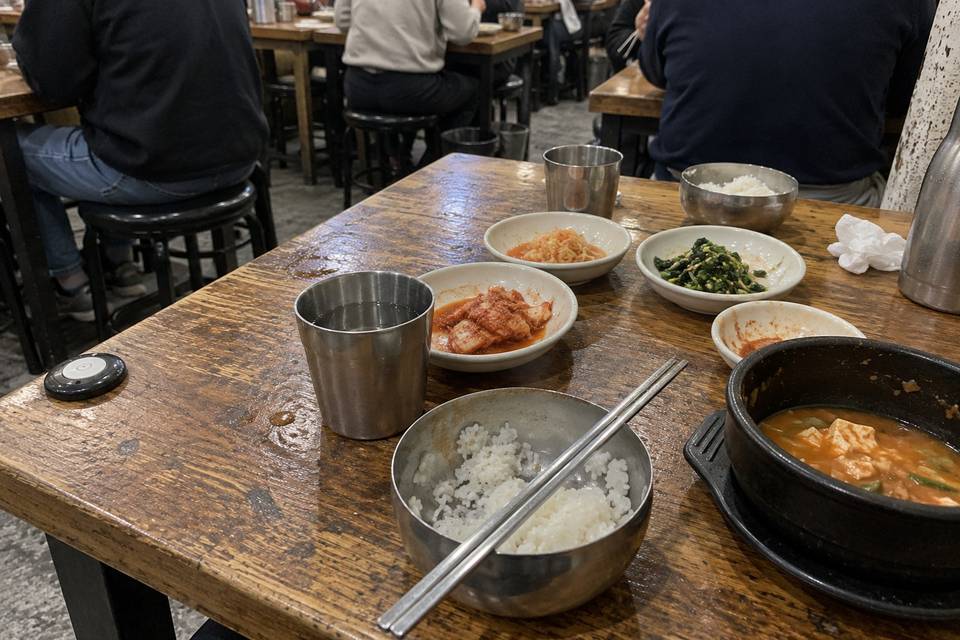
Korean Street Food Guide: 15 Must-Try Dishes
Hours and rules checked against Seoul Metropolitan Government (News Seoul), VisitKorea and Korean press reports from Nov 2025 to Aug 2026, on 7 Oct 2026.
Start with tteokbokki, a fish-cake skewer, hotteok and a mung-bean pancake: most snacks cost ₩1,000–₩7,000 at Seoul markets, while Myeongdong's evening stalls charge more. Carry ₩10,000–₩20,000 in small notes because some stalls still refuse cards, and prices quoted here come from 2024–2026 reports.
Best forFirst-timersBudgetSolo
Your situation → do this
| If you… | Do this |
|---|---|
| You only have one evening for street food in Seoul | Gwangjang Market food alley (open daily 09:00–23:00): bindaetteok, kimbap, tteokbokki, eomuk |
| You want the most choice on one street and don't mind paying more | Myeongdong after about 17:00; check the price card before you order |
| You don't eat pork, or you are vegetarian | Skip sundae and meat mandu; ask about fish broth before eomuk and tteokbokki |
| You are visiting between November and February | Add the winter-only snacks: bungeoppang, hotteok, roasted sweet potatoes |
Key takeaways
- Five to try first: tteokbokki, eomuk, hotteok, bindaetteok and kimbap. All five cost under ₩6,000 in recent Seoul reports.
- Gwangjang Market's food alley is open daily 09:00–23:00. Since 1 June 2026 its 109 stalls are registered by name.
- Myeongdong stalls charged ₩4,000–₩20,000 per item in a January 2024 survey, the top end for grilled seafood.
- Some Gwangjang stalls refused cards in November 2025. Carry ₩1,000 and ₩5,000 notes.
- Sundae is pork intestine; eomuk is simmered in anchovy broth (VisitKorea). Check before ordering if you avoid pork or fish.
| Gwangjang Market food alley | Daily 09:00–23:00; Jongno 5-ga Station exit 8 or Euljiro 4-ga exit 4Source: Seoul Metropolitan Government (News Seoul), Feb 2025 |
|---|---|
| Gwangjang stall rules | Real-name system from 1 Jun 2026; 120 penalty points in a year or 4 violations can cost a stall its permitSource: Seoul Shinmun, 20 May 2026 |
| Kimbap, Seoul average | ₩3,869 per roll (July 2026), up 6.8% in a yearSource: Korea Consumer Agency Chamgagyeok, via Herald Kyungje |
| Bungeoppang | Some stalls now charge ₩1,000 each, up from the old 3 for ₩2,000Source: Herald Kyungje, Oct 2025 |
| Tongin Market coin lunch | Coins ₩500 each; 11:00–16:00 weekdays, to 17:00 weekends; closed Tuesdays and the 3rd SundaySource: Seoul Metropolitan Government (News Seoul), Aug 2025 |
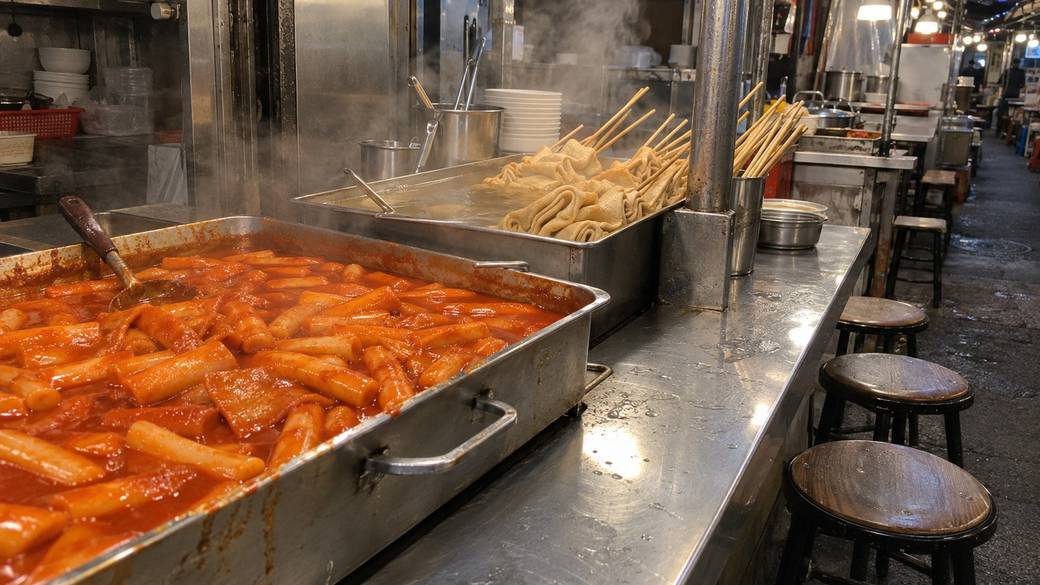
The fifteen snacks below are ranked by how well they work for a first trip: cheap, easy to find and easy to eat standing up. Prices come from dated Korean reports. For sit-down meals see how to order at a Korean restaurant, and browse more in Food & Drink.
Which Korean street foods should you try first?
We ranked each dish on four things: how easy it is to find in Seoul, the price in recent reports, how easy it is to eat on the street, and whether it is a classic VisitKorea lists under bunsik (Korean snack food). Popularity on social media did not count.
Must
Tteokbokki (떡볶이)
- What it is
- Chewy rice cakes simmered in sweet-spicy gochujang sauce, often with fish cake.
- Why go
- The core bunsik dish; about ₩4,000–₩5,000 a portion in recent Seoul reports.
- Time needed
- 5 min, eaten with a toothpick
Eomuk / odeng (어묵)
- What it is
- Fish cake on a skewer, kept hot in anchovy broth.
- Why go
- ₩1,000 a skewer at Gwangjang (Nov 2025); the broth in a paper cup is usually part of it.
- Time needed
- 2 min
Hotteok (호떡)
- What it is
- Fried dough filled with brown sugar and nuts that melt into syrup.
- Why go
- The classic winter sweet; versions with cheese or vegetables exist.
- Time needed
- 5 min, let it cool first
Bindaetteok (빈대떡)
- What it is
- Thick mung-bean pancake fried in oil until crisp at the edges.
- Why go
- Gwangjang Market's signature; ₩5,000 in a Nov 2025 report.
- Time needed
- 15 min, sit at the counter
Kimbap / mayak gimbap (김밥)
- What it is
- Rice and fillings rolled in seaweed; Gwangjang sells a thin version with mustard dip.
- Why go
- Seoul average ₩3,869 a roll (July 2026); safe for picky eaters.
- Time needed
- 10 min
Worth it
Bungeoppang (붕어빵)
- What it is
- Fish-shaped waffle with red bean or custard filling.
- Why go
- Winter only; now often ₩1,000 each instead of 3 for ₩2,000.
- Time needed
- 2 min
Gyeranppang (계란빵)
- What it is
- Small sweet bread baked with a whole egg on top.
- Why go
- A filling breakfast-style snack on cold mornings.
- Time needed
- 3 min
Sundae (순대)
- What it is
- Korean blood sausage: pork intestine stuffed with glass noodles, rice and pork blood.
- Why go
- The most Korean thing on the list; dip it in salt and pepper.
- Time needed
- 10 min
Twigim (튀김)
- What it is
- Battered and fried vegetables, squid, seaweed rolls or boiled egg.
- Why go
- Ask the vendor to dip it in tteokbokki sauce.
- Time needed
- 5 min
Mandu (만두)
- What it is
- Steamed or fried dumplings, including fist-sized wangmandu.
- Why go
- ₩4,000 a portion in Myeongdong (Jan 2024); meat versions usually contain pork.
- Time needed
- 5 min
Korean corn dog (핫도그)
- What it is
- Sausage or mozzarella on a stick, battered, sometimes rolled in potato cubes.
- Why go
- Easy first bite for kids; ₩4,000 in Myeongdong (Jan 2024).
- Time needed
- 5 min
If time
Dak-kkochi (닭꼬치)
- What it is
- Grilled chicken skewer glazed with sweet or spicy sauce.
- Why go
- Good protein snack, but tourist-street versions are pricey.
- Time needed
- 5 min
Tornado potato (회오리감자)
- What it is
- Whole potato spiral-cut onto a stick and fried.
- Why go
- Photogenic; ₩4,000 in Myeongdong (Jan 2024).
- Time needed
- 5 min
Street toast (길거리 토스트)
- What it is
- Buttered toast with egg, cabbage and ham, sweetened with sugar.
- Why go
- A cheap breakfast near subway exits; VisitKorea lists it among winter street foods.
- Time needed
- 5 min
Roasted sweet potatoes and chestnuts (군고구마·군밤)
- What it is
- Roasted in drum ovens on street corners.
- Why go
- Winter only; plain food that suits cautious eaters.
- Time needed
- 2 min
If you only manage one evening, get the five ★★★ dishes at one market rather than walking between areas. The ★★ snacks depend on season and diet. The ★ ones are fine, but you can find most of them back home.
How much does Korean street food cost?
Reported street food prices in Seoul, by source date (checked 7 Oct 2026)
| Dish | Reported price | Where | Report date |
|---|---|---|---|
| Eomuk skewer | ₩1,000 | Gwangjang Market | Nov 2025 |
| Bungeoppang | ₩1,000 each (was 3 for ₩2,000) | Seoul stalls | Oct 2025 |
| Kimbap roll | ₩3,869 average | Seoul restaurants | Jul 2026 |
| Tteokbokki | ₩4,000 (6 rice cakes) | Gwangjang Market | Nov 2025 |
| Bindaetteok | ₩5,000 | Gwangjang Market | Nov 2025 |
| Sundae | ₩7,000 (9 slices) | Gwangjang Market | Nov 2025 |
| Corn dog, mandu, tornado potato | ₩4,000 each | Myeongdong | Jan 2024 |
| Grilled squid, kimchi pork belly | ₩10,000 | Myeongdong | Jan 2024 |
| Grilled lobster | ₩20,000 | Myeongdong | Jan 2024 |
A market snack lunch of three or four items costs roughly ₩10,000–₩15,000 at these prices; Myeongdong costs more for the same plate. The Myeongdong figures are from a January 2024 survey, so expect them to be higher in 2026.
Prices have been rising fast. The wholesale price of Korean red beans, the filling in bungeoppang, hit ₩784,200 per 40 kg in October 2025, 1.5 times the year before, according to the Herald Kyungje report. Seoul’s average kimbap price rose 6.8% between July 2025 and July 2026 (Korea Consumer Agency data). Treat every number above as a floor.
Portion size matters as much as price. In November 2025 a YouTuber’s video of a ₩4,000 tteokbokki with six rice cakes and a ₩7,000 plate of nine sundae slices at Gwangjang caused a fresh row over overcharging (Seoul Shinmun). The same vendor told the customer there was a ₩5,000-per-person minimum.
Where should you go for street food in Seoul?
Pick one area per evening. They differ more in price and atmosphere than in what they sell.
Seoul street food areas compared (hours checked 7 Oct 2026)
| Area | Best for | Hours | Price level | Getting there |
|---|---|---|---|---|
| Gwangjang Market | Bindaetteok, kimbap, sit-down counters | Food alley daily 09:00–23:00 | Low | Jongno 5-ga exit 8 (Line 1) |
| Myeongdong | Most variety on one street | Evening stalls; fullest after dark | High | Myeong-dong Station (Line 4) |
| Tongin Market | Build-your-own coin lunch box | 11:00–16:00 weekdays, to 17:00 weekends; closed Tue and 3rd Sun | Low | Gyeongbokgung Station (Line 3) |
| Sindang-dong | Pan-cooked tteokbokki at a table | Restaurant hours | Low–mid | Sindang Station (Lines 2/6) |
Gwangjang is the best first choice for most visitors; Myeongdong is for variety if you accept higher prices.
Gwangjang Market (광장시장)
Seoul’s oldest permanent market, about a century old, is now mostly visited for its food alley around the east gate, north gate 2 and south gate 1. The food alley opens daily 09:00–23:00; the rest of the market closes on Sundays (News Seoul, Feb 2025). Take Gwangjang Market (광장시장)Naver MapGoogle Maps from Jongno 5-ga Station exit 8 on Line 1, or Euljiro 4-ga Station exit 4 on Lines 2 and 5.
The market has been working on its reputation. Prices have been shown with portion weights since December 2023. From 1 June 2026 Jongno-gu runs a stall real-name system: the 109 stalls collect penalty points for overcharging or reusing food, and a stall that reaches 120 points in a year or four violations can lose its permit. Seoul also sends 20 mystery shoppers, foreign ones included (Seoul Shinmun, 20 May 2026).
Myeongdong (명동)
The main shopping street turns into a line of food carts in the evening. VisitKorea’s November 2025 winter street food feature lists it first among Seoul’s food streets. It has the widest choice in Seoul, and also the highest prices. A January 2024 survey found most snacks at ₩4,000–₩6,000 and grilled seafood and meat at ₩10,000–₩20,000 (Dailian). Start at Myeong-dong Station (명동역)Naver MapGoogle Maps.
Tongin Market (통인시장)
A small neighbourhood market near Gyeongbokgung palace with a “dosirak cafe”: you buy brass coins (₩500 each) on the second floor and swap them at stalls for spoonfuls of food in a lunch tray. A ₩10,000 set of 20 coins is the usual buy. Coin sales stop at 15:00 on weekdays and 16:00 at weekends (News Seoul, Aug 2025). It suits a lunch stop on a palace day in a 7-day Seoul itinerary. Find it at Tongin Market (통인시장)Naver MapGoogle Maps.
Sindang-dong Tteokbokki Town (신당동 떡볶이타운)
This alley of restaurants is known as the birthplace of jeukseok tteokbokki, cooked in a pan at your table, starting with a shop that opened in 1953 (Visit Seoul). It is a sit-down meal rather than a stall snack, and good for groups.
Do street food stalls take cards?
Many do now, but bring cash anyway. Seoul’s Jung-gu district began installing card terminals at Myeongdong stalls in early 2024 (Kyunghyang Shinmun, Feb 2024). At Gwangjang in November 2025, reporters still found stalls refusing cards and asking for bank transfers, including a ₩2,500 hotteok stand (Seoul Shinmun).
Before a street food evening
- ₩10,000–₩20,000 in ₩1,000 and ₩5,000 notes rather than one ₩50,000 note
- Your overseas Visa or Mastercard as the main payment where a terminal is visible
- A prepaid card such as WOWPASS as a backup (see T-money vs WOWPASS vs Climate Card)
- Tissues or wet wipes; stalls rarely have napkins to spare
- A small bag for rubbish; street bins can be hard to find
If you come from Singapore, Malaysia or the Philippines, expect less hawker-centre-style seating: most stalls are stand-and-eat, and only market counters like Gwangjang’s have stools.
What if you don’t eat pork, or you’re vegetarian?
Most savoury street food is not halal or vegetarian by default. VisitKorea describes sundae as pig intestine stuffed with blood, glass noodles and sticky rice, and says eomuk is boiled in anchovy broth. Meat mandu usually contains pork. Tteokbokki is often cooked with fish cake and broth.
Which street foods suit which diet, per VisitKorea (checked 7 Oct 2026)
| Dish | Pork | Fish or anchovy | Safer for |
|---|---|---|---|
| Sundae | Yes | No | Nobody avoiding pork |
| Meat mandu | Usually | No | Ask for vegetable (야채) mandu |
| Eomuk | No | Yes | No-pork diets, not vegetarians |
| Tteokbokki | Rarely | Often (fish cake, broth) | Ask first |
| Hotteok, bungeoppang, gyeranppang | No meat filling | No | Most diets (egg in gyeranppang) |
| Roasted sweet potato and chestnuts | No | No | Every diet |
Sweet snacks and roasted vegetables are the safest choices, but no stall labels its cooking oil or dough.
For Muslim travellers from Malaysia, Singapore or India, treat street stalls as snack stops and use the Korea Tourism Organization’s Muslim-friendly restaurant labels for full meals. Our restaurant ordering guide has a written Korean line about broth and fish sauce that you can show vendors too. Vegetarians from India should ask “gogi, haemul an deureo-gayo?” (고기, 해물 안 들어가요? — “no meat or seafood in it?”), though a stall may not know what is in its sauce.
Which snacks are only sold in winter?
Bungeoppang, hotteok and roasted sweet potatoes and chestnuts are winter foods; VisitKorea calls bungeoppang “a famous snack for the wintertime.” Stalls appear as the weather turns cold and thin out by spring. That suits Australian and Singaporean travellers on December school holidays. In summer the same corners sell bingsu (shaved ice) instead.
October is in between: Seoul’s average low is about 11 °C (51 °F), so winter snacks are not guaranteed yet (see Korea weather by month). Tteokbokki, eomuk, kimbap and bindaetteok are sold all year.
How do you order and eat at a stall?
- Point at the dish and hold up fingers for the number of portions, or say “ige hana juseyo” (이거 하나 주세요, “one of these, please”).
- Confirm the price on the card before the vendor serves you.
- Eat at the stall. Koreans usually eat standing beside the cart and hand back the plate.
- For eomuk, take a skewer from the pot yourself, then pay for the number of sticks you hold up. Broth in a paper cup usually comes with it.
- Pay when you finish (or first at busy carts); there is no tipping.
- Return skewers and cups to the vendor’s bin rather than carrying them off.
Eating while walking is common on tourist streets like Myeongdong, but at markets people eat at the counter.
What mistakes do first-timers make?
Avoid these
- Ordering before checking the price card, especially for seafood in Myeongdong
- Carrying only ₩50,000 notes or only a card
- Eating a whole hotteok straight off the griddle: the sugar filling burns
- Filling up at the first stall; share portions so you can try four or five things
- Assuming eomuk or tteokbokki is vegetarian
- Visiting Gwangjang’s non-food sections on a Sunday, when they are closed
If something goes wrong, the Korea Travel Helpline 1330 answers in English and other languages, and Seoul’s mystery-shopper checks now cover overcharging and discrimination against foreigners at Gwangjang.
Questions people ask
- What is the most popular street food in Korea?
- Tteokbokki, chewy rice cakes in a sweet-spicy gochujang sauce, usually sold beside fish-cake skewers (eomuk). VisitKorea calls it the dish at the centre of bunsik, Korea's snack-food category. Expect about ₩4,000–₩5,000 a portion at Seoul markets in recent reports.
- Is Korean street food cheap?
- At markets, yes: a fish-cake skewer was ₩1,000 and a mung-bean pancake ₩5,000 at Gwangjang Market in November 2025. Myeongdong is the expensive exception, where a January 2024 survey found ₩4,000–₩6,000 for most snacks and ₩10,000–₩20,000 for grilled seafood and meat.
- Can I pay by card at Korean street food stalls?
- Often, but not always. Seoul's Jung-gu district added card terminals to Myeongdong stalls in 2024, yet reporters found Gwangjang stalls refusing cards in November 2025. Carry ₩10,000–₩20,000 in ₩1,000 and ₩5,000 notes as a backup.
- Is Korean street food halal?
- Generally not certified. Sundae is pork, mandu often contains pork, and eomuk is simmered in anchovy broth. Sweet snacks like hotteok and bungeoppang have no meat filling, but cooking oil and dough ingredients are not labelled. Use KTO's Muslim-friendly restaurant list for full meals.
- When is the best time to eat street food in Seoul?
- Evenings. Myeongdong's stall line-up fills out from late afternoon, and Gwangjang's food alley runs until 23:00. Visit November to February for winter snacks like bungeoppang, hotteok and roasted sweet potatoes.
Next in your trip
- How to order at a Korean restaurant — Call bells, kiosks and two-serving minimums for sit-down meals
- T-money vs WOWPASS vs Climate Card — WOWPASS doubles as a cash-free backup at market stalls
- Korea on a budget — Daily food budgets beyond street snacks
Sources
- 서울시·종로구, 광장시장 '바가지 요금·비위생' 노점 잡는다 (Seoul Shinmun, 20 May 2026) (Korean)
- 이곳에선 닫혔던 지갑이 열린다! 광장시장으로 산해진미 맛보러 가요 (News Seoul, 24 Feb 2025) (Korean)
- 엽전 들고 통인시장으로! 내 취향 도시락 만들어봤어요 (News Seoul, Aug 2025) (Korean)
- 광장시장이 또…“4000원짜리 떡볶이, 떡이 6개” (Seoul Shinmun, 26 Nov 2025) (Korean)
- 광장시장 현장 르포 (Nocut News, 28 Nov 2025) (Korean)
- 명동 바가지 요금 끝나지 않았다…길거리 음식 '1만원 대' 수두룩 (Dailian, 17 Jan 2024) (Korean)
- 명동 노점 카드결제·가격 점검 (Kyunghyang Shinmun, 5 Feb 2024) (Korean)
- 붕어빵 하나에 1000원? 겨울간식, 때이른 ‘몸값 전쟁’ (Herald Kyungje, Oct 2025) (Korean)
- 김밥 한줄 4000원이 기본? 이제 혼자 먹어도 ‘1만원 시대’ (Herald Kyungje, 26 Aug 2026) (Korean)
- Bunsik & Street Food (VisitKorea)
- Winter Street Food Battle: What’s Your Pick? (VisitKorea, 19 Nov 2025)
- Sindang-dong Tteokbokki Town (Visit Seoul)
Updates
- Published with Gwangjang Market's 1 June 2026 stall real-name system and July 2026 Seoul kimbap price.
About Korea Field Notes
An English guide to the practical side of visiting South Korea. Guides are researched from Korean-language official sources (Korail, T-money, Seoul Metro, the Korea Tourism Organization) and re-checked when rules or prices change. Each guide shows when its facts were last checked and lists its sources. About the site · How we research and update guides · Found something out of date? Tell us.