Facts About Busan: 22 Numbers That Shape Your Trip
Facts checked on 17 Nov 2026 against Busan Metropolitan City pages and press releases, Busan Transportation Corporation, Haeundae-gu, BISCO, VisitKorea, KMA climate normals and Korean press reports of official figures.
Busan is Korea's second city: 3.23 million people spread over 771 km², more land than Seoul with a third of the people, split between a harbour side and a beach side. The facts below cover its layout, transport, beaches and weather, each checked against city, metro and weather-agency sources on 17 Nov 2026.
Best forFirst-timersSoloFamilies
Your situation → do this
| If you… | Do this |
|---|---|
| You are deciding where to sleep | Pick a side: Nampo or Busan Station for the harbour, Haeundae or Gwangalli for the beaches |
| You only have one day | Stay on one side; the city is 771 km² and the sides are an hour apart |
| You want to swim | Go between late June and 31 August; Haeundae ran to 15 September in 2026 |
| You visit in winter from a warm country | Pack a real coat: January averages 3.6 °C, milder than Seoul but still cold |
Key takeaways
- Busan had 3,228,188 residents in September 2026, and a quarter of them are 65 or older.
- The city covers 771.33 km², about 166 km² more than Seoul, so pick one side per day.
- Busan's four metro lines carried about 862,000 riders a day in 2024, against Seoul Metro's 6.69 million.
- Haeundae Beach is 1.5 km long and passed 10 million visits in the 2026 season, a first for Korea.
- January averages 3.6 °C in Busan against −1.9 °C in Seoul, on KMA's 1991–2020 normals.
| Population | 3,228,188 (September 2026), 25.8% aged 65+Source: Busan Metropolitan City population briefing |
|---|---|
| Area and districts | 771.33 km², 15 districts (gu) and 1 county (Gijang-gun)Source: Busan Metropolitan City |
| Metro | 4 lines, 115.2 km; ₩1,600 (up to 10 km) or ₩1,800 by cardSource: Busan Transportation Corporation |
| Foreign visitors | 3,643,439 in 2025 (record); 3,934,876 in Jan–Sep 2026Source: Busan city figures via Kyunghyang Shinmun |
| Climate (1991–2020) | Year 15.0 °C · January 3.6 °C · August 26.1 °C · 1,576.7 mm rainSource: Korea Meteorological Administration |
These are 22 facts about Busan that change how you plan the days, from which side of the city to sleep on to which month you can swim, each checked against its source on 17 November 2026. For Seoul’s numbers see facts about Seoul; more short sourced answers live in Korea Facts.
How is Busan laid out?
- It is Korea’s second city, with about 3.23 million people. Busan’s October 2026 population briefing counts 3,228,188 registered residents in September 2026, 1,279 fewer than a month earlier. The city is shrinking slowly and ageing fast: 25.8% of residents are 65 or older.
- It has more land than Seoul. Busan covers 771.33 km², split into 15 districts (gu) and one county, Gijang-gun, per the city’s English introduction. That is about 166 km² more than Seoul with a third of the people, because mountains fill much of the middle. The practical result: districts sit in separate valleys and bays, and crossing the city takes time.
- Think of it as two sides. The old harbour side, around Busan Station and Nampo, has Jagalchi, Gukje Market and Gamcheon. The beach side, around Haeundae and Gwangalli, has the sand, the Blueline Park beach train and Haedong Yonggungsa. Seomyeon, the shopping hub where metro Lines 1 and 2 cross, sits between them. Our Busan 1-day itinerary keeps each day to one side for that reason.
- Its main mountain became a national park in 2026. Geumjeongsan, on the city’s northern edge, has been managed as Korea’s 24th national park since 3 March 2026, and Korean press called it the country’s first urban national park.
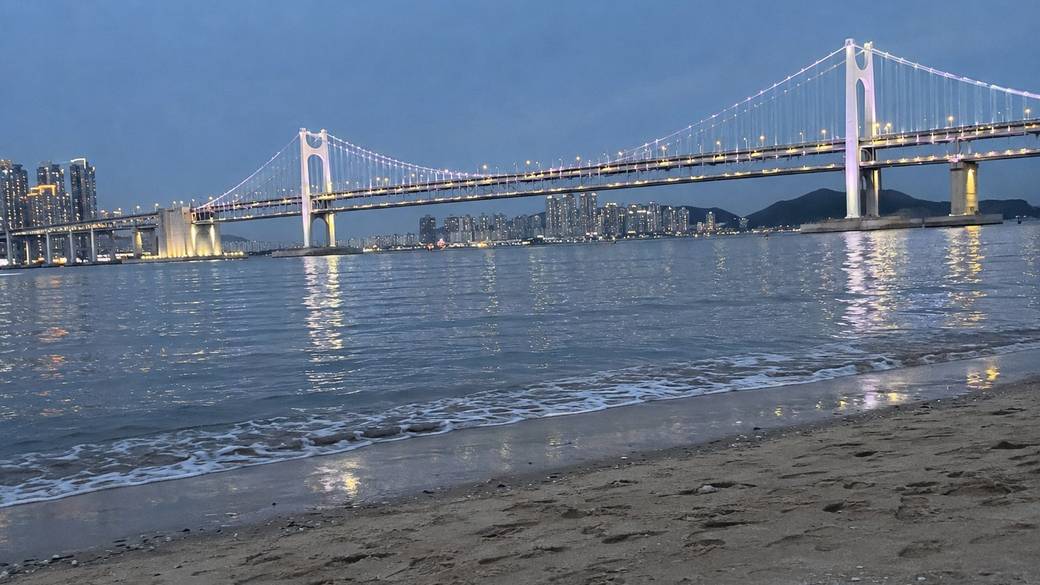
- Gwangan Bridge is 7.42 km of road over the bay. The city lists the double-deck bridge at 7,420 m, carrying eight lanes across Suyeong Bay in front of Gwangalli Beach. It is for cars only, with a ₩1,000 toll for a normal car (₩500 for a light car), per the bridge operator. You see it lit from the beach every night; you do not walk on it.
What history still shows in the city?
- Busan was South Korea’s wartime capital. The government ran the country from Busan from 18 August 1950 to 15 August 1953, according to the city’s Provisional Capital Memorial Museum, which counts it as 1,023 days. Refugees from the north crowded onto the hillsides then, and many of the steep stair neighbourhoods date from those years.
- Gamcheon began as a refugee village. Gamcheon Culture Village grew in the 1950s from war refugees and followers of the Taegeukdo religion settling a steep slope in Saha-gu, Gyeongbuk Maeil reported. A public-art project from 2009 painted it into the colourful lanes you see now. People still live in most of the houses, so keep voices down.
- Haedong Yonggungsa goes back to 1376. The seaside temple was first built in 1376 under the Goryeo dynasty, destroyed during the Imjin War of the 1590s and rebuilt in the 1930s, VisitKorea says. Our Yonggungsa vs Samgwangsa comparison covers hours and getting there.
How big is Busan as a port and for tourists?
- Busan Port is the seventh busiest in the world. It handled a record 24.88 million TEU of containers in 2025, Busan Ilbo reported from port authority figures, and ranked seventh in the world and second for transshipment, Kukinews reported in June 2026. The cranes you see from Busan Tower and the Busan Station side are that port.
- Jagalchi is the city’s fish market, and it closes some Tuesdays. The BISCO-run Jagalchi Market calls itself an international seafood market; the system is to buy fish on the ground floor and have it prepared upstairs. It closes on the 1st, 3rd and 5th Tuesdays of the month, so check the date before you plan a Nampo lunch. The Busan food guide covers what to order.
- Foreign visitors hit a record in 2025 and have already passed it in 2026. Busan counted 3,643,439 foreign visitors in 2025, up 24.4% on 2024, Kyunghyang reported. From January to September 2026 it counted 3,934,876, up 47%, so 2026 overtook all of 2025 in nine months; the city’s target for the year is 4 million.
What do the transport numbers mean for you?
- The metro is quiet by Seoul standards. Busan’s four metro lines run 115.2 km and carried about 862,000 riders a day in 2024, per Busan Transportation Corporation. Line 1 alone took 418,000 of those, and Line 2, the beach line, 322,000. Seoul Metro’s lines 1–8 carried 6.69 million a day in 2025, so you can usually ride with a suitcase outside rush hour.
- A ride costs ₩1,600 or ₩1,800. On a transit card, an adult pays ₩1,600 for up to 10 km and ₩1,800 beyond that; a QR single ticket costs ₩1,700 or ₩1,900, per the operator’s fare page. Seoul T-money cards work here, and T-money vs WOWPASS vs Climate Card explains which card to carry (the Climate Card is Seoul-only).
- The airport is in Busan, not Gimhae city. Gimhae International Airport sits in Gangseo-gu, a Busan district. The light rail runs to Sasang on Line 2, and the whole trip into town costs one fare of ₩1,600–1,800 on a card, as our Gimhae Airport to Busan guide sets out.
- A new airport is planned, but not soon. Gadeokdo New Airport, on an island west of the port, is now targeted to open in 2035, with main construction starting in the first half of 2027, Bizwatch reported on 9 November 2026 from the transport ministry. Earlier city pages still mention 2029; ignore them for any trip you are planning.
- The KTX from Seoul takes from 2 h 18 min. Seoul Station to Busan costs ₩54,400 in economy since the 1 September 2026 fare cut, and ride times range from 2 h 18 min to about 3 h 25 min depending on stops. The KTX Seoul to Busan guide shows how to pick a fast train.
What should you know about the beaches?
- Busan runs eight official beaches. The city opened eight beaches in the 2026 season, and its 17 September release counted a record 22.53 million visits across them, up 2.54%. The usual list of seven (Haeundae, Songjeong, Gwangalli, Songdo, Dadaepo, Ilgwang, Imnang) grows to eight when Dadaepo’s two sections are counted separately.
- Haeundae is 1.5 km long. Haeundae-gu describes the beach as 1.5 km of sand, 70–90 m wide. In 2026 it became the first beach in Korea to pass 10 million visits in one season, the city said, so July and August weekends are crowded.
- The swimming season is short. In 2026 Haeundae and Songjeong opened on 26 June; Haeundae closed on 15 September and the other beaches on 31 August. Outside those dates you can walk the sand, but there are no lifeguards and swimming is not supervised.
Busan vs Seoul in numbers (city, metro operator and KMA figures, checked 17 Nov 2026)
| Measure | Busan | Seoul |
|---|---|---|
| Residents | 3.23 million (Sep 2026) | 9.55 million (2026) |
| Area | 771.33 km² | 605.25 km² |
| Metro riders a day | about 862,000 (4 lines, 2024) | 6.69 million (Seoul Metro 1–8, 2025) |
| January average | 3.6 °C | −1.9 °C |
| August average | 26.1 °C | 26.1 °C |
| Rain a year | 1,576.7 mm | 1,417.9 mm |
Busan has more room and fewer people than Seoul, is about five degrees milder in winter and just as hot in August. Seoul’s figures come from our facts about Seoul page.
What are Busan’s weather and event numbers?
- Winters are mild for Korea, summers just as hot. On KMA’s 1991–2020 normals Busan averages 15.0 °C over the year, 3.6 °C in January and 26.1 °C in August. Coming from Singapore, Malaysia, the Philippines or India, a December to February trip still needs a warm coat, because the sea wind makes it feel colder. Visitors from the UK or Canada will find January easy.
- July is the wettest month. Busan gets about 1,576.7 mm of rain a year, with 326.8 mm in July alone. Pack an umbrella from late June through August, and see Korea’s weather by month for the national picture.
- October is festival month. The Busan International Film Festival held its 31st edition on 6–15 October 2026, so it has run every year since 1996, centred on the Busan Cinema Center near Centum City. The Busan Fireworks Festival lit up Gwangan Bridge on 7 November 2026; our fireworks guide tracks the 2027 date. Hotels near Haeundae and Gwangalli fill early on both.
The city’s symbols are on its signs and souvenirs: the camellia (dongbaek) is the city flower and the seagull the city bird, per Busan’s city-symbols page.
How should these facts change your plan?
Before you lock in the Busan days
- Pick one side of the city per day: harbour (Busan Station, Nampo, Gamcheon) or beach (Haeundae, Gwangalli, Yonggungsa).
- Check whether your Nampo day falls on the 1st, 3rd or 5th Tuesday, when Jagalchi is closed.
- Plan swimming only between late June and the end of August.
- Book October and early-November hotels early if your dates touch BIFF or the fireworks.
- Load a T-money card before you arrive; one card covers the metro, buses and the airport light rail.
Most first-timers give Busan two or three days; is Busan worth visiting weighs it against more days in Seoul, and where to stay in Busan matches each side of the city to a base.
Questions people ask
- How many people live in Busan?
- About 3.23 million. Busan's October 2026 population briefing gives 3,228,188 registered residents for September 2026, down 1,279 on the month before. About 25.8% are 65 or older.
- Is Gimhae Airport in Busan or in Gimhae?
- In Busan. Despite the name, Gimhae International Airport sits in Gangseo-gu, a district of Busan, on the city's western edge. The Busan–Gimhae light rail links it to metro Line 2 at Sasang for ₩1,600–1,800 on a transit card.
- Is Busan warmer than Seoul in winter?
- Yes, by about five degrees. KMA's 1991–2020 normals give Busan a January average of 3.6 °C, against −1.9 °C in Seoul. It is still cold enough for a coat, especially by the sea in the wind, so travellers from Singapore, Malaysia or the Philippines should pack one.
- When can you swim at Haeundae Beach?
- During the official season, when lifeguards are on duty. In 2026 Haeundae and Songjeong opened on 26 June, Haeundae closed on 15 September and the other city beaches closed on 31 August, per Busan's September release. 2027 dates are not announced yet.
- Is Busan bigger than Seoul?
- In land, yes; in people, no. Busan covers 771.33 km² against Seoul's 605.25 km², but has about 3.23 million residents to Seoul's 9.55 million. Much of that land is mountain, so the city is a string of separate districts along the coast.
Next in your trip
- Choose a base: harbour side or beach side — The two sides are far apart, so your base decides most travel times
- Book the KTX from Seoul — ₩54,400 in economy and from 2 h 18 min
- Plan three days in Busan — One day per side plus a temple or beach day
Sources
- 부산광역시 – 부산 인구정책 브리핑 2026년 10월 (2026년 9월 주민등록인구) (Korean)
- Busan Metropolitan City – Introduction (area, districts)
- 부산광역시 임시수도기념관 – 임시수도 역사 (Korean)
- 부산광역시 임시수도기념관 웹진 – 피란수도 1,023일 (Korean)
- Busan Metropolitan City – The seven bridges of Busan
- 부산시설공단 광안대교 – 통행료 안내 (Korean)
- 트위그뉴스 – 부산 금정산 국내 첫 도심형 국립공원 지정 (4 Mar 2026) (Korean)
- 경북매일 – 감천문화마을, 피난민과 태극도 신도들이 만든 마을 (28 Oct 2025) (Korean)
- 경향신문 – 지난해 부산 방문 외국인 관광객 364만명 역대 최대 (11 Feb 2026) (Korean)
- 경향신문 – 부산 외국인 관광객 1~9월 393만명 (6 Nov 2026) (Korean)
- 부산일보 (Daum) – 작년 부산항 컨테이너 물동량 2488만 TEU, 역대 최대 (29 Jan 2026) (Korean)
- 쿠키뉴스 – 부산항 세계 7위, 환적 2위 (17 Jun 2026) (Korean)
- 자갈치시장 (BISCO) – 시장 안내 (Korean)
- 부산교통공사 – 2024년 노선별 운영 현황 (Korean)
- 부산교통공사 – 운임안내 (Korean)
- 비즈워치 – 가덕도신공항 2035년 개항 목표, 2027년 상반기 착공 (9 Nov 2026) (Korean)
- 부산광역시 – 2026년 8개 해수욕장 폐장, 역대 최다 방문 기록 (17 Sep 2026) (Korean)
- 해운대구 – 해운대해수욕장 소개 (Korean)
- VisitKorea – Haedong Yonggungsa Temple
- 기상청 – 신 기후평년값(1991~2020) 보도자료 (25 Mar 2021) (Korean)
- 부산국제영화제 – 2026 출품 규정 (제31회, 10월 6–15일) (Korean)
- Busan Metropolitan City – City symbols
Updates
- Published with 22 sourced Busan facts, including September 2026 population, the 2026 beach season record and Jan–Sep 2026 foreign visitor numbers.
About Korea Field Notes
An English guide to the practical side of visiting South Korea. Guides are researched from Korean-language official sources (Korail, T-money, Seoul Metro, the Korea Tourism Organization) and re-checked when rules or prices change. Each guide shows when its facts were last checked and lists its sources. About the site · How we research and update guides · Found something out of date? Tell us.