Facts About Jeju Island: 22 Numbers That Shape Your Trip
Facts checked on 17 Nov 2026 against Jeju Province, Jeju bus information, HiKorea, the K-ETA portal, KMA climate normals, the Hallasan National Park office (via Financial News) and Korean press reports of official figures.
Jeju is a 1,850 km² volcanic island, three times the size of Seoul, with 664,792 residents and 13.86 million visitors in 2025, so plan three or more nights and pick buses or a car early. The facts below cover entry rules, transport, Hallasan, weather and culture, each checked against official or press sources on 17 Nov 2026.
Best forFirst-timersBudgetFamilies
Your situation → do this
| If you… | Do this |
|---|---|
| You hold an Indian or Philippine passport | Fly straight into Jeju from abroad: 30 days visa-free, island only |
| You don't drive or have no licence permit | Use the ₩1,150 buses and a card; most of the coast is reachable |
| You want to climb Hallasan to the summit | Book Seongpanak or Gwaneumsa on the park site; winter entry closes 11:30 |
| You are coming from Singapore, Malaysia or the Philippines in winter | Pack a warm jacket: January averages 6.1 °C in Jeju City |
| You only have one or two nights | Base in one area, Jeju City or Seogwipo, and skip the far side |
Key takeaways
- Jeju covers 1,850.1 km², about three times Seoul, around Hallasan, South Korea's highest peak at 1,947 m.
- Seoul (Gimpo)–Jeju carried 13.3 million passengers in 2025, the world's busiest air route.
- Indian and Philippine passports get 30 days visa-free when flying straight into Jeju; a repeal bill was filed 13 Nov 2026.
- Regular buses cost ₩1,150 by card, and cash is no longer accepted on board.
- January averages 6.1 °C in Jeju City against −1.9 °C in Seoul, on KMA's 1991–2020 normals.
| Area and population | 1,850.1 km² · 664,792 registered residents (2025) · 2 citiesSource: Jeju Special Self-Governing Province |
|---|---|
| Visitors | 13,861,748 in 2025 (2,242,187 foreign); 11.72 million in Jan–Oct 2026Source: Jeju Tourism Association via Seoul Shinmun; Jeju Province via Financial News |
| Bus fare | ₩1,150 by card, frozen for 2026; no cash on boardSource: Jeju bus information; Halla Ilbo |
| Hallasan | 1,947 m; winter entry 05:00 to 11:30 (Seongpanak, Gwaneumsa) or 12:00 (Eorimok, Yeongsil)Source: Jeju Province; Hallasan National Park office via Financial News |
| Climate, Jeju City (1991–2020) | Year 16.2 °C · January 6.1 °C · August 27.2 °C · 1,502.3 mm rainSource: Korea Meteorological Administration |
These are 22 facts about Jeju Island that change how you plan a trip, from your passport’s entry rules to whether you need a car and which month suits you. Each was checked against its source on 17 November 2026. For the mainland numbers see facts about Busan and facts about Seoul; more short sourced answers live in Korea Facts.
How big is Jeju, and how many days does it need?
- Jeju is bigger than it looks on the map. The island covers 1,850.1 km², Jeju Province says, about three times the area of Seoul. Hallasan sits in the middle, so the main roads and bus routes run around the coast or straight across the mountain’s flanks. Seongsan, on the east tip, is 86–95 minutes from the airport by express bus, so a two-night trip leaves little time for both coasts.
- About 665,000 people live there. Jeju Province gives 664,792 registered residents and 28,508 registered foreign residents as of 2025. Most live in Jeju City on the north coast, where the airport is.
- It is one province with two cities. Jeju Special Self-Governing Province was set up on 1 July 2006 and has two administrative cities: Jeju City in the north and Seogwipo in the south. Seogwipo also takes in Jungmun’s resort hotels and the waterfalls. That split is how most people choose a base, as our where to stay in Jeju guide explains.
- Hallasan is South Korea’s highest mountain. Jeju Province lists it at 1,947 m. On the mainland the highest peak, Jirisan, is lower, so Jeju’s summit is the national high point, and it gets snow in winter.
How do you get in, and which entry rules apply?
- Seoul (Gimpo)–Jeju is the busiest air route in the world. It carried 13.3 million passengers in 2025, top of IATA’s ranking for a second year, New Daily reported on 20 July 2026. Flights leave Gimpo all day, but domestic schedules for winter 2026 are thinner: 2,948 flights a week, 3% fewer than last winter, Jeju Province told a tourism meeting on 16 November. Our Seoul to Jeju flight guide compares the airlines.
- Jeju has its own visa-free rule. Under the Jeju visa-free scheme on HiKorea, most passports that need a Korean visa can stay up to 30 days without one if they arrive on an international flight or ship straight into Jeju. You must stay on the island. This matters most for Indian and Philippine travellers: connecting through Singapore, Hong Kong or Taipei keeps the rule open, connecting through Seoul does not.
- That rule is under political pressure. A bill to abolish Jeju’s visa-free entry was filed in the National Assembly on 13 November 2026, Jeju Ilbo reported. Jeju Province opposes it and it has not passed, so the rule still applies today. If you are relying on it for a 2027 trip, check again before you book a non-refundable fare.
- The K-ETA exemption for many Western passports ends with 2026. Visitors from the US, UK, Canada, Australia and Singapore need no K-ETA for arrivals until 31 December 2026, and should plan on one from 1 January 2027 unless an extension is announced. Malaysians already need a K-ETA, and it has applied in Jeju too since 1 September 2022. Our K-ETA guide tracks the notice.
Jeju entry by passport (HiKorea, K-ETA portal, Jeju Ilbo, checked 17 Nov 2026)
| Passport | Fly straight into Jeju | Via Seoul first |
|---|---|---|
| India, Philippines | Visa-free up to 30 days, island only | Korean visa needed |
| Malaysia | K-ETA needed | K-ETA needed |
| US, UK, Canada, Australia, Singapore | No K-ETA until 31 Dec 2026 | No K-ETA until 31 Dec 2026 |
The direct-to-Jeju route changes the answer only for visa-required passports; everyone else follows the national rules, explained in our Korea tourist visa guide.
Do you need a car on Jeju?
- The buses are cheap and cashless. A regular bus costs ₩1,150 by transit card, and fares are frozen for 2026, Halla Ilbo reported in August. Jeju buses stopped taking cash on 1 October 2024 and now accept contactless Visa cards as well as T-money, per Jeju bus information. Express buses cost ₩2,000–3,000. Our Jeju without a car guide shows which routes reach which coast.
- New late-night airport buses start on 25 November 2026. Night buses 101 (to Seongsan), 102 (to Hangyeong in the west) and 121 (to Namwon in the south-east) will leave the airport at about 22:40, Jeju Province said on 16 November, per Financial News. Until now a late landing outside Jeju City meant a taxi; check the Jeju Airport to the city guide for the other late options.
- Rental cars cannot go to Udo until July 2029. The ban on most visitors’ rental cars on Udo, the island off Seongsan, was extended for three years to 31 July 2029, Twig News reported. You walk onto the ferry and use the island’s buses, bikes or your feet. Everywhere else, a car saves time inland, which is what our Jeju rental car guide weighs up.
What makes the landscape different?
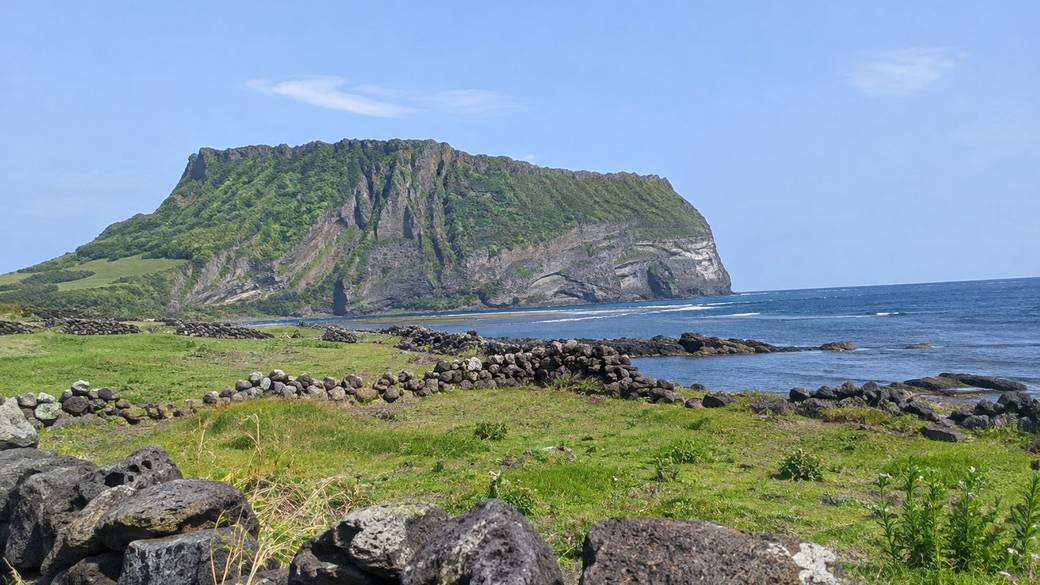
- Three parts of the island are UNESCO World Heritage. “Jeju Volcanic Island and Lava Tubes” was listed in 2007 and covers Hallasan and its national park, the Geomunoreum lava tube system and Seongsan Ilchulbong, the tuff cone rising from the sea at the east tip, per IUCN’s World Heritage Outlook.
- There are about 368 oreum. A 1997 provincial survey counted 368 of these small volcanic cones, 210 in Jeju City and 158 in Seogwipo, Seoul Shinmun reported; other sources round it to “about 360”. Many have short paths to the top and make easy half-day walks.
- Manjanggul lava tube reopened in 2026. Part of the UNESCO lava tube system, it reopened on 30 May 2026 after two years and five months closed following a rockfall, Jnuri reported. Our is Jeju worth visiting page has its fee and hours.
- Hallasan’s winter hours start early. From 1 October 2026 to 31 March 2027 all trails open at 05:00. Entry closes at 11:30 on Seongpanak and Gwaneumsa, the two summit trails, and at 12:00 on Eorimok and Yeongsil, the park office said via Financial News. The summit trails need a booking on visithalla.jeju.go.kr; Yeongsil does not. See best hiking trails in Korea for trail lengths.
- The Olle walking routes total 437 km. The Jeju Olle Foundation runs 27 courses covering about 437 km around the coast and onto the smaller islands, per its listing on Korea’s public data portal.
What is Jeju’s weather really like?
- Winters are the mildest in Korea’s big cities. On KMA’s 1991–2020 normals, Jeju City averages 16.2 °C over the year, 6.1 °C in January and 27.2 °C in August. That is warm for Korea, not for Singapore or Manila: the coast is windy, and Hallasan gets snow. Visitors from the UK or Canada will find a Jeju January easy. Swimming season is short: the 12 designated beaches ran from 24 June to 6 September in 2026, Twig News reported.
- It rains often, though not the most. Jeju City gets 1,502.3 mm a year, less than Busan, but on 127.8 days, more than any other major city in KMA’s list. September brings 227.8 mm as typhoons pass, so keep a Jeju rainy-day plan ready. Summer nights are hot too: 30 tropical nights a year, against 12.5 in Seoul.
Jeju vs Seoul vs Busan in numbers (Jeju Province, KMA 1991–2020 normals, checked 17 Nov 2026)
| Measure | Jeju | Seoul | Busan |
|---|---|---|---|
| Area | 1,850.1 km² | 605.25 km² | 771.33 km² |
| January average | 6.1 °C | −1.9 °C | 3.6 °C |
| August average | 27.2 °C | 26.1 °C | 26.1 °C |
| Rain a year | 1,502.3 mm | 1,417.9 mm | 1,576.7 mm |
| Days with rain | 127.8 | 108.6 | 99.0 |
| Tropical nights | 30.0 | 12.5 | 17.1 |
Jeju is the biggest and the mildest in winter, but also the most often wet and the hottest on summer nights; for month-by-month detail see Korea’s weather by month.
How many people visit Jeju?
- About 13.9 million visitors came in 2025, and foreign arrivals are rising. The Jeju Tourism Association counted 13,861,748 visitors in 2025, of whom 2,242,187 (16.2%) were foreign, up 17.7% on 2024, Seoul Shinmun reported. The foreign record, 3,603,021 in 2016, has not been matched. From January to October 2026, Jeju counted 11.72 million visitors, 2.23 million of them foreign (up 14.2%), while Korean visitors fell 0.6%.
What culture and history will you see?
- The haenyeo divers are fewer every year. Jeju counted 2,371 working haenyeo at the end of 2025, down from 14,143 in 1970, Twig News reported, and 63% are 70 or older, per Financial News. Their culture was inscribed as UNESCO intangible heritage in 2016. The haenyeo guide covers the museum and the free daily show at Seongsan.
- Jeju has its own language, and UNESCO lists it as critically endangered. UNESCO added Jejueo to its atlas of endangered languages in December 2010 at the “critically endangered” level, one step before extinct, Seoul Shinmun reported. Islanders also speak standard Korean, so you will not need Jejueo, but you will see it in shop names and slogans.
- The stone grandfathers are older than they look. Jeju’s 48 original dol hareubang statues date from about 1754. Forty-seven survive: 45 on the island, 2 at the National Folk Museum in Seoul, and one is missing, Seoul Shinmun reported in 2025. The ones you see by hotel doors are copies; originals stand at Gwandeokjeong and the Jeju Mokgwana in Jeju City. The island’s darkest chapter is recorded too: the Jeju 4·3 Archives, on the 1947–1954 civilian killings, joined UNESCO’s Memory of the World register on 10 April 2025, Newsis reported.
How should these facts change your plan?
Before you lock in the Jeju days
- Give Jeju three nights or more; the island is three times the size of Seoul.
- Check your passport’s route: visa-free only on a direct international arrival into Jeju.
- Decide car or bus before you book a hotel; bus users should base near a main stop.
- For the Hallasan summit, book Seongpanak or Gwaneumsa and start before the cut-off.
- Pack a windproof jacket from November to March, and rain gear for September.
Most first-timers fly in from Seoul for three to five days; is Jeju worth visiting weighs it against more days on the mainland, and Jeju vs Okinawa compares it with Japan’s island for winter warmth.
Questions people ask
- How big is Jeju Island?
- Jeju covers 1,850.1 km², per Jeju Province, about three times the area of Seoul. It is one province split into two cities, Jeju City in the north and Seogwipo in the south, with Hallasan in the middle, so plan at least three nights to see both coasts.
- Do I need a visa for Jeju?
- It depends on your passport. Indian and Philippine travellers can stay 30 days visa-free if they fly or sail straight into Jeju from abroad, but cannot go on to the mainland. US, UK, Canadian, Australian and Singaporean visitors need no K-ETA until 31 December 2026; Malaysians need one.
- Is Jeju warm in winter?
- Milder than Seoul but not warm. KMA's 1991–2020 normals give Jeju City a January average of 6.1 °C, against −1.9 °C in Seoul, and the coast is windy. Visitors from Singapore, Malaysia, the Philippines or India should still pack a warm jacket.
- How many haenyeo divers are left on Jeju?
- Jeju counted 2,371 working haenyeo at the end of 2025, down from 14,143 in 1970, and 63% are 70 or older. The province funds training for new divers. Our haenyeo guide lists the museum and the free diving show at Seongsan.
- Can you swim in Jeju in November?
- Not in the official season. Jeju's designated beaches ran from 24 June to 6 September in 2026, so lifeguards are gone by autumn. The sea is still walkable and November averages 13.3 °C in the air in Jeju City, which suits hiking and oreum walks better.
Next in your trip
- Book the flight from Seoul — Gimpo–Jeju is the busiest route in the world, with flights all day
- Get from Jeju Airport to your hotel — Limousine 600 to Jungmun costs ₩4,500
- Plan three days on Jeju — One day per coast plus Hallasan or Udo
Sources
- Jeju Special Self-Governing Province – Location and size (area, Hallasan)
- Jeju Special Self-Governing Province – Administrative districts
- Jeju Special Self-Governing Province – Jeju in numbers (as of 2025)
- 서울신문 – 2025년 제주 관광객 1386만명, 외국인 224만명 (31 Jan 2026) (Korean)
- 파이낸셜뉴스 – 제주 관광소비 엇갈려, 1~10월 관광객 1171만명·심야버스 신설 (17 Nov 2026) (Korean)
- 뉴데일리 – 김포~제주 2년 연속 세계 1위 노선 (20 Jul 2026) (Korean)
- 하이코리아 – 무사증 입국 (제주 무사증) (Korean)
- 제주일보 – 제주 무사증 폐지 법안 발의 (13 Nov 2026) (Korean)
- K-ETA – Official portal (exemption list and notices)
- 제주버스정보 – 버스 요금·환승·교통카드 안내 (Korean)
- 한라일보 – 제주 버스·택시 요금 올해 동결 (12 Aug 2026) (Korean)
- 트윅24 – 우도 렌터카 운행제한 3년 연장, 2029년 7월까지 (30 Jul 2026) (Korean)
- IUCN World Heritage Outlook – Jeju Volcanic Island and Lava Tubes
- 제이누리 – 만장굴 2년 5개월 만에 재개방 (29 May 2026) (Korean)
- 파이낸셜뉴스 – 한라산 입산 마감 최대 3시간 당겨진다, 10월부터 동절기 시간 (28 Sep 2026) (Korean)
- 한라산국립공원 탐방예약 (Hallasan trail reservations) (Korean)
- 공공데이터포털 – 사단법인 제주올레 코스 정보 (27 courses, 437 km) (Korean)
- 서울신문 – 1997년 오름 종합보고서 368곳 (17 Mar 2023) (Korean)
- 기상청 – 신 기후평년값(1991~2020) 보도자료 (25 Mar 2021) (Korean)
- 트위그뉴스 – 제주 지정 해수욕장 12곳 6월 24일~9월 6일 운영 (10 May 2026) (Korean)
- 트위그뉴스 – 1만4143명→2371명, 제주해녀의 위태로운 숨비소리 (20 Sep 2026) (Korean)
- 파이낸셜뉴스 – 제주해녀 은퇴식, 현직 63%가 70세 이상 (30 Aug 2026) (Korean)
- 서울신문 – 유네스코, 제주어 소멸위기 언어 등록 (18 Jan 2011) (Korean)
- 서울신문 – 사라진 돌하르방 하나 (20 Jun 2025) (Korean)
- 뉴시스 – 제주 4.3 기록물, 유네스코 세계기록유산 등재 (11 Apr 2025) (Korean)
Updates
- Published with 22 sourced Jeju facts, including Jan–Oct 2026 visitor numbers, the 25 Nov late-night airport buses and the 13 Nov visa-free bill.
About Korea Field Notes
An English guide to the practical side of visiting South Korea. Guides are researched from Korean-language official sources (Korail, T-money, Seoul Metro, the Korea Tourism Organization) and re-checked when rules or prices change. Each guide shows when its facts were last checked and lists its sources. About the site · How we research and update guides · Found something out of date? Tell us.