How Many Days in Seoul? (Answer by Trip Style)
Palace closing days and seasonal hours checked against the Korea Heritage Service on 13 Oct 2026; airport rail, Climate Card and Suwon details as checked in our linked guides on 1–7 Oct 2026.
Most first-timers need 4 full days in Seoul: three cover the main palaces, Bukchon, a market, the National Museum and Namsan, and the fourth adds Suwon's fortress or Gangnam. Give it 3 days on a long weekend from Singapore, Manila or Kuala Lumpur, and 5–7 if Seoul is your only stop (checked 13 Oct 2026).
Best forFirst-timersFamiliesSolo
Your situation → do this
| If you… | Do this |
|---|---|
| You fly in from Singapore, Malaysia or the Philippines for a long weekend | 3 full days is enough: two palace days and a museum-and-Namsan day. |
| It's your first Korea trip, 10–14 days, and you also want Busan | 4 full days in Seoul (5 nights), then KTX south; our 10-day plan fits this, and the 2-week plan adds Jeju. |
| Seoul is your only stop for a week | 6 days in the city plus 1 day trip, Suwon being the easiest without a tour. |
| You're coming from the US, Canada or the UK | Add half a day: the time difference is 8–17 hours, so keep day 1 light. |
| You only have a 1–2 day stopover | Do Gyeongbokgung and Bukchon (not on a Tuesday) and Namsan at night. |
Key takeaways
- Three full days covers Seoul's core; four lets you add Suwon, Gangnam or a DMZ tour without rushing.
- Arrival and departure days are half days at best: the AREX Express alone is 43 minutes from Terminal 1.
- Gyeongbokgung closes on Tuesdays; Changdeokgung, Changgyeonggung and Deoksugung close on Mondays.
- From November to February Gyeongbokgung closes at 17:00 (last entry 16:00), an hour earlier than in October.
- On a 10-day Korea trip, 4 nights in Seoul leaves 5 for Gyeongju and Busan.
| Gyeongbokgung closing day and hours | Closed Tuesdays; Sep–Oct 09:00–18:00, Nov–Feb 09:00–17:00 (last entry 1 hour before)Source: Korea Heritage Service, checked 13 Oct 2026 |
|---|---|
| Monday closures | Changdeokgung, Changgyeonggung, DeoksugungSource: Korea Heritage Service |
| Wednesday free entry | Changdeokgung, Changgyeonggung, Deoksugung, Jongmyo from Oct 2026; not GyeongbokgungSource: Korea Heritage Service; Segye Ilbo, 26 May 2026 |
| Incheon Airport to Seoul Station | AREX Express 43 min from Terminal 1, ₩13,000; last train from T1 22:48Source: AREX, checked 2 Oct 2026 |
| Climate Card short-term pass | 1 day ₩5,000 · 3 days ₩10,000 · 5 days ₩15,000 · 7 days ₩20,000, plus ₩3,000 cardSource: Seoul Metropolitan Government, checked 1 Oct 2026 |
This page answers one planning question: how many nights to book in Seoul before you lock in flights and hotels. It sits in our Seoul section; the day-by-day plans it points to live in Itineraries. Once you know your nights, our first trip to Korea checklist shows which bookings, like KTX seats and the Secret Garden, must be made before you fly.
What can you see in 2, 3, 4, 5 or 7 days?
Count full days, from your first morning in the city to your last evening. Then match that number to the table below.
What fits in Seoul by number of full days (closing days and hours checked 13 Oct 2026)
| Full days | What fits | What you skip | Best for |
|---|---|---|---|
| 1–2 | Gyeongbokgung, Bukchon, one market, Namsan at night | Secret Garden, museums, Gangnam, day trips | Stopovers, add-on to a Japan trip |
| 3 | Two palace days, Gwangjang Market, National Museum, Namsan | Gangnam, Jongmyo, day trips | Long weekends from Southeast Asia |
| 4 | The 3-day core plus Suwon, Gangnam or a DMZ tour | A slow pace | Most first-timers on a 7–14 day Korea trip |
| 5–6 | All five royal sites, two free museums, Gangnam, one day trip | A second day trip | Families, slow travellers |
| 7 | Everything above at an easy pace, plus a spare day | Other cities | Seoul-only trips |
The jump that matters most is from 3 to 4 days: the fourth day is the first one that isn’t needed for the core sights, so it can go to whatever you came for.
1–2 days: a stopover, not a trip
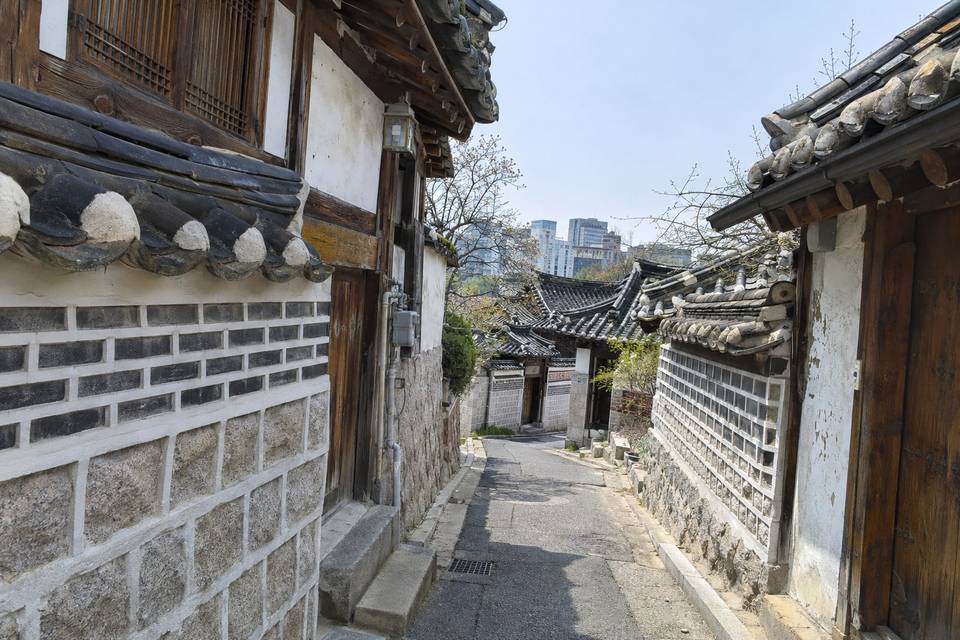
With one or two days, stay in Jongno or near Seoul Station and keep to the old city. Gyeongbokgung, Bukchon’s hanok lanes and an evening on Namsan sit close together. Avoid Tuesdays, when Gyeongbokgung is shut.
3 days: the core
Three days is the minimum that covers both main palaces without rushing. Our 3-day Seoul itinerary orders them around the weekly closures: Gyeongbokgung and Bukchon, then Changdeokgung and its Secret Garden with Gwangjang Market, then the National Museum and Namsan.
4 days: the sweet spot
A fourth day gives you a choice instead of a checklist. Spend it on Suwon’s fortress, on Gangnam and COEX, on a guided DMZ tour, or on shopping in Seongsu and Myeongdong. It is also your buffer if rain or jet lag costs you a morning.
5–7 days: Seoul as your only base
From five days you can see all five royal sites and both sides of the Han River. Our 5-day Seoul itinerary fits two palace days, one day trip and Seongsu around one hotel, and our 7-day Seoul itinerary uses six city days and one day trip, which is the most a first visit needs before other cities become the better use of time.
Do arrival and departure days count?
Usually not. Incheon is a long way from the city, so a landing day is rarely more than an evening walk.
- The ride in: the non-stop AREX Express takes 43 minutes from Terminal 1 to Seoul Station for ₩13,000. Add immigration, baggage and check-in, and an afternoon landing leaves you the evening. Our Incheon Airport to Seoul guide compares the trains, buses and taxis.
- Late landings: the last AREX Express from Terminal 1 leaves at 22:48 (checked 2 Oct 2026). After that you need a bus or taxi.
- The day you leave: most international departures need you at Incheon two to three hours early, so plan a morning near your hotel at most.
So a “4-day” Seoul stay usually means 5 nights: land on day 0, four full days, fly on day 5.
Which weekdays change the plan?
Seoul’s palaces each close one day a week, so a short stay that lands on the wrong weekdays loses its best sights. This matters most at 2–3 days; from 4 days there is room to shuffle.
Seoul royal sites: closing days and free days (Korea Heritage Service, checked 13 Oct 2026)
| Site | Closed | Free on Wednesdays? | Note |
|---|---|---|---|
| Gyeongbokgung | Tuesday | No | Busiest palace; guard ceremony |
| Jongmyo | Tuesday | Yes, from Oct 2026 | Royal shrine, timed tours |
| Changdeokgung | Monday | Yes, from Oct 2026 | Secret Garden tour extra |
| Changgyeonggung | Monday | Yes, from Oct 2026 | Joined to Changdeokgung |
| Deoksugung | Monday | Yes | Next to City Hall |
In short, a Monday–Tuesday pair is the worst two-day window, and a stay that includes a Wednesday saves palace fees at four of the five sites.
If a closing day falls on a public holiday, the palace opens that day and closes on the next working day instead, according to the Korea Heritage Service.
Season matters too. From November to February Gyeongbokgung closes at 17:00, with last entry at 16:00, an hour earlier than in October. With shorter daylight, a winter trip needs roughly half a day more for the same list. Our Korea weather by month guide shows what each month feels like.
Does where you fly from change the answer?
Yes, mostly through the time difference. Korea doesn’t use daylight saving, so the gap shifts when your country changes its clocks.
Time difference to Seoul, UTC+9, by home country (checked 13 Oct 2026)
| From | Seoul is ahead by | Clock change to watch | Effect on day 1 |
|---|---|---|---|
| Singapore, Kuala Lumpur, Manila | 1 hour | None | Full day if you land early |
| India | 3 h 30 min | None | Mild; often an overnight flight |
| Sydney, Melbourne | Seoul is 2 hours behind | Australian summer time began 4 Oct | Almost none |
| UK | 8 hours, then 9 from 25 Oct | UK clocks go back 25 Oct | Plan a light first day |
| US and Canada, East | 13 hours, then 14 from 1 Nov | Clocks go back 1 Nov | Heavy; keep day 1 short |
| US and Canada, West | 16 hours, then 17 from 1 Nov | Clocks go back 1 Nov | Heaviest; add half a day |
If you’re crossing eight or more time zones, count your first full day as a half day and put the walking-heavy palace day second.
- Singapore, Malaysia, the Philippines: with a one-hour gap, a 3-day long weekend works. Muslim travellers who want halal meals can base near Itaewon; our halal food guide lists certified restaurants and the Seoul Central Mosque.
- Australia: jet lag is minimal, so trips tend to be longer and multi-city. Give Seoul 4 days and the rest to Busan or Jeju.
- US, Canada, UK, India: after a long flight, most people make it a multi-city trip. Four Seoul days within a 10–14 day trip is the usual balance.
How should you split days between Seoul and other cities?
Start from your total trip length, then give Seoul its share. The table assumes you fly in and out of Incheon.
Suggested Seoul share by total trip length (fares checked 7 Oct 2026)
| Total days in Korea | Seoul | Rest of the trip | Our plan |
|---|---|---|---|
| 4–5 | All of it | Suwon as a day trip | 3-day plan + 1 day |
| 7 | 4–5 days | Busan for 2 days, or stay put | 7-day Seoul plan |
| 10 | 4 nights | Gyeongju 2, Busan 3 nights | 10-day Korea plan |
| 14 | 5 nights | Busan, plus Gyeongju or Jeju | Mix the 10-day plan with Jeju |
| 21 | 5 + 3 nights | Andong, Gyeongju, Busan, Jeju | 3-week Korea plan |
Seoul gets the biggest share at every length, because it has more first-visit sights than anywhere else, but it stops growing past 5–6 nights on multi-city trips.
The Seoul–Busan KTX costs ₩54,400 one way in economy. For a single week, our Korea 7-day itinerary spends 4 nights in Seoul and 2 in Busan. Our 10-day Korea itinerary splits the nights 4 Seoul, 2 Gyeongju and 3 Busan, and the 3-week itinerary adds Andong and Jeju. If you’re unsure about adding the island, see is Jeju worth visiting.
How many extra days do day trips need?
Each day trip costs one full Seoul day. Pick one for a 4–5 day stay, two at most for a week.
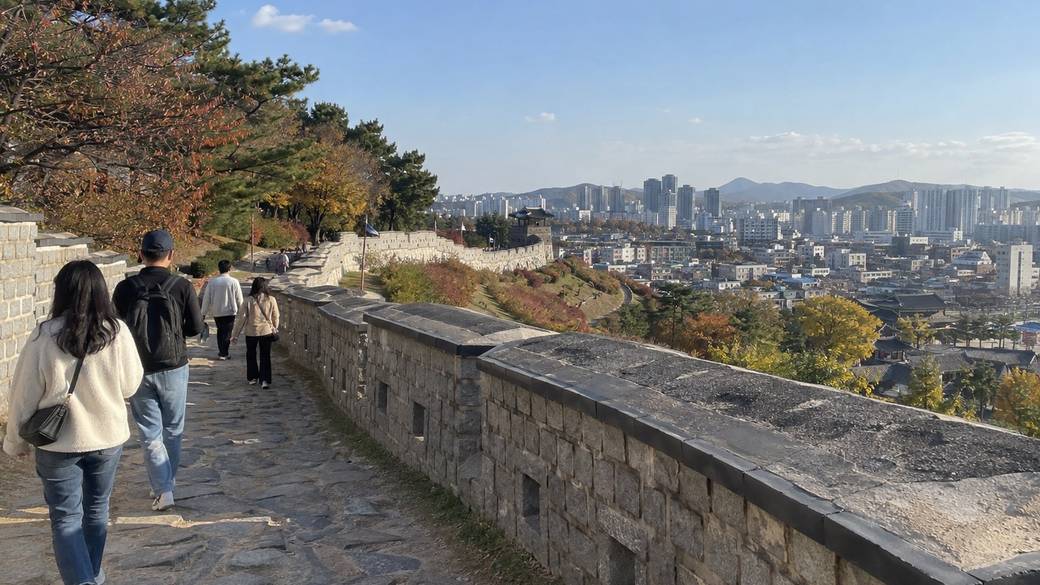
- Suwon Hwaseong Fortress. The easiest trip without a tour. Suwon city directs visitors to take subway Line 1 to Suwon Station, then a bus to the fortress gates. The walls are free and always open; Hwaseong Haenggung palace costs ₩2,000. Allow most of a day.
- The DMZ. Foreign visitors go on an organised tour from central Seoul, and tours check passports. It takes a full day and needs booking ahead.
- Nami Island and Gapyeong. A full day by train, local bus and ferry. Entry is ₩19,000 including the return ferry (Nami Island, checked 16 Oct 2026); whether it beats a tour is worked out in our Nami Island verdict.
The Climate Card short-term pass covers Seoul only (₩15,000 for 5 days, ₩20,000 for 7, plus ₩3,000 for the card). It doesn’t take you to Suwon or Gapyeong, so on day-trip days you’ll pay normal fares on T-money. Our transit card comparison shows when the pass pays off.
What do people get wrong when choosing?
Common mistakes
- Counting the landing day as a full day. It rarely is; book one more night than your list of full days.
- Putting a 2-day stay on Monday and Tuesday. Every royal site is shut on one of those days.
- Giving Seoul 2 days on a long-haul trip. After 13+ hours of time difference, day 1 is lost to jet lag.
- Splitting a 7-day trip across three cities. Each move costs about half a day; two bases is the limit.
- Planning winter days like October. Gyeongbokgung closes an hour earlier from November, and daylight is shorter.
When this advice is wrong: if you’re in Seoul for something specific, like a concert, a medical appointment or a shopping list, count that as its own day and add it to the numbers above. Where you sleep matters as much as how long; our where to stay in Seoul guide matches neighbourhoods to trip length.
Questions people ask
- Is 3 days in Seoul enough?
- Yes for a first look. Three full days fit Gyeongbokgung and Bukchon, Changdeokgung with its Secret Garden and a market, then the free National Museum and Namsan. What you give up is Gangnam, Jongmyo, a slower pace and any day trip out of the city.
- Is 2 days in Seoul worth it?
- Worth it as a stopover, not as a whole trip. Two days cover one palace, Bukchon, a market and the Namsan view at night. Avoid making a Tuesday one of the two days, because Gyeongbokgung is closed, and a Monday rules out Changdeokgung.
- Is 7 days in Seoul too long?
- Not if Seoul is your only base. Seven days lets you see all five royal sites, two big free museums and both sides of the river at an easy pace, with a day trip to Suwon's fortress. If you also want Busan, cut Seoul to four or five days.
- How many days should I spend in Seoul and Busan?
- On a 7-day trip, about 4 full days in Seoul and 2 in Busan. On 10 days, 4 nights in Seoul, 2 in Gyeongju and 3 in Busan works well. The Seoul–Busan KTX is ₩54,400 one way in economy.
- Do I count the arrival day as a Seoul day?
- No, unless you land before noon. Immigration, the 43-minute AREX Express from Terminal 1 and hotel check-in eat most of an afternoon. Plan full days only from your first morning, and treat the last day as a half day before the airport.
Next in your trip
- Pick your Seoul neighbourhood — Your number of nights decides whether Jongno or Hongdae makes more sense
- Use the 3-day Seoul plan — Palace days ordered around the Monday and Tuesday closures
- Book the KTX if you're heading to Busan — Seoul–Busan economy is ₩54,400; seats open two months ahead
Sources
- Korea Heritage Service – Royal palaces and Jongmyo: opening hours and closing days (관람시간) (Korean)
- Korea Heritage Service – Admission fees and free entry (관람요금) (Korean)
- 세계일보 – 궁·종묘 매주 수요일 무료 개방, 8월부터 순차 적용 (26 May 2026) (Korean)
- 공항철도 AREX – 직통열차 소개 (운임·소요시간) (Korean)
- Seoul Metropolitan Government media hub – Climate Card tourist passes (기후동행카드 관광권) (Korean)
- Suwon City – Hwaseong Fortress and Hwaseong Haenggung visitor information (Korean)
- timeanddate.com – Time zone in Seoul, South Korea (KST, UTC+9, no daylight saving)
Updates
- Added Nami Island's 2026 entry fare (₩19,000 with the ferry) to the day-trips section.
- Published, with palace closing days and November–February hours checked against the Korea Heritage Service.
About Korea Field Notes
An English guide to the practical side of visiting South Korea. Guides are researched from Korean-language official sources (Korail, T-money, Seoul Metro, the Korea Tourism Organization) and re-checked when rules or prices change. Each guide shows when its facts were last checked and lists its sources. About the site · How we research and update guides · Found something out of date? Tell us.